• Looking for a smarter way to manage your heating this winter? We’ve been testing the new Aqara Radiator Thermostat W600 to see how quiet, accurate and easy it is to use around the home. Click here read our review.

Combi boiler replacement

Joined
18 Aug 2007
Messages
332
Reaction score
13
Location
Cheshire
Country
United Kingdom
Been getting quotes for the replacement of my Baxi 105e 31Kw Combi boiler. The ones I have been offered are a Baxi 36kW and a Worcester 32kW.
My present boiler is working but is old and I'm expecting things to go wrong soon, hence the replacement. When running in winter, it seems to be working hard, rarely stopping when the required temperature in the house or boiler has been reached. So I'm determined to ensure my next one is large enough to do the job.
Looking at the specs on the two on offer, I see that the outputs of 36kW and 32kW have heating outputs of 24kW. I'm not too sure what that means so if anyone can explain, I would appreciate it.
I've been trying to find out the same parameter of my present one, Baxi 105e (31kW) but cannot find the heating power listed, as a comparison. Can anyone enlighten me.
TIA.
 
Just to add to my initial post, the plate inside the boiler has the following info Q Hs=33.8kW P=29.6kW Condensing P=31kW
 
Unless you live in a castle, your heating requirements will probably be under 15kW - never mind 24!

A combi is sized for hot water demand, as heating mains-temperature cold water instantly on-demand needs a lot of energy. Are you happy with the hot water flow from your hot taps now? Any idea of your incoming cold flow rate?

If your boiler never stops on heating, do you have a thermostat? What's it set to? Are your radiators large enough, and the supplying pipework? Do they all get very hot to touch, all over? Do you have TRVs?

Replacing a working boiler is probably not very sensible economics, but it would be sensible to prepare yourself (in terms information and finances).
 
On the odd occasion that I run a bath, if I turn the hot tap on full, the water is not hot enough, I have to close it to a mid point. When running hot water in a sink or basin, it is fine.
There is a room stat, normally set to 20C but it rarely reaches that temp unless it is quite mild outside.
One of the people that quoted filled a graduated container from a basin tap and said that the incoming flow is fine.
I would say that the radiators are large enough, some are a little colder at the bottom, which I assume is sludge that would be eradicated with a flush. I have one TRV on a bedroom rad.
On the last service, the engineer told me that the boiler was getting near its end of life. I've had it for over 15 years and don't want the hassle of a panic replacement in the middle of winter, and extra expense, there are decent deals on in summer. I've just had new windows fitted so hopefully next winter, we will see a difference.
I just wanted to ensure that the new boiler is no less powerful than the present one. Until recently I assumed that 32kW and 36kW boiler would be more powerful than a 31kW one, but then I read about this heating power, hence the question about my present Baxi.
 
Combi boilers are sized for hot water requirements and are almost always vastly overpowered for heating. Around 80% of UK homes need 10kW or less to satisfy heating requirements. Too much power can be as bad as not enough when it comes to heating, and can actually increase the amount of time it takes to get your home up to the desired temperature.

You need to know your flow rate in litres per minute rather than in terms of "fine / not fine". Same with your radiators, a heat loss calculation (which is required when replacing a boiler anyway) will determine whether your radiators are suitably sized or not. Saying "they look right in the room" doesn't really get you anywhere.

If you want better hot water performance you need to go for a boiler that has a higher kW rating for hot water generation, or alternatively a system boiler and hot water cylinder. For best heating performance & efficiency you often actually need to look at what the minimum heat output of a proposed boiler is rather than its maximum.
 
I think Viessmann make a combi boiler that gives ~ 36kW to DHW but can modulate to < 2kW to heating, best of both worlds?
 
@richw and @muggles have given the answer, a condensing boiler, is designed to capture the latent heat, to do that is needs to modulate (turn down) to match what you require, so if set up correctly it should be running all the time, but not flat out. Unless using a modulating thermostat like with OpenTherm, the standard set up is this.

The boiler fires up at full output, the water goes through all radiators, at a rate set with the lock shield valve, so all get a fair crack of the whip. As each room heats up, the TRV starts to close, and reduces the flow in that radiator, which increase the flow in the rest, and when enough have started to close, the by-pass valve starts to open, so hot water returns to the boiler, the boiler senses this and reduces the output to suit, but there is one small problem, it can't totally turn the boiler off, it will first reduce output to the minium and then start turning on/off/on etc, called the mark/space ratio, but it needs some device so on a warm day, it will not run.

The old books said a wall thermostat should be put in the room kept coolest (so it is unlikely to fire up in the summer) with no alternative heating, this includes sun through windows, on the ground floor, as heat raises, and no outside doors, and that room has no TRV, however most homes there is no such room, so we look for an alternative, this could be used the hall, which does have an outside door, but also fit a TRV, so the room can recover fast after the door is opened, but the TRV and wall thermostat needs carefully matching.

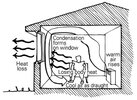
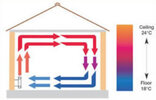
Today, we tend to use multi-thermostats, I have three in the main house, one in the living room on the wall, one in the hall on the wall, and one in wife's bedroom built into the TRV head. One could use all linked TRV heads and have no wall thermostat, but it depends on where the radiator is. Ideal would be an internal wall, so the TRV is not cooled by the outside temperature, but in the days before double glazing, we tended to put the radiator under the window, and we still see the pictures in the text books. circulation2.jpgand the air does move, circulation.jpg so the TRV head is in the best place when the heating is running, but not always the best place before the heating switches on. My wife's bedroom TRV head will turn on heating because the wall is cold, even when the room is still warm, today, clearly don't need central heating, but wife's TRV is showing 20.5ºC and living room where I am sitting shows 23.5ºC wall thermostat, one TRV shows 23ºC the other 21.5ºC and the room is a bit on the warm side, so one has to consider where to place thermostats which can fire the central heating.

With the likes of Drayton Wiser, I think it allows one to have up to 9 thermostats connected to one hub, these can be wall mounted, or combined with the TRV, my first attempt I got it wrong, the hall cools down too slowly, you can adjust heat uptime with the lock shield valve, but not the cool downtime. So had to put a second thermostat in the living room, but still need one in the hall, as there is an open fire in the living room, which would if lit, cool the rest of the house, and wife's bedroom likely coldest room in the house, but only used at night, so the TRV is programmed only to heat room at night, and Living room TRV programmed only to heat in the day.

Mine is a large house, and to heat all rooms 24/7 would cost a fortune, so the 10 programmable TRV heads means rooms only heated when required, so only need one tank of oil per year.

 
@richw and @muggles have given the answer, a condensing boiler, is designed to capture the latent heat, to do that is needs to modulate (turn down) to match what you require, so if set up correctly it should be running all the time, but not flat out. Unless using a modulating thermostat like with OpenTherm, the standard set up is this.

The boiler fires up at full output, the water goes through all radiators, at a rate set with the lock shield valve, so all get a fair crack of the whip. As each room heats up, the TRV starts to close, and reduces the flow in that radiator, which increase the flow in the rest, and when enough have started to close, the by-pass valve starts to open, so hot water returns to the boiler, the boiler senses this and reduces the output to suit, but there is one small problem, it can't totally turn the boiler off, it will first reduce output to the minium and then start turning on/off/on etc, called the mark/space ratio, but it needs some device so on a warm day, it will not run.

The old books said a wall thermostat should be put in the room kept coolest (so it is unlikely to fire up in the summer) with no alternative heating, this includes sun through windows, on the ground floor, as heat raises, and no outside doors, and that room has no TRV, however most homes there is no such room, so we look for an alternative, this could be used the hall, which does have an outside door, but also fit a TRV, so the room can recover fast after the door is opened, but the TRV and wall thermostat needs carefully matching.

Today, we tend to use multi-thermostats, I have three in the main house, one in the living room on the wall, one in the hall on the wall, and one in wife's bedroom built into the TRV head. One could use all linked TRV heads and have no wall thermostat, but it depends on where the radiator is. Ideal would be an internal wall, so the TRV is not cooled by the outside temperature, but in the days before double glazing, we tended to put the radiator under the window, and we still see the pictures in the text books. View attachment 387318and the air does move, View attachment 387319 so the TRV head is in the best place when the heating is running, but not always the best place before the heating switches on. My wife's bedroom TRV head will turn on heating because the wall is cold, even when the room is still warm, today, clearly don't need central heating, but wife's TRV is showing 20.5ºC and living room where I am sitting shows 23.5ºC wall thermostat, one TRV shows 23ºC the other 21.5ºC and the room is a bit on the warm side, so one has to consider where to place thermostats which can fire the central heating.

With the likes of Drayton Wiser, I think it allows one to have up to 9 thermostats connected to one hub, these can be wall mounted, or combined with the TRV, my first attempt I got it wrong, the hall cools down too slowly, you can adjust heat uptime with the lock shield valve, but not the cool downtime. So had to put a second thermostat in the living room, but still need one in the hall, as there is an open fire in the living room, which would if lit, cool the rest of the house, and wife's bedroom likely coldest room in the house, but only used at night, so the TRV is programmed only to heat room at night, and Living room TRV programmed only to heat in the day.

Mine is a large house, and to heat all rooms 24/7 would cost a fortune, so the 10 programmable TRV heads means rooms only heated when required, so only need one tank of oil per year.

Hence pinnacle!
 

If you need to find a tradesperson to get your job done, please try our local search below, or if you are doing it yourself you can find suppliers local to you.

Select the supplier or trade you require, enter your location to begin your search.


Are you a trade or supplier? You can create your listing free at DIYnot Local

 
Back
Top