
Correct way to earch metal dimmer switch

Joined
21 Aug 2012
Messages
14
Reaction score
0
Location
Fife
Country
United Kingdom
Hi folks

First time replacing a lightswitch. Looks fairly simple - changing from a rocker to a dimmer. However would appreciate advice on the correct way to earth it. There's no wire supplied, so am I right in thinking that any decentish wire should work (for example, if just cut up an old unused plug cable?). When I have an earthing wire would I simply run it from the earth on the metal box in the wall to the earth on the face plate as per the line I've drawn in brown? Presumably I'd need to keep the earth wire that's currently connected to the metal wall box too?

Or can I simply get the earth wire that's currently attached to the metal wall box and, instead, connect it to the face plate?

Any advice hugely appreciated!

Boog
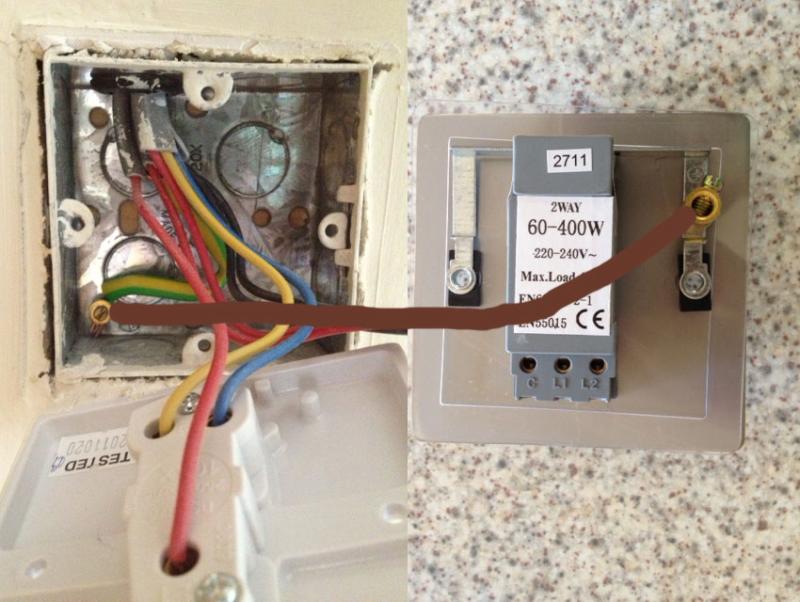
 
leave the wire connected to the lug on the backbox and take another piece and join to the faceplate.

the standard way of doing this is to use a piece of bare copper from twin and earth and sleeve yellow/green but you can use the green/yellow from flex if you dont have T+E, just make sure the ends are tidy and you get all of the cores into the lugs
 
You could just move the earth conductors from the box's earth terminal to the switch's earth terminal. The box will be earthed via the metal screw in the fixed lug on the left in your photo.

P.S. Stranded and solid conductors (mixture of) should not be connected together in the same screw terminal.
 
You could just move the earth conductors from the box's earth terminal to the switch's earth terminal. The box will be earthed via the metal screw in the fixed lug

Although this is allowed by the regulations (as long as at least one lug is fixed) it is considered bad practice - the back box & front plate should be linked by an earth wire. I have seen the fixing screw of a socket outlet glowing a dull red due to the resistance heating effect of an earth fault current flowing through it. This circuit was not covered by an RCD (and nor did it need to be) and the fault current was such that the 32A MCB was quite happily passing the current without a care in the world.

Adrian
 
You could just move the earth conductors from the box's earth terminal to the switch's earth terminal. The box will be earthed via the metal screw in the fixed lug

Although this is allowed by the regulations (as long as at least one lug is fixed) it is considered bad practice - the back box & front plate should be linked by an earth wire. I have seen the fixing screw of a socket outlet glowing a dull red due to the resistance heating effect of an earth fault current flowing through it. This circuit was not covered by an RCD (and nor did it need to be) and the fault current was such that the 32A MCB was quite happily passing the current without a care in the world.

Adrian

No it's not.

You have to understand what you are doing and why.

The regulations require that 'exposed conductive parts' are earthed.

A metal back box alone is not an exposed conductive part - so does not require an earth.

If the screws connecting the faceplate to the back box are metal, then they could be classed as 'exposed conductive parts' and so earthing the back box will earth the screws.

If fitting a metal faceplate - this is an 'exposed conductive part' and requires earthing - as in the ops example.

If you confirm that earthing the faceplate also earths the screws that hold it in place, then there is no need to earth the back box.

There is no such thing as 'bad practise' - you do what is required to satisfy the regulations. :)
 
Rubbish! You need to understand why we earth things!

Its nothing to do with exposed conductive parts. Its to do with creating a path that a fault current can take in order to operate the protective device in the event of a conductor coming into contact with an part that it shouldn't- the basic principles of EEBADS. I agree that the box isnt an exposed conductive part - but that isnt why it needs to be earthed!

Consider an earth fault between the phase core of a cable & the steel of the back box. If the backbox is only earthed via the fixings screws then this screw will be in the fault path & will have to take the fault current for the time period until the fuse operates (if it ever does!) If that screw is loose or does not make good contact with frontplate that will lead to poor connection, and hence heating, increasing the time until the fuse operates.

If the back box has been linked to the CPC then the fault current will not need to go via the screw, hence removing a potential weak point in the fault current path & leading to a more reliable fault clearance.
 
Rubbish! You need to understand why we earth things!

Its nothing to do with exposed conductive parts. Its to do with creating a path that a fault current can take in order to operate the protective device in the event of a conductor coming into contact with an part that it shouldn't- the basic principles of EEBADS. I agree that the box isnt an exposed conductive part - but that isnt why it needs to be earthed!

What has 'Earthed Equipotential Bonding' got to do with 'earthing' a back box?

A back box does not require earthing - unless you want to show me a regulation that says it does.....'money where your mouth is' time! :D
 
unless you want to show me a regulation that says it does.....'money where your mouth is' time! :D

Sometimes the regs ( or lack of a reg ) go against common sense

If the backbox is only earthed via the fixings screws then this screw will be in the fault path & will have to take the fault current for the time period until the fuse operates (if it ever does!)

I have seen a socket with clear signs that a fixing screw had over heated. Couldn't take it off to find out why but fault current was probably the cause.
 
I have seen a socket with clear signs that a fixing screw had over heated. Couldn't take it off to find out why but fault current was probably the cause.

Which is why we have all agreed that fixing screws, (being 'exposed conductive parts') require earthing - whether that's achieved by 'earthing' the back box or 'earthing' the metal faceplate doesn't really matter.

But a back box, itself, does not require 'earthing' - there is no reason to do so.

Where, by the way, was the fault current flowing to down these fixing screws?

With a plastic faceplate and metal fixing screws to a metal back box, I would earth the back box - but only in order to earth the fixing screws, which are exposed conductive parts.

With an 'earthed', metal faceplate, metal fixing screws and a 'fixed' lug connecting to the back box, I fail to see how a fault between 'line' and the back box would not clear, so no requirement to earth the back box as well.

If you start prattling on about bad connections between the fixing screw and the back box, then exactly the same argument could be used for the terminations of your 'earth fly lead' to the back box - so it's not a reason.......you could make up all kind of 'ifs' and argue all night, if you wanted. :)
 

If you need to find a tradesperson to get your job done, please try our local search below, or if you are doing it yourself you can find suppliers local to you.

Select the supplier or trade you require, enter your location to begin your search.


Are you a trade or supplier? You can create your listing free at DIYnot Local

 
Back
Top