Hi all, I'm new to the forum and to fixing CH problems as well.
I've got a couple of questions and was wondering if anyone could shed some light.
The set up is a follows:
The installation is 30 years old and has a hotchpotch of Stelrad radiators. It's in a flat and is an open vented system.
- Cold water tank and F&E tank in loft, each has own respective vent pipe
- Ideal Icos HE18 boiler is a floor below the loft (boiler was installed 2009)
- Water cylinder, circ pump and 3 way valve is about 3 feet below boiler
- 3 rads on same floor as water cylinder and one rad a floor below this level
System has been making occasional low level clunks since it's installation 4 years ago. It got worse recently,so I thought it might be hot spots, as I tested the F&E cold feed and vent and didn't find a blockage in either. I then started to make all rad valves and bleed vents usable before various water draining and desludging routines etc.
I half drained water from lowest rad, so I could replace a bleed valve on a higher level rad. On completion, I turned on mains to F&E tank and only about a gallon of water seems to have gone down the cold F&E feed pipe (air in system I guessed).
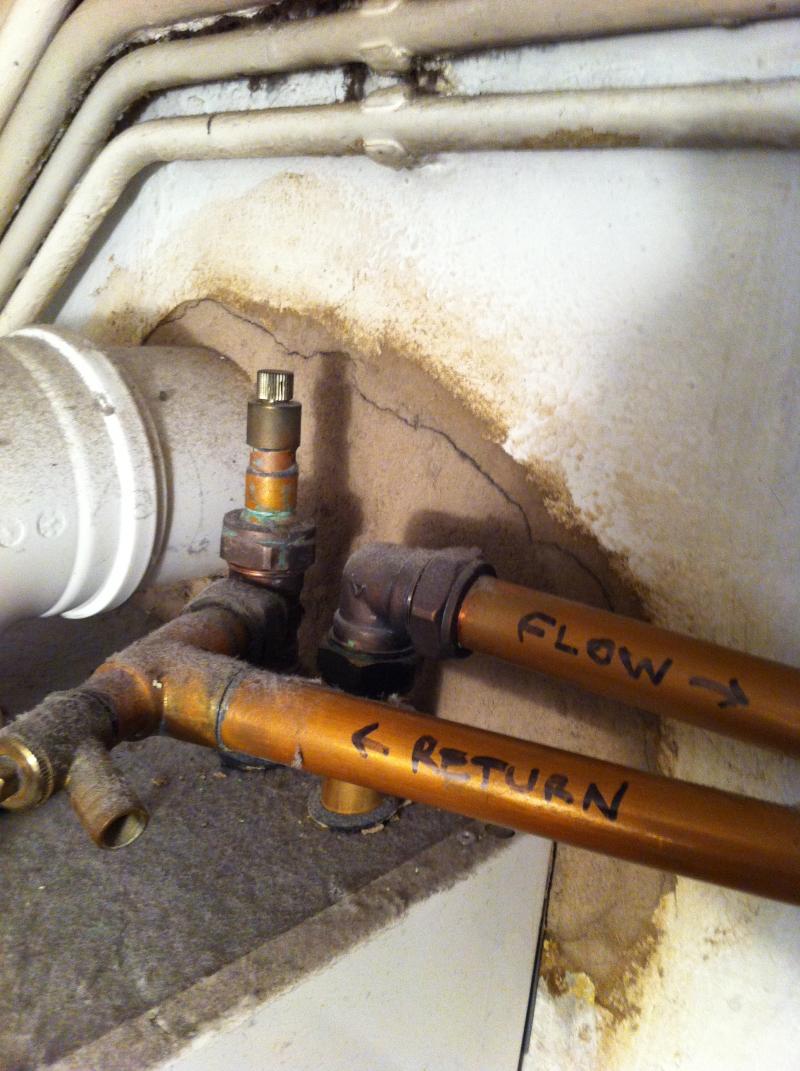
So, then I was looking at correct order of rad bleeding, refilling etc, when I discovered something I think is a bit strange. At the top of the boiler immediately (3" from boiler) there are two in-line devices on its return pipe:
- What looks like a drain cock (be interested to know when to use it)
- What looks like an end cap, but with a straight knurled thumbscrew on it that is turnable
Thing is that I've never touched them and they were both OPEN i.e. not fully turned off to the right when I found them! I'm thinking that they may have been introducing air into the system for four years, but I don't know. I feel like turning both off, but don't know if the second one is an overpressure safety device and not sure if I should touch it.
I have attached a picture and was wondering if someone could tell me what they are and also anything else that might be useful for me to know.
Thanks a lot in advance guys
I've got a couple of questions and was wondering if anyone could shed some light.
The set up is a follows:
The installation is 30 years old and has a hotchpotch of Stelrad radiators. It's in a flat and is an open vented system.
- Cold water tank and F&E tank in loft, each has own respective vent pipe
- Ideal Icos HE18 boiler is a floor below the loft (boiler was installed 2009)
- Water cylinder, circ pump and 3 way valve is about 3 feet below boiler
- 3 rads on same floor as water cylinder and one rad a floor below this level
System has been making occasional low level clunks since it's installation 4 years ago. It got worse recently,so I thought it might be hot spots, as I tested the F&E cold feed and vent and didn't find a blockage in either. I then started to make all rad valves and bleed vents usable before various water draining and desludging routines etc.
I half drained water from lowest rad, so I could replace a bleed valve on a higher level rad. On completion, I turned on mains to F&E tank and only about a gallon of water seems to have gone down the cold F&E feed pipe (air in system I guessed).
So, then I was looking at correct order of rad bleeding, refilling etc, when I discovered something I think is a bit strange. At the top of the boiler immediately (3" from boiler) there are two in-line devices on its return pipe:
- What looks like a drain cock (be interested to know when to use it)
- What looks like an end cap, but with a straight knurled thumbscrew on it that is turnable
Thing is that I've never touched them and they were both OPEN i.e. not fully turned off to the right when I found them! I'm thinking that they may have been introducing air into the system for four years, but I don't know. I feel like turning both off, but don't know if the second one is an overpressure safety device and not sure if I should touch it.
I have attached a picture and was wondering if someone could tell me what they are and also anything else that might be useful for me to know.
Thanks a lot in advance guys