Discover more, immersion heater, Gemini generated content may include mistakes?

Joined
27 Jan 2008
Messages
29,196
Reaction score
3,576
Location
Llanfair Caereinion, Nr Welshpool
Country
United Kingdom
1785777723040.png OK, thought may as well have a look, was a bit bored. So on the minus side
Can be less energy efficient than other systems like gas boilers or solar thermal, especially if used as the primary heating method. (-)
Requires electricity, which can be expensive depending on local tariffs. (-)
I can only see how heat pumps could be more efficient to the immersion heater, as to more expensive depending on local tariffs, yes good point.

Gas boilers, for instance, are often more energy-efficient for heating large volumes of water and providing central heating. Solar thermal systems utilize the sun's energy, offering significant long-term savings, although they require a higher initial investment. Tankless (on-demand) water heaters heat water only when needed, potentially saving energy compared to keeping a tank of water hot.
I think it is highly unlikely a gas boiler can be more energy-efficient. Note energy, not cost to run.

Solar thermal systems, often use an immersion heater, it is a more efficient way of transferring energy to using water.

So called tankless (on-demand) often use a small immersion heater, if electrically powered. Remember the article does include many types of immersion heater, not just the type which fits in a large storage tank.

OK, my immersion heater does have the option to run on a timer, and to detect when solar production is being exported, so it is likely cheaper to run than systems with just a thermostat and cut out.

But why have we, it seems, been brainwashed that the immersion is expensive? When the central heating is already running, then yes it works our cheaper to using a large storage tank immersion heater, due to electric prices in the UK being tied to gas, so gas is always cheaper. But moving energy with wires, is far more efficient to moving it with water in pipes, and also if a boiler is cold, the energy used to heat it up before even one drop of hot water is used, has to be factored in.

So likely the under sink immersion heater is overall the most efficient, as hardly any energy wasted heating pipes. The instant water heater even better, but there is a problem getting enough power to the heater, which technically is still an immersion heater, so to reduce cable sizes required, the small water store around 7 litres and an immersion is likely best option.

However for example with this house, it would require 5 units instead of one, and they are not big enough to fill a bath, at least within a reasonable time, and this goes for any instant heater too, be it electric or gas, the time to fill a bath is doubled if not using stored hot water.

OK I rarely use a bath, and instant electric works well for a shower, be it from instant gas, or stored DHW, the delay between switch on and hot water at the shower, can be a problem with a small shower cubical where one can't step out of the water flow.

Instant electric showers can be more expensive to run, as often they use more current to what a battery storage system can provide, but the amount used is so small, it is hardly worth worrying about.

So yes I use oil to heat DHW when the CH is running, but at any other time the immersion heater is likely cheaper, even when electric is 5 times the price.

So why is there so much miss information about immersion heaters. Is it from the days when we had no insulation around the cylinder?

When we have off-peak, having the immersion on a timer makes sense, but unless electric is cheaper at some time of the day, timers are pointless. A 40 gallon tank will stay hot for 2 days.
 
I think it is highly unlikely a gas boiler can be more energy-efficient.
10+ years ago when the primary source for electricity generation was gas, using the gas directly for heating would be more efficient than using the same gas to generate electricity and then using that electricity for a resistive heater.
Not as valid now, as gas isn't the main source of electricity.

At the point of use, the gas boiler is less efficient than an electric heater, but that's only a small part of the total system.
 
Well the answer (like most things in life) is "It in my working lt Depends" , once we add it depends into our question we can start to make a relevant comparison.

Until you add "it depends" into a question you might have asked a silly question and/or get a silly answer.

"How much does an average house rewire cost these days" I got asked a few times.
One answer I often gave was "About the same as a second hand car" ,
of course I might get a reaction such as "That is a stupid answer!"
and I might then retort "Well you started it!" .

Like Morq eluded to, efficiency is probably a better idea and under all of the varying circumstances, there is often no such thing as a "one size fits (nearly) all circumstances" so it depends.

A chap I used to know had a well used saying.
In a factory some would see him talking to a foreman or superintendent or the works manager etc and once the conversation ended you`d be surprised at the number of people who came to this guy and asked "What did he say?" his answer was always "the".
(his reasoning was - I can not remember everything he said nor the order in which he said it but I think it`s a safe bet that he would have said "the" a few times).
 
Last edited:
@flameport points out the energy wasted making the electric to start with, although transporting gas is not without any energy use.
Have we been poorly educated into not knowing what "efficiency" means?
This is the problem, we seem to swap energy used, and price paid, and we look at not the energy used, but the cost.
@ebee and the "depends" is a good answer, but the main problem is, how can we measure the cost?

My mother's boiler was next to the sink, but with a washing up bowl in the sink, I needed to fill it, as the first 3 inches at least was cold water, so I assume that much hot water left in the boiler, which is cold by time I come to use it again.

Habit is a problem, as although by time I have washed my hands the hot water has not arrived at the tap, I still turn on the hot water tap.

I think to fill a bath, in the main gas or oil is cheaper, but even taking a shower, not so sure. Again mothers house, she had a power shower, which had to be removed when the combi boiler fitted as illegal to pump from the main. The new shower not quite as good, but not that much in it, however it did mean could use a hand held shower head, the pressure did not lift it of its rest.

But the combi boiler was a problem, it had two modes, eco on or eco off, with eco on the reservoir in the boiler was not used, which means taps have to be turned on full to fire the boiler, so wasting water (and energy) when washing under a running tap, plus splashes everywhere, turn the eco off, and kitchen taps work as normal, although boiler will fire up at random times to keep reservoir hot, the problem was the shower, it would get hot from reservoir water, but go cold again before the boiler could heat fresh water. So neither option overall worked that well.

I was suspicious on how much gas used, but the meter was rather difficult to read, and since the cylinder had been ripped out, even if it did use a lot more, I was not going to refit the cylinder.

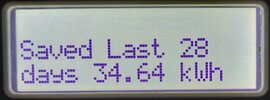
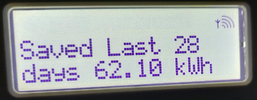
But the same applied to electric, I had until solar fitted, no way to measure the electric used. So I just accepted what I had been told, in that immersion heaters are expensive, due to having an iboost+ fitted, I can now see what is used in 1, 7, or 28 days, latter is better as it is less dependent on what done in any day. Last 28 days1.jpg So this was actually last year in June, so I can see 1.24 kWh/day average at 12p/kWh loss had I exported instead, that's 15p per day. Or 40p at 32.277p/kWh I pay for peak electric.

As to cost with oil, the boiler is rated at 20 kW, it is not a modulating type, so there is no thermostat on the cylinder connected to the boiler, and my Nest Gen 3 thermostat will allow me to select heating times in increments of ½ hour, and which days of the week, using it 4 days a week the water was only warm, so worried about legionnaires, so ran once a day, it did not actually run for ½ hour, after 20 minutes the return hot water would turn off the boiler, so 28 x 20 / 60 = 9.3 hours per 28 days, x 20 kW = 187 kWh per 28 days, compared with 35 kWh with electric, so over 5 times as much energy used to heat the water with oil.

But the second problem is, that heat is released into my flats' kitchen, and the living room and the landing from the pipe work, and this summer I have been using an AC to cool the living room, so it would need to run longer if using a boiler for hot water, or I will be less comfortable due to the extra heat. So there is another reason to use an immersion heater in the summer.

Winter the reverse is true, we want the extra heat, and if the DHW is heated at the same time as the central heating is running, then not really paying to heat up the boiler, it is hot anyway for the central heating, so winter is a completely different kettle of fish. Not that it matters, I have no way to turn off the heating of domestic hot water when the central heating is running.

As to those with a combi boiler, not a clue in winter, but no real option, once a combi is fitted you have no storage tank.

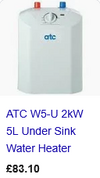
OK units like this 1785839960993.pngcould be used, but at the cost to use a gas boiler, how long would it take to pay back the outlay. I would mean instant hot water, no delay, and technically it is an immersion heater. But you lose cupboard space.

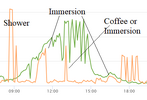
If I look at energy use, the immersion follows the solar production, so two peaks are the immersion, the peak between could be either cup of coffee or immersion, but when it fires up there are no losses, where with a boiler there are.

Note:- The iboost+ means my immersion does not always use 3 kW, it just uses the excess, so the first and last curve is following solar production. 1785841600836.png The bar graph from a smart meter is useless, I can only see my use because of the solar software.

So the boiler in winter, but the immersion in summer seems likely the way to go for anyone with a cylinder for hot water.
 
My mother's boiler was next to the sink, but with a washing up bowl in the sink, I needed to fill it, as the first 3 inches at least was cold water, so I assume that much hot water left in the boiler, which is cold by time I come to use it again.

It would have been common in those days to have had an Ascot above the sink?
 
It would have been common in those days to have had an Ascot above the sink?
Oh, those were the days my friend. As the song said. It was what the link said, that prompted the thread. It was good in the way it also talked about commercial immersion heaters, pointing out the immersion in the cylinder is not the only immersion heater, then missed the under sink immersion heater.

As to 9" v 28" nothing. When I moved in there was a very short one fitted, and I got it swapped for a longer one, and electric use did go up, but get a dull day so no solar heating, and hot water lasts until next day.

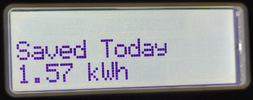
I also tried fitting a jacket, it was an insulated tank, but not that thick, so thought the jacket would same money, hardly made any difference. The saved today 1785844134169.pngcan vary a lot, as can last 28 days 1785844389183.png near double what it was a year ago, as to why, not a clue. Must have used a lot of hot water for something.

But most people simply don't know how much used either gas or electric on domestic hot water.
 
Oh, those were the days my friend.

They still are. Ascot may have gone, but you can still buy instant gas water heaters.

I sometimes wonder why more isn't done wrt to having 2 appliances, one for CH and one for DHW, each optimised for the specific task.
 
This is the problem, we seem to swap energy used, and price paid, and we look at not the energy used, but the cost.

TBF, cost is a factor. If it takes you X minutes to earn enough to pay for a bath heated by gas, but 5X minutes to pay for an electrically heated one, which is more efficient?
 
With me, with solar and oil, it means two fill ups per year using oil for DHW and one using solar for DHW, not that it uses twice as much, but a tank full will not see out the year if used for DHW in summer.

Cost with electric at either 8.625p/kWh off-peak, or 12p/kWh loss revenue if using solar there is no debate, electric is cheaper.

With no off-peak or solar, the question is not so cut and dried, but there is not a lot in it. With a combi boiler no option, but with a system boiler it is down to losses in the boiler and pipework between boiler and store, and the droop of the thermostat, i.e. how many times a week does it fire up.

With my C Plan and no tank thermostat it was a suck it and see, and ½ hour 4 times a week not enough, so needed once a day, which likely only heated it over the 60°C needed a couple of times a week, and I was worried about legionnaires, and was considering using the immersion once a week to be sure.

With a tank thermostat legionnaires should not be a problem, but it can fire up the boiler many more times a week, and we have losses each time it fires up.

I looked at mothers combi boiler, and there was a problem working out how much it had used, as it could modulate, so running for 40 minutes did not tell one how much it had used, and there was no way to change it anyway so what was the point? The cylinder had been taken out.

So only with a system boiler do you have the option. But my old programmer would only allow 1.5 hours minium run time, so time alone was too long, and the thermostat alone would trigure multi times a day, so it needed a combination of both to keep costs down. And clearly distance between cylinder and boiler was going to change how efficient. Pipe lagging was pointless, as pipes were cold by the next time it fired up. Winter does not matter want the heat in the house, it is the summer where there is a problem.

Be it a gas cooker instead of an induction hob, or gas DHW, in summer it is putting heat into the home which we don't want.

Gas or oil DHW may work out slightly cheaper, if paying a lot for electric, but the margin is very small either way, but it has been drummed into us for years that gas is cheaper, and we have just accepted it without question, but only reason gas can be cheaper is that electric prices are tied to gas. Anyone who has split tariffs with an off-peak rate, electric is cheaper.
 
They still are. Ascot may have gone, but you can still buy instant gas water heaters.
... and nor does it necessarily have to be gas (obviously relevant if the house does not have a gas supply).

In the house I am currently attempting to 'refurbish', pending restoration of the gas supply to the house, I am temporarily relying on an electrical (9.5 kW) instant water heater (a sort-of electric combi, without any connected rads), and that is working fine (even for showers). The water heating obviously costs more than it would cost if I could heat with gas but nevertheless cheaper than any sort of electrical heating which involved the storage of heated water!
I sometimes wonder why more isn't done wrt to having 2 appliances, one for CH and one for DHW, each optimised for the specific task.
So do I - and I've certainly seen it done, more than once!
 
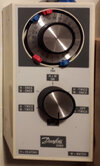
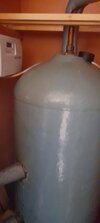
I wanted a wireless thermostat to work the DHW in summer, the programmer Danfoss3060programmer.jpg would only go down to a 2-hour burn, but when swapped for Nest Gen 3 I could set to ½ hour, the tank would stay warm for around 3 days, so experimented with 3 and 4 days only a week, but worried about legionnaires so once a day, the immersion at around 9" would not span a day without enough sun, so increased the insulation, but it had little effect. Tank before lagged.jpgTank after lagging.jpg You can see the iboost+ controller in the first picture. The longer immersion heater 27" does mean I can span a day, and it also uses a lot more energy, I did look at the Willis system, but the cost for the savings, was just not worth it.

I did use an under sink immersion heater in a caravan, and it did work well, 1 kW and about 7 litres I seem to remember and very well insulated.

And heat loss is the whole problem, be it the boiler, the pipe work boiler to cylinder, the cylinder, or the pipe work cylinder to tap, they all incure losses, and all will change home to home, as will the amount of hot water used also change what are acceptable losses.

I tend to wash hands under flowing water, rather than fill the sink, so each use, the amount of water used is small. A dish washer does the dishes, so DHW use is low. But the reduction in oil used through the summer, is quit marked since moving to the immersion heater.
 

If you need to find a tradesperson to get your job done, please try our local search below, or if you are doing it yourself you can find suppliers local to you.

Select the supplier or trade you require, enter your location to begin your search.


Are you a trade or supplier? You can create your listing free at DIYnot Local

 
Back
Top