Downlights with or without transformers

It's always amused me, how the government banned the 60w or 100w incandescent light bulb, of which one were more than adequate to illuminate a room, yet people are encouraged to be throwing 500w to 1000w of light to illuminate a room by using these spot lights.

The government's policy on what light bulbs are/are not OK isn't logical. Not very well thought through.
 
It's always amused me, how the government banned the 60w or 100w incandescent light bulb, of which one were more than adequate to illuminate a room, yet people are encouraged to be throwing 500w to 1000w of light to illuminate a room by using these spot lights.
blank65x10t.gif
whathesaidsmiley.gif


Okay, very confused now after those posts. I hadn't thought of using LED, purely down to the cost. Was going to use 240V downlights (I now know without transformers).
blank65x10t.gif
Voltage isn't the issue, nor, really, is lamp type. It's the small diameter of GU10 lamps, 99.999% of which have MR16 envelopes, or equivalent - 2" diameter. As Aragorn says, LED ones won't use much electricity, but they'll still be no good at the job you want them to do and you'll still need ceilings like swiss cheese.

blank65x10t.gif
It's horses for courses, what function do you need in each room, and what aesthetics? For example, in places like kitchens, bathrooms, WCs, possibly hallways and landings where you just want unobtrusive efficient lighting that just gets on and does the job, there's a lot to be said for this type of light:


blank65x10t.gif
There are loads of those around, they all look pretty much the same - Google for PL downlights.

blank65x10t.gif
Most have options for different covers, e.g. floating glass like this:

blank65x10t.gif
TLG_CHLC_F_OP.jpg


blank65x10t.gif
which look quite nice, but be warned that insects will go in there to die.


blank65x10t.gif
If you want LED, again go for larger sizes, e.g. the Thorn BaseLED.

blank65x10t.gif
led-downlight-337740.jpg


blank65x10t.gif
http://www.thornlighting.co.uk/download/Base_LED_Brochure.pdf

blank65x10t.gif
http://www.thornlighting.co.uk/PDB/Ressource/teaser/E2/TLG_BaseLED.pdf

blank65x10t.gif
http://www.thornlighting.co.uk/object/PDF/datasheet.aspx?CompanyID=7&GroupID=12650&CL=E2&CC=GB


blank65x10t.gif
For something a little less utilitarian in the lounge, dining room etc, you should spend time looking at proper lighting shops and websites - cast your net wider than the limited range of cr*p they have in the sheds. As the old saying goes, if all you have is a hammer, everything looks like a nail. And if all you do is look in DIY sheds or web retailers competing purely on price everything that isn't hideous looks like a downlighter.


we are building an extension on the back.
blank65x10t.gif
Will you have, or could you make changes to have, a higher ceiling in that?

blank65x10t.gif
Could you put curves at the top of the walls and fit concealed cold-cathode neon lighting above a cornice?


blank65x10t.gif
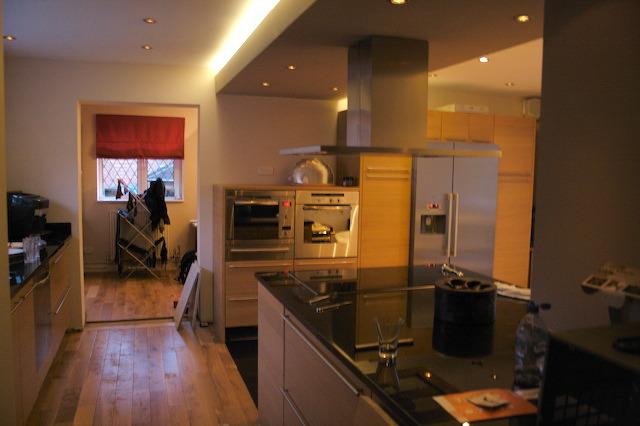
Or could you have a dropped section with the same above it? Here's an example of that in a domestic kitchen showing that it isn't only suitable for nightclubs and hotel foyers:

blank65x10t.gif

blank65x10t.gif
(Ignore the fact that there are also torches in there :? )
 
How many:I put 7 x 35W halogen in my 4m x 2m kitchen (which also has under cupboard lights, and a light in the cooker hood). It’s workable, but I’m upgrading to 50W as I prefer more light in the kitchen.
As a rough guide, if the lights are 600mm-1000mm apart you should be OK (and 600mm min from the wall). If it’s too bright, you can fit a dimmer. In a 3m x 3m room, I would want at least 9, and possibly 12. If you don’t fancy the idea of 12, in a non-kitchen area, you have a bit more flexibility as you have the option of additional table lamps etc.


I find that 600mm from the walls and then every 1000mm - 1200mm there after works well for an even spread of light.

12v or 240v: I can see no advantage to 12v – the transformer uses as much power as a 240v bulb, and the transformers keep packing in and needing replacing.


That's simply incorrect. 12V halogens have a thicker filament so burn hotter and produce a whiter light. They also produce more lumens per watt so are more efficient than a mains halogen lamp.

As for transformers, unless you are buying the cheapest rubbish on the market, or installing them incorrectly, then you should have no reliability issues. I'd say that only 1 out of every 100 transformers I've fitted has failed before 10 years.

LED or halogen: LED are pricey, especially if you want dimmable ones, and even the ‘warm tone’ lights don’t give a very nice light. I’m not convinced that the technology is quite ‘there’ yet for domestic applications. Halogens do get hot. You need a good 10-15cm clear around them in the ceiling void.


LED is not far off at all. I've been fitting 7.9W halers H2 LED downlighters. They are as bright as 50W halogen lights, and produce a fantastic bright even light. Whilst they are initially more expensive, they will pay for them selves in reduced energy costs.

I have also fitted lots of 5W GU10 LED lamps which I pay about £10 each for, and these are about the same brightness as a 35W halogen.

There is NOTHING wrong with downlighters. If you like them then you install them.

Whilst one light on it's own is no good for lighting a room, a properly designed layout of several lights makes for a fantastic lighting installation.
 
That's simply incorrect. 12V halogens have a thicker filament so burn hotter and produce a whiter light. They also produce more lumens per watt so are more efficient than a mains halogen lamp.

How much power does the transformer consume?


As for transformers, unless you are buying the cheapest rubbish on the market, or installing them incorrectly, then you should have no reliability issues. I'd say that only 1 out of every 100 transformers I've fitted has failed before 10 years.

My observation was based on three people, out of a sample of 3! It's good to get long term experiential evidence like this.

LED is not far off at all.

I agree. Hopefully prices will come down and quality of light will go up very soon. I just wasn't convinced it was reliable enough for me to put in my house just yet, for the additional costs.

Whilst they are initially more expensive, they will pay for them selves in reduced energy costs.

The bulbs I was looking at: Halogen - £2/bulb, 28W consuption. LED - £14/bulb, 7 W consuption. Electricity: 12p per kWh. With 11 bulbs, I'd be saving about 5p/day (not that I over analysed this at all). Off set that again the shorter life of Halogens, and the additional cost of LEDs, and you'll find that the time I spend working it out wqould have been better spent in the pub.


There is NOTHING wrong with downlighters. If you like them then you install them.

Whilst one light on it's own is no good for lighting a room, a properly designed layout of several lights makes for a fantastic lighting installation.

Completely agree. Really pleased with ours. But you really need more than 4!
 
That's simply incorrect. 12V halogens have a thicker filament so burn hotter and produce a whiter light. They also produce more lumens per watt so are more efficient than a mains halogen lamp.

How much power does the transformer consume?

None. It's a transformer. There will be some losses due to inefficiencies within the transformer, but they are negligible on something like this.


Whilst they are initially more expensive, they will pay for them selves in reduced energy costs.

The bulbs I was looking at: Halogen - £2/bulb, 28W consuption. LED - £14/bulb, 7 W consuption. Electricity: 12p per kWh. With 11 bulbs, I'd be saving about 5p/day (not that I over analysed this at all). Off set that again the shorter life of Halogens, and the additional cost of LEDs, and you'll find that the time I spend working it out wqould have been better spent in the pub.


There are online calculators which will work it out for you such as on the halers website.


There is NOTHING wrong with downlighters. If you like them then you install them.

Whilst one light on it's own is no good for lighting a room, a properly designed layout of several lights makes for a fantastic lighting installation.

Completely agree. Really pleased with ours. But you really need more than 4!

Unfortunately there are some people on this site who refus to accept this despite having never actually seen a proper downlighter installation.
 
Yep, because half a dozen unobtrusive lights looks much more pleasant than one big numb fitting in the middle of the room.
 
Yep, because half a dozen unobtrusive lights looks much more pleasant than one big numb fitting in the middle of the room.
1) No they don't, they look offensive.

2) For ceiling lights I'd advise fitting one you like, not a big numb one that you don't.
 
Yep, because half a dozen unobtrusive lights looks much more pleasant than one big numb fitting in the middle of the room.
1) No they don't, they look offensive.

Just because you don't like them it doesn't automatically mean that no one else should be allowed to have them.

2) For ceiling lights I'd advise fitting one you like, not a big numb one that you don't.

I like a downlighters installation. Thanks for advising this. :D
 
It's a problem I've got to contend with myself, as my hallway is narrow and there's on pendant, leaving a lot of dark spots as the hallway has a few turns in it and pendants are too obtrusive for it.
 
Fit a warm white halers H2 fitting every 1000mm and you'll never look back.
 
I think they're superb. they are IMO as bright as a 50W halogen, they comply with building regs for energy efficiency, and prevention of passage of sound, fire and moisture. They look good, they have a nice beam shape, they only use 7.9W per fitting.
 

If you need to find a tradesperson to get your job done, please try our local search below, or if you are doing it yourself you can find suppliers local to you.

Select the supplier or trade you require, enter your location to begin your search.


Are you a trade or supplier? You can create your listing free at DIYnot Local

 
Back
Top