• Looking for a smarter way to manage your heating this winter? We’ve been testing the new Aqara Radiator Thermostat W600 to see how quiet, accurate and easy it is to use around the home. Click here read our review.

Earth funnies and phantom voltages on lighting circuit

Joined
25 Sep 2020
Messages
45
Reaction score
2
Country
United Kingdom
Hi

I've been helping a friend out with some electrical work and issues. She was complaining about getting a slight 'buzz' from the hall lightswitch (brass finish type). I tried it and got diddley squat. I drew the line a licking it. However when I put a meter on it to earth I got about 50-60v AC and connecting it to earth I got a current of almost exactly 1 milliamp. *Theoretically* the circuit is earthed (well its got an earth wire anyway) but I'm pretty sure when I did a continuity test to a known good earth I got 'open circuit'. I fitted a new outside light anyway (LED type), metal casing also 'earthed'. This gave the same surface voltage, etc and also glowed slightly even when switched off. Hmmm.
I've 'fixed' the problem temporarily simply by running a wire from the a switch plate on the circuit to a plug earth. This has completely fixed the problem for now, removing all voltages and stopping the outside light glowing. I'm assuming this is some kind of induced voltage caused by wires running near each other. I can't see how it can be a direct short or my plates should be showing 240v not 50-60V? The 1ma drain is of course nowhere near enough to trip the 100ma house RCD.
Any thoughts on what might be happening here very welcome. Obviously there is an earth fault which needs fixing. I might find it, but if I don't is there any reason I shouldn't just make my temporary earth connection permanent? (I'm sure there is - someone will tell me where in the regs it says you can't do that . . . . ).

Thankyou !
 
*Theoretically* the circuit is earthed (well its got an earth wire anyway)
Not much good if the earth wire is not connected to earth at the consumer unit.

but I'm pretty sure when I did a continuity test to a known good earth I got 'open circuit'.
Could you not be absolutely sure and then if you are find out why?


Connecting to the socket earth is alright but I would prefer to discover the actual cause.

Perhaps the light circuit is not earthed and metal fittings should/must not be used.
 
*Theoretically* the circuit is earthed (well its got an earth wire anyway) but I'm pretty sure when I did a continuity test to a known good earth I got 'open circuit'. I fitted a new outside light anyway (LED type), metal casing also 'earthed'. This gave the same surface voltage, etc and also glowed slightly even when switched off. Hmmm.
I've 'fixed' the problem temporarily simply by running a wire from the a switch plate on the circuit to a plug earth. This has completely fixed the problem for now, removing all voltages and stopping the outside light glowing. I'm assuming this is some kind of induced voltage caused by wires running near each other. I can't see how it can be a direct short or my plates should be showing 240v not 50-60V? The 1ma drain is of course nowhere near enough to trip the 100ma house RCD.

Theoretically, is just not adequate! It needs to be earthed properly.

Yes, it will be induced voltage, from the not earthed wire, running adjacent to live current carrying conductors, but it could just as easily, under fault conditions, become actually live, and extremely dangerous.

You need to trace the earth wire back to where it ought to be actually earthed, and ensure it is connected to earth. I would begin, by suspecting the wiring might be so ancient, that it was originally wired pre-1960's, with no earth on the lighting circuit at all. In which case, it is long overdue for rewiring. Until such time as that is done, all metal switch plates need to be replaced with insulated plastic ones, and any metal fittings removed for safety.
 
What is the wiring type?

A picture would be very useful.

All cables, irrespective of type, especially old perished cables, can induce voltage near adjacent conductors without a functional earth.

A high impedance multimeter would pick this up easily.

Pre 1966 lighting circuits, without an earth wire, do not accommodate metal fittings.
 
Last edited:
Afternoon all and thanks for your thoughts on this.

The majority of the wiring at the switches is modern, that is to say plastic T&E although from memory it's black and red rather than blue and brown, so not THAT modern. That said I did find one old bit of rubber wire, but I only found one end so far and I'm not yet sure which circuit it's on (if any). That might help explain the induced voltages. To be further investigated. I do have a megger to check this out if needs be.

I'm pretty sure the metal plate switches were fitted at the same time as the wiring was done. I doubt any self-respecting electrician would have fitted all these metal plate switches without a circuit earth - the house is full of them and most are OK. The people who did it seemed to be obsessed with 2-way switching on every light and there are some places where you can reach both switches at the same time! Potty.

At a guess I'd suspect the bit of old rubber wire was probably used as a path for one of these 2-way switching setups as maybe it was tricky to run in new cable at that point. Or they couldn't be bothered. I doubt it's the main feed - if it is we're in trouble - but there's no rubber wire at the consumer unit, but it's all a bit labyrinthine so could be nailed on the end of something else.

I found another thread with the pretty much exact same problem. Fix - find broken earth continuity and repair. I expect mine will be exactly the same - the trick will be finding where the earth is broken. In the meantime my drain-to-earth fix will serve.

https://www.diynot.com/diy/threads/another-tingling-light-switch-thread.496456/ 60V

I wonder why the phantom voltage always seems to be about 60 volts ?
 
I'm pretty sure the metal plate switches were fitted at the same time as the wiring was done. I doubt any self-respecting electrician would have fitted all these metal plate switches without a circuit earth - the house is full of them and most are OK. The people who did it seemed to be obsessed with 2-way switching on every light and there are some places where you can reach both switches at the same time! Potty.

I think you have made the point that it wasn't a self-respecting electrician who did the work -rather, it was some total amateur, with little idea, and who knew little about safety. You say you have found some old rubber cable, last used in the 1940's. Definitely time to call someone properly qualified in.
 
Even pre-1966, to not have an earth it had to satisfy a list of conditions, including had to be a filament lamp, so most LED bulbs will not comply anyway.

I assume a TT supply with a 100 mA RCD? Seem to remember the old ELCB-v would trip at 50 volts, and the earth stake was connected through the ELCB-v which would not allow much current to travel to the earth stake, not enough to trip even a 30 mA RCD if left in circuit.

I did find one home with a RCD after the ELCB-v and I could not find the earth rod, which it turned out was in another building.
 
"I assume a TT supply with a 100 mA RCD? "

eric, you assume correctly. The, er, interesting thing is I still haven't found the earth rod either! It's currently looking like the main earth might just be connected to a water pipe under the sink. I've read that was considered acceptable practice at one point. Next job is to get the kick board off the kitchen cupboard! I assume a proper earth rod will have to be fitted now.

Despite what Harry says I don't think this was an 'amateur' job at the time*. Most of it seems legitimately done - as part of a big loft and kitchen extension job- just a question of trades maybe cutting a few corners here and there. . . . . I expect they were getting fed up with being told to install yet ANOTHER 2-way light switch . . . . .

* 'at the time' in this case probably means late '90's or early 2000's.
 
Take a pic of the supply cable and meter and we might be able to tell what the supply type is.
 
The, er, interesting thing is I still haven't found the earth rod either! It's currently looking like the main earth might just be connected to a water pipe under the sink.
Even if that is not (the main earth) the wire should still be there.

I've read that was considered acceptable practice at one point.
Not considered so now only because the water company might change their pipe to plastic and not care about you.
 
I think we‘re looking at two different issues here. The lack of earth continuity, possibly combined with mains filter capacitors, explains the tingles, while the glow of the LED is caused by capacitive coupling between parallel wires, which is quite a common issue. There are store-bought load elements, basically a simple 330 nF type X2 filter capacitor, to pull down those phantom voltages.
 
* 'at the time' in this case probably means late '90's or early 2000's.

Red and black, changed to brown and blue in 2001.

If you provide some photos of the installation, and accessories, we can all provide a more accurate, and better opinion on both the age, and standard of the installation. Any rubber insulation, left in the installation, sets alarm bells ringing, suggesting ancient. An installation is only as good as it's very worst part.
 
My parent's house, built 1954. I know there was a good earth when I was around 14, as an error on my part ruptured a 13 amp fuse when line contacted the earth connection. That's around 1962.

But returning in 2004, I could not find any sign of an earth, other than the GPO party line earth. At this point changed to TN-C-S.

There was no gas to start with, and I can't be sure if we had gas when I was 14. The water was changed from cast iron pipes to plastic, but never was an ELCB-v or a 100 mA RCD fitted. Attempts to fit a 30 mA RCD failed, it only covered the wet room, and had to get the house re-wired before we could fit a mixture of RCD's and RCBO's.

I think it was a case of when the water main was replaced, the earth was lost. Should have a PIR now called an EICR every 10 years, but it was not until the wet room was installed that we did any inspection and testing, at which point I knew it needed a re-wire, but dad said you can do it when I'm gone, I'm not living in a building site, so after his death and when mother was in hospital we got a rapid rewire done.

13th edition was 1955, and I have no knowledge what was required before then, but the house did not comply with 13th edition as the wall lights had no earth, it was permitted until 1966 (14th edition) to have lights without an earth, but there were some conditions, like being filament lamps, and mounted at such a height that they cannot readily be touched, so the wall lights would not have complied.

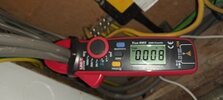
At the time of the wet room my clamp-on meter would only read in increments of 10 mA, I now have one which can measure in increments of 1 mA, and we are allowed 30% so with a 30 mA RCD 9 mA is the limit. Diffrence line neutral 8 Feb 24 reduced.jpg I am just within the limits for the whole house, but my house has 14 RCBO's and a pair of RCD sockets. So each circuit is well within limits.

However the odd thing is the installation certificate and the EICR does not require the leakage to be documented. We test the installation resistance, but we do that using DC, so any capacitive or inductive linking is not measured, well may be measured, but reading not written down.

When my solar panels were fitted, the electrician measured the earth loop impedance to the earth rod, and showed me it was 0.8 Ω or some equally unbelieveable figure, there is no way a single earth rod gets that reading, he had clearly measured the wrong wire. but "
NOTE 2:* The resistance of the installation earth electrode should be as low as practicable. A value
exceeding 200 ohms may not be stable." it was unlikely to be above 200 Ω, and not sure about the earth to a TN-S supply, which once the DNO supply (which is TN-C-S) fails and the earth rod is required it will be, so the inverter links neutral to earth which it does once it becomes an island supply.

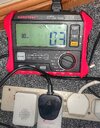
But only option is to measure, Loop-test.jpg my meter should measure ELI, but I don't trust it, but loop impedance meters are not cheap, mine was £80, the RCD test seems OK, but don't trust the loop test.

So in real terms only way is to get an electrician, to DIY costs too much in test equipment.
 
Hi folks. Many thanks for your further replies and updates, all very interesting. I'll attempt to respond re some of the points mentioned !

I'm likely up there tomorrow so can likely get some pictures for context - although they probably won't tell you much you don't already know.

I'm 99% sure the supply is TT. It's in a rural area, comes on an overhead pole via a bit of coax, has no TN-S earth point on the cable (wrong cable anyway) as has no TN-C-S business at the supply head. As I mention there's a bit of old green earth wire stuck into the wall next to the supply cable but the box has a modern yellow/green earth wire coming out of it which I've dug out from under some plaster and looks like it's headed off towards the sink. When (if) I find it connected to the water pipe, I can check whether there's any evidence of this being now plastic.

Ragnar, thanks for the detail on the likely fault causes. All I can say is earthing the 'floating earth' has fixed everything - however I would have though that if the glowing LED was caused by cable induction - post switch, as of course it's off at this point - fixing the earth would not have changed that - unless the fitting needs some kind of earth drain or reference to behave?

Murdo - yes an EICR is on the cards - but only once I've found and fixed all the basic/minor issues as most of the work is just time-consuming faffing around trying to find where stuff goes.

Harry - first thing I'm going to do is disconnect the rubber wire and see what happens. If all I lose is a one light switch I'm not too bothered - there'll be another one! If everything goes dark, yes we may have a problem.

Eric - That's quite the saga - but I'm glad to see you have the exact same clamp meter as me! Plus I also have various multimeters, and a basic megger. Unfortunately I am a bit of a gear enthusiast and as I'm already 80% of the way there the idea of getting a basic loop/RCD tester, well I think I may just have to do it. I'm not spending £600 upwards on a Megger MFT but £80 for some basic device sounds OK . . . . However the one you have is 'no longer available' on Amazon - but you can get it on Ali Express for only £60 . . . . which does make me wonder if there is maybe some issue with UK certification:D . . . . maybe £60-£80 is a bit too good to be true !
 

If you need to find a tradesperson to get your job done, please try our local search below, or if you are doing it yourself you can find suppliers local to you.

Select the supplier or trade you require, enter your location to begin your search.


Are you a trade or supplier? You can create your listing free at DIYnot Local

 
Back
Top