First Time tiling DIY - Hearth - Part DUX

Joined
10 Jan 2010
Messages
244
Reaction score
47
Location
London
Country
United Kingdom
Opening a continuation of this post, as I actually had more queries before everyone started bickering...
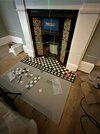
IMG_9897.jpg

I've received the tiles now and made a rough layout. I am not intending to use the warm-up board, I just want to use it to make a perfect cutout for the flooring guy to work around. The Warmupboard is 1250mm wide, but all the hardibackers (or any cement board) are only 1200mm. I've indicated the red line, where approximately 1200mm is. So I need to use two boards and there will be a weak spot where the two boards join together. What would you recommend where this weak point should be?

1. Keep it at the outside that 95% rests on once piece and that little bit on the right is on a second small piece, risking a weak edge
2. Make two symmetric pieces and have the cut/transtion smack down the middle?

Other question, if I have space, any harm adding a schluter decoupling matt? There seems to be more and more preference to use decoupling instead of hardibacker. Or will it make things worse?
 
Get a Hardibacker, split it in half lengthways turn them round 90deg, then cut both to the right width. The join just simply has to run down the centre so that both sides are the same. Much more stronger than a small ' piecemeal' edge join, and more professional. It'll have next to no foot traffic on it, so no need to put any hardi-scrim tape over it, just fill it with the rapidset when you're tiling and scrape it flat with the roadside of your trowel
 
Thanks really helpful. I've also done some more googling and it appears that decoupling mats are not ideal for tiles smaller than 50mmx50mm and as individual pieces these are 45x45. In fact some of the matting instructions they specifically caution not to use under mosaic tiles. I've also ordered a slower setting thinset, I think I will need more time to get these straight as a beginner...

Might come back with more questions along the way, or if not, the final product in mid Jan.
 
Alright, so finally I can proceed with this project!

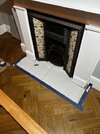
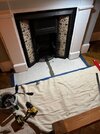
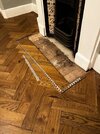
The floor has been laid and looks fantastic. As agreed with the flooring installer, they left the to-be-tiled area untouched and left a clean line.

IMG_0010.jpg

The metal trim is measured, cut, bent and ready and I have everything ready besides the hardibacker, which brings me to my next question:

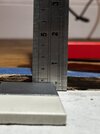
The total hight difference between the floorboards and the new hardwood flooring is between 21mm and 22mm. The Victorian checker tiles are 7mm thick. How do I go about filling the area?

Option 1
3mm adhesive +
6mm hardibacker = 9mm (although screwed down the adhesive might compress and I will only get 7.5-8mm) +
3mm adhesive + 7mm tiles = 18-19mm
In this scenario I would probably need to be generous with adhesive to get it level to the 21mm

Option 2
1.5-2mm adhesive +
12mm hardibacker = 15mm (although screwed down the adhesive might compress and I will only get 13.5-14mm) +
1.5-2mm adhesive + 7mm tiles = 22-23mm
In this scenario I would need to be quite scarce with adhesive and it still might be proud 1mm or so

Any thoughts/advice anyone?
 
Hi again,
Glad your prep work is done and you're ready to go.

Things to note :-
As the Victorian checks are mosaics, they are relatively quick and easy to lay, but to avoid problems later with trying to clear the adhesive out of the ( many) grout lines, it is essential that you use a 4mm notch Trowel to stick them ! i.e. The finishing height of the tile will be set by the Hardie height.

Any height adjustments you wish to make by varying the adhesive height should be done under the Hardie. Given your sizes, a 6 or an 8 mm trowel is the way to go.

Before you start laying, put a 90deg square on the inside 2 corners of your trim, otherwise you'll by cutting angled edges along one side !
 
Oh - and make sure the spacers you use are the exact size as the gaps on the mesh, otherwise each tile to tile line will stick out a mile away ! ( If you put one in every single square you'll stop them ' squishing' together)
 
Any height adjustments you wish to make by varying the adhesive height should be done under the Hardie. Given your sizes, a 6 or an 8 mm trowel is the way to go.
Thanks for responding.

Are you saying I should use the 6mm hardibacker and build up, i.e. option 1?

I have the 4mm notch trowel for the mosaics, but will pickup another 6-8mm one for the adhesive, when I go to get the hardibacker. Would you still recommend to screw down the hardibacker in addition to the adhesive? I feel like either the screws won't add much value/stability unless properly tightened.. but if properly tightened it will compress the adhesive down?

Oh - and make sure the spacers you use are the exact size as the gaps on the mesh, otherwise each tile to tile line will stick out a mile away ! ( If you put one in every single square you'll stop them ' squishing' together)
Ah.. I was actually planning to not use any spacers at all as they are stuck to a mesh and just manually adjust them as needed. The thing is (maybe I bought a cheap brand) that the tiles them selves are also not perfectly straight on the mesh, so spacers don't really do much. Is it absolutely necessary to use spacers?
 
A 6mm notch Trowel under a 6mm Hardie will give you 10mm once it's screwed down. A 7mm thick mosaic with a 4mm notch Trowel will give you 9 to 10 mm when lightly ' grout float pressed' into place. That's a total of 19 to 20 mm. Any extra height you want over this, has to go under the Hardie. Ie 8 mm notch instead of 6. Yes, you do need screws , a. To hold them in place and stop them moving until the adhesive sets, and b. To allow you a little adjusting on the boards height before it sets when you put your straight edge across them and discover its not as flat as you think !
Don't forget your Metal Edge size ( I'm assuming you've bought 8 or 10 mm) in your setting heights, as you don't want a big metal lip sticking up all the way around.

Spacers are essential. Not only between each ( 6 squares by 6 squares ? ) tile, to keep all the lines running straight and ' invisible joins ' when grouted, but you'll also find the individual tiles on the mesh won't all be placed square and parallel on the mesh. Keep a brand new Stanley blade handy, you WILL be cutting the mesh to straighten the odd one or two after they're down!
 
Alrighty, first rookie mistake...

Whilst scribing and cutting the exact shape onto the hardibacker, I have now spent half hour multitooling the perfect shape onto the wrong side. Meaning, the half that goes on one side, would now have to go topside down into the space... and I can't just use this on the other side as there aer slight differences in shapes, so therefore it would not fit. Is there a difference in surface on the hardibacker impacting tile adhesiveness or should I be fine installing this upside down?

I don't have any hardibacker left, so can't just use a new sheet and redo (at least today).
 
Ok, google tells me it is fine to use either side. Both pieces now cut to size, unfortunately during cutting/snapping small bits broke off on the lower left and top right... I think I will just live with it and just place the loose pieces in into the adhesive...

IMG_0060.jpg

I bought mapei keraflex maxi S1 (non-fast setting, to allow more time for corrections)... once I fix the cement board, how long to I need to wait until I can do the tiling? Technical data says 24h for floors until grouting and 24h for foot traffic, but neither is applicable. If I leave 5-6 hours in between could I in theory do both on one day? Or safer to wait 24h to let it fully set?
 
Either side of the Hardi is good - they’re both the same. You can tile onto it even in your case where you’ve used ‘slow set’ to stick it, as long as you’ve used the screws as described earlier. The one thing you cant do is grout earlier - it’s not worth the risk. Tile it, and as a rookie trust me, you’ll appreciate the extra time to clear out all those grout lines !
 
Thanks. Didn't have the time to do tiling today as well, but I finished to put the cement boards down. Now I will have to wait probably until next weekend for the tilling.

IMG_0065.jpg

One issue is that I seem to have pressed the boards quite tight or maybe I should've used 8mm instead of 6mm notches. The distance I need to cover is still 13-14mm to be flush with the floor... 7mm tile plus 3mm adhesive... might be a tad low. Any suggestions for this?
 
Last edited:
In this tutorial he is using a 8mm notch trowel for the same tiles. If I used a 8mm or even 10mm very carefully, I might be able to gain 4-5mm in height? In that case I would have 5mm+7mm, which might be acceptable.... what do you think? Or any other ideas to gain a few extra mms in height?

IMG_0066.jpg
 
Last edited:
Just found a company that ships out free samples of 4mm tile backerboard. This might work to bridge the gap, such as that I can do the final tile laying with my 4mm notch trowel instead of faffing around trying to lay a level 5mm thick adhesive bed.
 

If you need to find a tradesperson to get your job done, please try our local search below, or if you are doing it yourself you can find suppliers local to you.

Select the supplier or trade you require, enter your location to begin your search.


Are you a trade or supplier? You can create your listing free at DIYnot Local

 
Back
Top