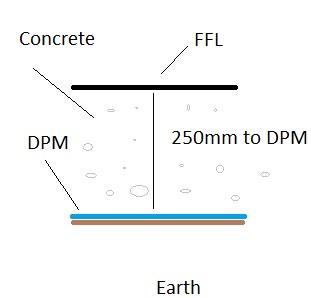
Fit a 110mm waste in?

Why would you want to?

That is an awful lot of concrete! I have to assume it is so for a structural reason and 110 taken out of it will weaken it considerably.

I think you need to post a lot more information about what the concrete is doing and where you propose to place the pipe in it

If you place the pipe say 360mm above the DPM you should be OK ;-)
 
Hi blagard it is for structural reasons but not throughout.

The walls are solid thick stone and the floor by the looks of it used to be timber before being ripped out and replaced with concrete.

I think the reason it is this thick is because of the load bearing section in the middle of the house. I am digging out right at the front door next to the wall so your attempts at fear-mongering have failed you here lol

The pipe itself runs from one corner of a room to the other going no where near the load bearing wall. I would go on to write loads and loads but I often notice on here I give long winded descriptions to people that never had any intention of helping me or knowing the answer, and my query goes unanswered so I won't bother
 
The picture I have from your description is that it is a concrete floor slab 250mm thick over the whole floor because one part of it supports a load bearing wall. To be honest this simply makes no sense to me.

I am familiar with floor slabs that have a load bearing part for a wall, but the method used is usually to thicken the concrete locally. so the slab would be around 100 thick elsewhere. If yours was built to this method the DPM would rise to just about 100mm below FFL.

The next issue is breaking out either would very likely result in damage to the DPM. So if the aim is to avoid going through it I think you would be lucky not to.

The floor should be flat and level. The pipe will need to be laid to a fall around 20mm for each metre run (can be less but gives you an idea) so over 3m the pipe occupies a 170mm thick zone. Eventually it penetrates the DPM at the edge where the DPM gets turned up.

What I am suggesting is to install the pipe below the DPM.

However if you are right about the whole slab being 250mm thick and you can get in without damage to the DPM it should in fact be physically possible to bury the pipe in the concrete. As for problems there may well be a few!

First of all the Building Inspector may have reasons to say no - You must clear this with him/her first anyway. Secondly I have never buried such a length of drain pipe in a slab and would not do so because so far as I am aware it is not tried and tested. I would defer to the opinion of others who have actually done this.
 
Blagard as you have been kind enough to write that I'll show you a plan of the proposal.

View media item 69119
I've dug within that red box and that is where the DPM is at 250mm. I think rather than structural reasons, the reason the FFL is high is because of the staircase. If they had gone any lower they would have needed to make an extra tread.

I actually posted my other question here but got no satisfactory conclusion with regards the IC, as I will have to puncture the DPM in this area without a doubt. The conservation area status restricts a stack outside the house, this is the only reason I'm forced to bugger with this floor, believe me if I had any other option I wouldn't be digging it up.

Installing the pipe below DPM would involve tearing up the entire strip across the floor, I can't do this unless there is a way to repair/waterproof it, nobody seems to have an answer for this. Someone told me to wrap the pipe in new DPM, what on earth will that achieve!!

It could be possible that the slab is think in this area because of the drain pipe which runs underneath which I'm trying to find so I can connect the IC. Please try not to worry me about load bearing matters, I'm tense enough at it all already
 
Just Google Joining DPM's. One example is:

Where it is necessary to join sheets of the DPM, first make sure that the surfaces to be joined are clean and free of moisture. Overlap the sheets by at least 4 to 6" (100 to 150mm) and use a double sided butyl tape or mastic strip compound to join the sheets together to form a continuous waterproof barrier. The exposed overlap joints can then be sealed using 4" (100mm) jointing tape. If any area of the DPM is damaged during installation this should be patched by overlaying a fresh piece of DPM to cover the damaged area and to overlap by at least 6" (150mm) in all directions. Once again use double-sided mastic strip, or butyl tape to create a waterproof barrier, and then seal down the edges with jointing tape

Also internal manhole information should be on the Web.

As before I advise going through the DPM so in your case the invert of the branch can join the main run with a standard junction.

Edit: As the work is in a basement situation I would strongly advise using such DPM methods as the water tightness of the DPM is much more important than usual ground level slabs

Edit again:
The main function of manholes is access to the drain runs. It may be that if there is another manhole out of the picture (below on your sketch) to allow rodding of the main run from both ends and if the branch has a slow bend with access pipe where it comes out, access will be satisfied and a junction allowed instead of a manhole. Just ask your building inspector.
 
Blagard thank you for the pointers. I was honestly expecting to go into this week wearily with no idea on progression. I was not putting the right things into into google search, was writing things like DPM repair - it got me no where. I've also had people telling me that breaking through the DPM in my house is akin to killing a baby which made matters worse.

By the sounds of it the overlapping and sealing is pretty standard although not that common practice. Still I have something to go on. I'm worried about overlapping because this will involve more breaking out which in turn means more potential for ripping the membrane. Breaking across and not downward I hope is the answer - will see

Perhaps I should point out that there is no other access beyond, until the public drain, so I'm forced to fit a chamber here for rodding. This is the one I'm intent on having : http://www.drainagepipe.co.uk/produ...inspection-chamber-set-internal-use-3191.aspx

I hope you agree that this is the right one to get. The floor will have laminated timber as a finishing.

I'm excited now as I can use this info to seal a small section in the corner elsewhere the previous builders had for some reason neglected and left a piece of old fireplace to cover up which was saturated underneath
 
Joining DPM's has been normal from the start. Most come on roll of a certain width, so you can imagine that in a superstore with huge floor areas, there are going to be many joints. It is only in a house where most can be done with single widths that you don't often see it.

You choice of inspection chamber looks fine. With the existing chamber you already have an idea if it was suitable for the depth.

With the right materials to hand I am sure you can see a way forward.
Good luck
 

If you need to find a tradesperson to get your job done, please try our local search below, or if you are doing it yourself you can find suppliers local to you.

Select the supplier or trade you require, enter your location to begin your search.


Are you a trade or supplier? You can create your listing free at DIYnot Local

 
Back
Top