
Fitting a 4 mm HPL overlay on top of an old laminate worktop: would it work?

Would you fit this for a customer?**

  • Yes, sounds workable

    Votes: 0 0.0%
  • Yes, but depends on the kitchen

    Votes: 0 0.0%
  • No, I'd rather rip out and replace

    Votes: 0 0.0%
  • No, I don't think it would hold up (water, movement, looks)

    Votes: 0 0.0%

  • Total voters
    0
Joined
21 Sep 2026
Messages
6
Reaction score
0
Country
Netherlands
Hi all,

I'm a Master's student (sustainable business) researching how to keep old laminate worktops out of the skip. Thanks again to everyone who answered my poll on removed worktops a few weeks ago. Most of you said they're rarely reusable once they're out, which led to this idea.

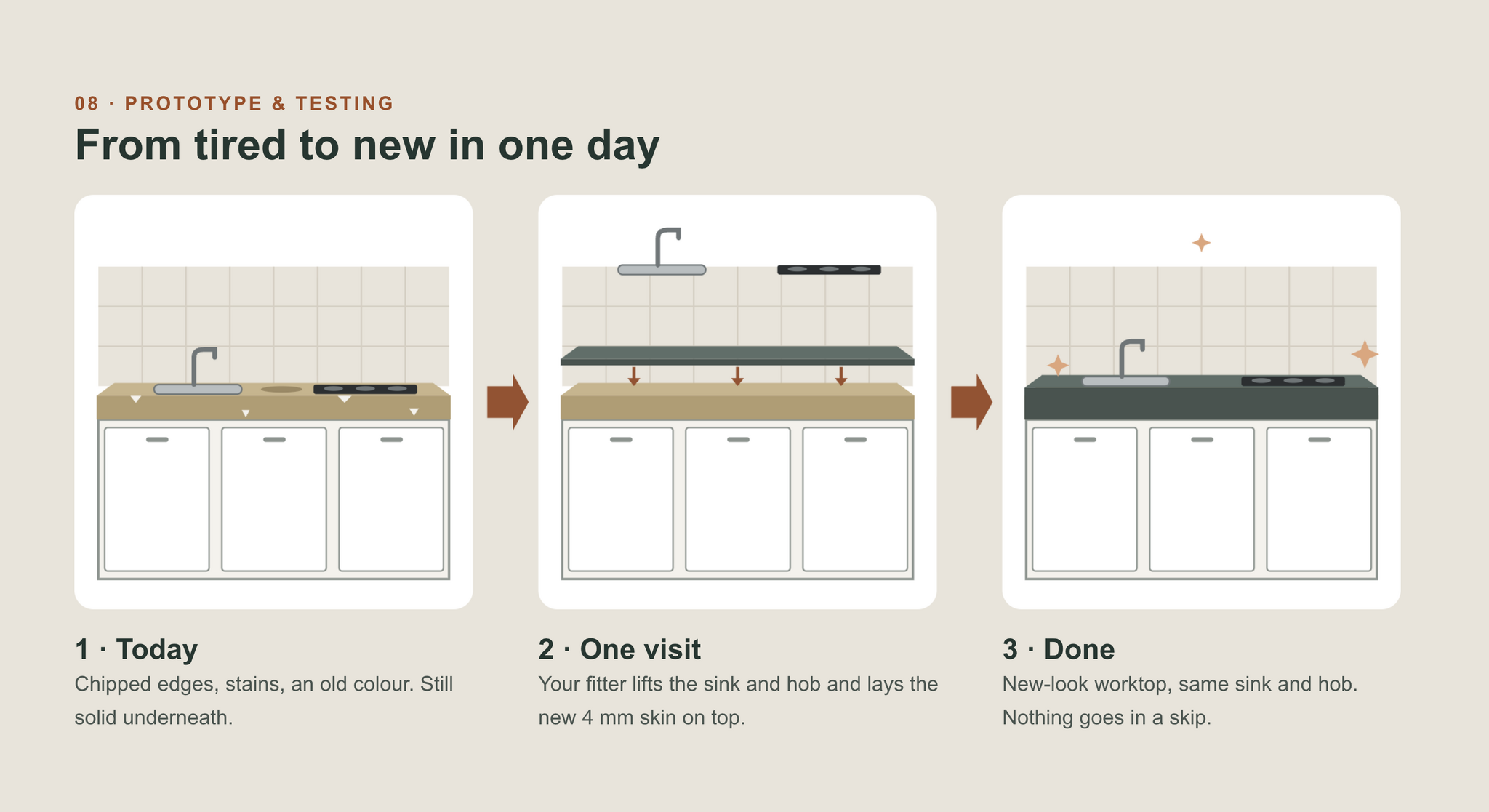
**The idea:** instead of ripping out a tired laminate worktop, you fit a pre-cut ~4 mm compact HPL skin **on top of** it. There's no glue, so the skin can come off again later. Sink and hob are lifted out and refitted. Panel price would be about the same as a new laminate worktop. Height goes from 38 to ~42 mm.

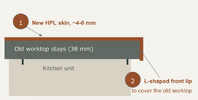
There are 2 options for the front edge (see first image). Both are held by a small hidden bracket with 2 short screws from below:
- **A: L-cap.** One L-shaped piece; the lip hooks over the old edge. Looks seamless.
- **B: Flat skin + edge strip.** A separate same-decor HPL strip on the front; the brackets unscrew from below.

View attachment 424543
*[image: 2 options for the front edge]*
Screenshot 2026-10-17 at 12.01.08.png

*[image: fitting steps]*

**And if you have a minute, reply with the number + a short answer:**

- Question 1: Which edge would you rather fit, **A or B**? Why? (Or how would you do it instead?)
- Question 2: How long would it take you vs a standard rip-out and replace (2 lengths, 1 sink, 1 hob)?
- Question 3: Where would it go wrong, or when would you say "not on this job"? (cut-outs, joints, sealing round the tap, upstands, the lip/bracket catching drawers, undermount sink, swollen chipboard…)
- Question 4: What would make it worth offering for you, e.g. training/certificate, customer leads, less disposal hassle? Or what puts you off?
- Question 5: other comments or recommendations

Short answers are fine. Happy to take longer replies via email: [email protected] too.

Replies may be quoted **anonymously** (no usernames) in my university report. Nothing is sold here and no company is involved in this post.

Cheers,
Ann
 

Attachments

  • Screenshot 2026-10-17 at 11.22.53.png
    Screenshot 2026-10-17 at 11.22.53.png
    49 KB · Views: 13
  • retop_edge_profile_clean.png
    retop_edge_profile_clean.png
    203.7 KB · Views: 16
Hi all,

I'm a Master's student (sustainable business) researching how to keep old laminate worktops out of the skip. Thanks again to everyone who answered my poll on removed worktops a few weeks ago. Most of you said they're rarely reusable once they're out, which led to this idea.

**The idea:** instead of ripping out a tired laminate worktop, you fit a pre-cut ~4 mm compact HPL skin **on top of** it. There's no glue, so the skin can come off again later. Sink and hob are lifted out and refitted. Panel price would be about the same as a new laminate worktop. Height goes from 38 to ~42 mm.

There are 2 options for the front edge (see first image). Both are held by a small hidden bracket with 2 short screws from below:
- **A: L-cap.** One L-shaped piece; the lip hooks over the old edge. Looks seamless.
- **B: Flat skin + edge strip.** A separate same-decor HPL strip on the front; the brackets unscrew from below.

View attachment 424543
*[image: 2 options for the front edge]*

View attachment 424544
*[image: fitting steps]*

**And if you have a minute, reply with the number + a short answer:**

- Question 1: Which edge would you rather fit, **A or B**? Why? (Or how would you do it instead?)
- Question 2: How long would it take you vs a standard rip-out and replace (2 lengths, 1 sink, 1 hob)?
- Question 3: Where would it go wrong, or when would you say "not on this job"? (cut-outs, joints, sealing round the tap, upstands, the lip/bracket catching drawers, undermount sink, swollen chipboard…)
- Question 4: What would make it worth offering for you, e.g. training/certificate, customer leads, less disposal hassle? Or what puts you off?
- Question 5: other comments or recommendations

Short answers are fine. Happy to take longer replies via email: [email protected] too.

Replies may be quoted **anonymously** (no usernames) in my university report. Nothing is sold here and no company is involved in this post.

Cheers,
Ann
How are you going to screw into (L bracket front lip) just 4mm of material?
 
How are you going to screw into (L bracket front lip) just 4mm of material?
Good point, thanks! In my drawing one screw goes up into the old worktop and one into the lip, and you’re right that 4 mm is very thin for that. That’s exactly what I need to test.
  1. Do you have any other solution that isn’t glue, so the skin can still be removed later?
  2. If it has to be screwed, what thickness would you recommend for the lip/edge?
 
I like the idea, it looks like it has lots of potential.

Lots of people refresh kitchens with new doors, so this is a continuation of that idea.

I don't understand the need to make it removable - anyone who wants to cover up their worktops is very unlikely to care about covering it in glue. It would be much more solid if fully glued, it would have a nice solid thud to it rather than the flimsy/bendy clatter you may get if not.
 
Ugh.
Laminate worktops are usually rounded, for good reason.

Liquids would run off the edge and get drawn up into the gap. Then stink.
So, Form a curve into the cap material, then use a silicone type sealant to fix and seal the gap.
That's easy to cut, and can be cleaned off if required from the old worktop.
You would in any case need to seal the joints at any rear upstand.
You will also need joints at changes of worktop direction.

Postformable versions of HPL are readily available, so you could pre-form a radiused edge for your fitters. But you can't buy them in B&Q so you have a commercial moat.

You really haven't thought his through at all, have you?
Therefore I assume it's SPAM.

But - I got some battery acid on one I have which attacked it, so I could use some of it..
 
Therefore I assume it's SPAM.
I think it's genuine. No need to be nasty, it's good to bounce about ideas.

I found this...


Which appears to be laminate overlays, but all the options are full thickness worktops, suggesting they've given up.

Loads of companies offer quartz overlays, but others give a long list of reasons why it's a bad idea and suggest a full replacement costs little or nothing extra and results in a vastly better job.

That is the crunch - most consumers care vastly more about whether the end result is good and price than they do about re-using a slab of chipboard.

I don't think the eco angle is really much of a gain - a chipboard worktop literally grew on trees to start with (plus a bit of glue), and when disposed of properly it is likely to be incinerated and the heat used to generate electricity. So its lifespan is fairly similar to wood grown for power generation, just with a delay in the middle where it was a worktop. The CO2 saved by keeping it would probably be trivial compared to that generated in all the manufacturing, delivery and fitting involved in keeping it.
 
I think it would be easier and very much quicker to cap than remove the old worktops, especially with an efficient cutting tool, like a very small circular saw, small edge router, etc.
Hugely easier to carry about, too. AFAIR there are two distinct from radius profiles, one about 6mm radius and one maybe 20mm. But I noticed mine curves a little further than 90°. The tighter radius version could be used to cover formerly square edged upstands, etc.
I don't think I've seen a worktop with the double bump "B" shaped edge profile.
 
Last edited:
I haven't seen a B-shaped worktop either. It's possibly a thing in other countries.

Square edge worktops exist, so if it was anything other than square then it wouldn't be universal - the corner of the existing worktop would collide with the internal curve inside the overlay.

If the top was pre-joined to the edge then it would be very fragile, so prone to transit damage. Much weaker than a standard worktop. Also probably prone to splitting after being fitted.
 
If you really wanted a square edge that's easy, no point pre-joining that. I have an edge trimmer somewhere which has a ball bearing which runs on the vertical face, to trim the top at the right angle.
I think flat, and a couple of edge profiles would cover 99%. It doesn't have to be a perfect match, just seal the edge.
Things like wallplates/upstands could acquire a tight radius. It wouldn't matter if they were hollow at the top.
 
Thank you both, this is really helpful. And no, it is not spam. I am a student in the Netherlands, and this idea is part of a university project on what happens to old kitchen worktops. I am not selling anything.

A few things I took from your replies:
  • Edge: A flat panel plus a separate edge strip, cut and sealed on site, is the option I am going with. Your comments confirm why a one-piece or curved edge would not fit every worktop.
  • Sealing: I will add silicone at the front seam, the upstand and the corner joints to the fitting steps.
  • Removable: I made it removable so the top layer could be taken back and recycled later. I understand the solid feel of a glued top matters more to most people, so I will note this as a trade-off.
  • Eco angle: Fair point about chipboard and energy recovery. I will not claim CO2 savings without proper numbers.

Two quick follow-up questions, if you have a minute:
  1. Do you fit kitchens for a living, or do you mostly do your own DIY? This helps me describe the feedback correctly in my report.
  2. If a customer wanted a new look but not a full replacement, would you rather fit an overlay like this or replace the worktop? Roughly how long would each job take you?

Thanks again for taking the time.
1. Extreme DIYer! I've fitted two kitchens from scratch.

2. Honestly, I'd be worried that an overlay could be more work than a replacement. Fitting worktops isn't really a big deal, other than jointing the corners, and an overlay is probably going to have similar issues.
 
Back
Top