

- Joined
- 22 Aug 2006
- Messages
- 7,861
- Reaction score
- 1,494
- Country

I had a couple of dozen or so rental or development properties, some of which I refurbed completely, plus my own.
I also employed people to do it for many, and got other people's properties refurbished, using individuals or teams of builders.
All last century now so things may have changed.
Sorry but I'd fire you! You haven't understood the problems or considered what you've been told. As a result you'd make a mess, and less good that what you're replacing. That last point will kill you quickly.
You need to learn from people who have experience, and consider why the industry does not provide what you want to do.
Forget about re-using the laminate if you took it off, it would be scratched and scrap. I doubt those composite laminated materials can be recycled.
Square-edged laminate worktops take lumps out of people's hands. I've done it to myself a couple of times.
A flat panel with a separate strip would be hopeless in many cases. For rear upstands, you would need two pieces which would be very fiddly indeed. You'd need special tools to do it, it would make mess and take a lot of time. You would be gluing little pieces of strip on.
It would not be possible to do that in situ with a clean edge. The upstand may be anything from zero up to 38mm thick.
There are I'd say three common worktop profiles
One has a small radius top and bottom, with a slightly convex middle - your joint would be in mid-air and the front isn't always flat like this one
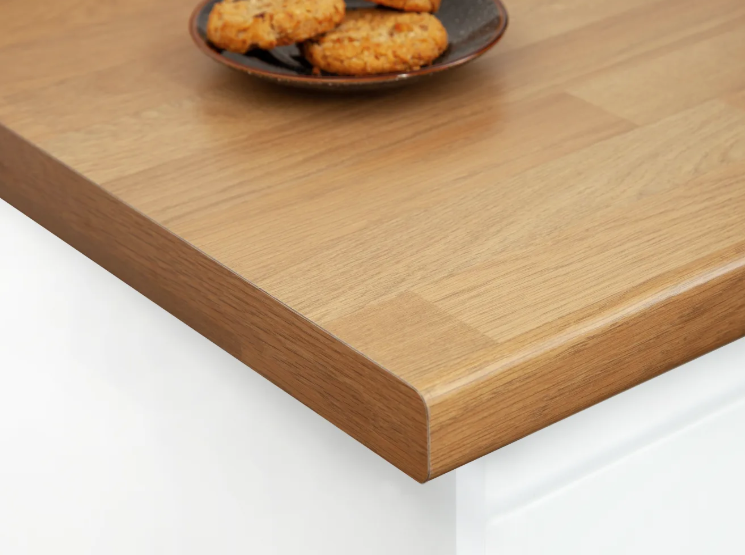
WHere it's convex, your front strip would be horrible to fit.
Many have a larger radius on the top edge, and either
1) go to a 90° bottom edge
or
2) carry the curve on so it goes backwards a little
With 1) you'd have a large gap under the joint, with
2) you have a large gap under the joint, AND a retreating surface to glue your front strip to, leaving a dangerous joint a the top which would be less that 90, and impossible to make neatly.
Having thought more I would still use two different preformed profiles, plus flat material.
One with a small radius at the top , and going straight down, which would suit the one pictured.
the other a much larger radius, because many worktops have a much larger top edge radius than the one shown. If it could be turned back slightly that would fit MY laminate worktops, and many others.
Like these

The first would fit most cases, the second could be cut to go over square edged small upstands, (turned to be vertical) where the hollow top wouldn't matter
The first would avoid leaving a sharp 90 in place of the rounded bottom edge in the picture shown earlier.
I also employed people to do it for many, and got other people's properties refurbished, using individuals or teams of builders.
All last century now so things may have changed.
Sorry but I'd fire you! You haven't understood the problems or considered what you've been told. As a result you'd make a mess, and less good that what you're replacing. That last point will kill you quickly.
You need to learn from people who have experience, and consider why the industry does not provide what you want to do.
Forget about re-using the laminate if you took it off, it would be scratched and scrap. I doubt those composite laminated materials can be recycled.
Square-edged laminate worktops take lumps out of people's hands. I've done it to myself a couple of times.
A flat panel with a separate strip would be hopeless in many cases. For rear upstands, you would need two pieces which would be very fiddly indeed. You'd need special tools to do it, it would make mess and take a lot of time. You would be gluing little pieces of strip on.
It would not be possible to do that in situ with a clean edge. The upstand may be anything from zero up to 38mm thick.
There are I'd say three common worktop profiles
One has a small radius top and bottom, with a slightly convex middle - your joint would be in mid-air and the front isn't always flat like this one
WHere it's convex, your front strip would be horrible to fit.
Many have a larger radius on the top edge, and either
1) go to a 90° bottom edge
or
2) carry the curve on so it goes backwards a little
With 1) you'd have a large gap under the joint, with
2) you have a large gap under the joint, AND a retreating surface to glue your front strip to, leaving a dangerous joint a the top which would be less that 90, and impossible to make neatly.
Having thought more I would still use two different preformed profiles, plus flat material.
One with a small radius at the top , and going straight down, which would suit the one pictured.
the other a much larger radius, because many worktops have a much larger top edge radius than the one shown. If it could be turned back slightly that would fit MY laminate worktops, and many others.
Like these
The first would fit most cases, the second could be cut to go over square edged small upstands, (turned to be vertical) where the hollow top wouldn't matter
The first would avoid leaving a sharp 90 in place of the rounded bottom edge in the picture shown earlier.


