Fixing TT earthing problems and gas bonding for an EV charger

Joined
14 Mar 2004
Messages
52
Reaction score
2
Country
United Kingdom
We've ordered an EV charger via Octopus and they came and did a site survey and we have a few problems that need addressing.

The house has a TT electrical system and the earthing rod resistance came back as 350 ohms and they want it lower than 200 ohms.

The second problem is the gas meter is not bonded.

The water and gas enter the property right next to the earthing rod. The property was extended about 20 years ago and the gas meter was moved to the new outside wall.

When they moved the gas meter they damaged the water pipe and when this was repaired I took photos which show the locations of the green plastic covered copper water pipe, the yellow gas pipe and the earthing rod. The cut off yellow pipe went to the old gas meter.
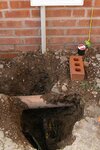
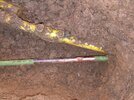
SANY0174a.jpg SANY0184.JPG

There are two 10mm earth cables that run from the consumer unit, one going to the earthing rod and the other attached to the water pipes by the stop tap just behind the wall shown above. Both cables had low resistance and look to be in good condition.

1. The yellow gas pipe looks to be plastic to me and if this is the case does the gas meter need to be bonded?

2. If the gas meter does need to be bonded does it have to have a separate earth cable to the consumer unit or could it be joined to the water pipes bonding as the services enter the property?

I ask this as the distance between them is about 500mm and both are accessible at the back of a cupboard so it would be easy to whereas to get an extra cable to the consumer unit would be lot of hassle as it's in the centre of the property quite a distance away and it's not an easy route.

3. To improve the grounding should the earthing rod be removed to check for corrosion, replaced with a larger diameter one (current one is 9mm) and adding an additional rod a couple of meters away and connecting the two together?


The other alternative option is to have the property converted to a PME system thus doing away with the earthing rod and if the gas meter needs earthing then we could reuse the existing earth cable that went to the earthing rod.

4. I've had a quote from the DNO for this and it's about £165 and would take about 6 weeks however other than switching the earths to the new earthing terminal is this likely to require a lot of extra work as the plastic consumer unit is 20 years and fitted to the regs back then. I can give more details of the consumer unit setup as and when needed.


We currently have a looped supply with next door and the DNO have given the go ahead for a restricted charger which will be unrestricted after the property is unlooped in the future but this is likely to be months away.

5. Does a looped supply cause any problems for converting to a PME system, is it allowed if your neighbour is on a TT system?

The DNO recommended waiting for unlooping before converting to a PME but obviously this delays things quite a bit.

Any thoughts on the above before I try and get a sparky involved so I know what I'm talking about?
 
Likely the earth rod has become disconnected, and just needs a new clamp fitting,
1770211652470.png
I know mine wants renewing, old one has split. Typical reading one earth rod is 60Ω and the regulations say
NOTE 2:* The resistance of the installation earth electrode should be as low as practicable. A value exceeding 200 ohms may not be stable. Refer to Regulation 542.2.2.
but if the car is charged outside, likely a TT earth is safer to a TN-C-S earth.
 
The second problem is the gas meter is not bonded.
The actual meter does not have to be bonded - only a metal supply pipe where it enters the premises.

There are two 10mm earth cables that run from the consumer unit, one going to the earthing rod and the other attached to the water pipes by the stop tap just behind the wall shown above. Both cables had low resistance and look to be in good condition.
Ok.

1. The yellow gas pipe looks to be plastic to me and if this is the case does the gas meter need to be bonded?
No - as above.

2. If the gas meter does need to be bonded does it have to have a separate earth cable to the consumer unit or could it be joined to the water pipes bonding as the services enter the property?
It could be joined to another.

3. To improve the grounding should the earthing rod be removed to check for corrosion, replaced with a larger diameter one (current one is 9mm) and adding an additional rod a couple of meters away and connecting the two together?
It depends on the situation. It could be any of those.

4. I've had a quote from the DNO for this and it's about £165 and would take about 6 weeks however other than switching the earths to the new earthing terminal is this likely to require a lot of extra work as the plastic consumer unit is 20 years and fitted to the regs back then. I can give more details of the consumer unit setup as and when needed.
You do not have to change the CU because of any of this.
 
1. Can you post a picture of the gas meter showing the pipes attached to it?

2. If using a single bonding conductor, best practice is to run it unbroken from one to another, in your case from water to gas. This comes not from the electrical regulations but from BS7430, the code of practice for earthing. But you could join it to the water Protective Equipotential Bonding conductor.

3. You could fit a longer rod, or it could be that the ground where the rod is driven into is too rocky. If the ground is good, you could add another rod, but you'd have to take care where you drive it in to avoid drains and other services.

4. Don't worry about your consumer unit. It doesn't need changing.
 
My son had a charger fitted by Octopus, and they fit a dedicated consumer unit, and will not use the existing even, if as with my son's case, brand new, would outlets reserved for the EV charger. So the only consideration is TT or TN-C-S, the loss of PEN problem with TN-C-S means in many cases better using TT, but there are arguments both ways. I as said would not expect an earth rod over 100Ω or under 20Ω in domestic, yes can get with multi earth rods down to 8Ω, but would guess simply the clamp has failed, and it is disconnected. Try simple first, renew the clamp.
 
Thank you every one for the rapid replies, much appreciated.

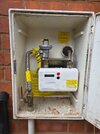
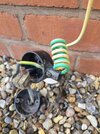
Here's a picture of the meter and the earthing rod as it stands.

Gas meter.jpg Earthing rod.jpg

Looking at the pipe entering the gas meter housing it's hard to tell what it's connected to as it disappears into the hockey stick.

From the pictures is it possible to say with any surety that the supply pipe is plastic or is there any other test I can do?

If the supply is plastic do the gas pipes inside the house need bonding?

If they do and it is possible to earth the gas and the water pipes with the existing earth cable from the consumer unit this would make life so much easier.

If I'm understanding correctly it's preferred to use an unbroken wire for them both and this should be possible as the existing earth cable to the water supply passes right by the gas pipe.


As for the earthing rod there is light corrosion on the exposed part of it with more at the top above the clamp. There is also a little movement left and right at the top of it but it's not loose in the ground.

The clamp itself looks intact and if I put a multimeter from the exposed copper wire before the ring connector on the cable to a cleaned up part of the rod before it goes underground then there is only 1 ohm of resistance and as there was low resistance in the earth cable to the consumer unit am I right in thinking that the problem is likely the rod in the ground.

I fortunately know the location of the underground services fairly well as the whole section was excavated for foundations and pipe repairs/work and there are photos. I believe there is soil down to a bit over a meter as shown in the pictures exposing the pipes and then it's hard rocky ground.

I take it if I was to replace the existing rod and clamp there is no easy way for me to test the rod without getting a sparky in with a proper tester?

Useful to know I shouldn't need to change the consumer unit regardless of the route we go.
 
My son had a charger fitted by Octopus, and they fit a dedicated consumer unit, and will not use the existing even, if as with my son's case, brand new, would outlets reserved for the EV charger. So the only consideration is TT or TN-C-S, the loss of PEN problem with TN-C-S means in many cases better using TT, but there are arguments both ways. I as said would not expect an earth rod over 100Ω or under 20Ω in domestic, yes can get with multi earth rods down to 8Ω, but would guess simply the clamp has failed, and it is disconnected. Try simple first, renew the clamp.
Your right, Octopus will only fit a charger with an additional consumer unit regardless of whether you have a brand new consumer unit as I asked this exact question.

I can understand where they're coming from as doing this means that they don't have to worry about the rest of the electrics in the house.

The loss of PEN problem you mention tallies with what I've read while looking at the option of changing to a PME system. I note that a number of chargers can require their own earthing rod for this issue although I believe the Hypervolt we've ordered doesn't need one regardless.

Getting a cable from the CU to the charger location is a whole other challenge as the CU is in the middle of the house which fortunately looks solvable problems we lift some floor boards for them.
 
Looking at the pipe entering the gas meter housing it's hard to tell what it's connected to as it disappears into the hockey stick.
From the pictures is it possible to say with any surety that the supply pipe is plastic or is there any other test I can do?
Not without disconnecting the internal pipework.

If the supply is plastic do the gas pipes inside the house need bonding?
No, but it won't matter if you bond them unnecessarily as they will be earthed by appliances.

If they do and it is possible to earth the gas and the water pipes with the existing earth cable from the consumer unit this would make life so much easier.
Yes. It is possible.

If I'm understanding correctly it's preferred to use an unbroken wire for them both and this should be possible as the existing earth cable to the water supply passes right by the gas pipe.
It is preferred by the people who write that but it is not a regulation.
 
Not without disconnecting the internal pipework.


No, but it won't matter if you bond them unnecessarily as they will be earthed by appliances.


Yes. It is possible.


It is preferred by the people who write that but it is not a regulation.

Thank you very much for a fast answers again.

It sounds like I should just bond them internally regardless then and being able to use the same cable as the water will save a hell of a lot of disruption.
 
It sounds like I should just bond them internally regardless then
Gas pipes are like that.

and being able to use the same cable as the water will save a hell of a lot of disruption.
Yes.

You could, if you wanted, use the water pipe - or other metal parts except gas pipes - as part of the bonding conductor itself which makes a mockery of the claims that it must be a continuous cable.
 
Gas pipes are like that.


Yes.

You could, if you wanted, use the water pipe - or other metal parts except gas pipes - as part of the bonding conductor itself which makes a mockery of the claims that it must be a continuous cable.

Thanks for the reply, the info on this thread has made my day.

Incidentally there is a very old earthing connector with the frayed remnants of a cable attached to it on a water pipe near to the CU so my guess is that sometime in this house's 100 year history the water pipes were the earth.
 
The loss of PEN problem you mention tallies with what I've read while looking at the option of changing to a PME system. I note that a number of chargers can require their own earthing rod for this issue although I believe the Hypervolt we've ordered doesn't need one regardless.
There are a few ways to make it safe should there be a loss of PEN, this may change, as one method used is to auto disconnect if the voltage goes out of range, but there are proposals to increase the voltage range permitted, if this happens, then that method would no longer work.

Since there are other problems with loss of PEN I hope this is rather rare, but as it stands, seems cheaper and safer to add a rod to converting to PME. (also called TN-C-S, but reverse is not true)
 
There are a few ways to make it safe should there be a loss of PEN, this may change, as one method used is to auto disconnect if the voltage goes out of range, but there are proposals to increase the voltage range permitted, if this happens, then that method would no longer work.

Since there are other problems with loss of PEN I hope this is rather rare, but as it stands, seems cheaper and safer to add a rod to converting to PME. (also called TN-C-S, but reverse is not true)
Based upon the answers given by you and others in this thread staying with TT looks to be the easier and potentially better option.

Interesting to learn the difference between PME and TN-C-S, I thought the terms were interchangeable.

For anyone else that finds this thread in future and would like a school day according to Google:-

TN-C-S is a form of Protective Multiple Earthing (PME), making them practically synonymous in the UK for most residential installations. TN-C-S describes the system type (combined neutral and earth, separated at installation), while PME is the technique used by suppliers to earth that neutral conductor at multiple points
 
PME has multiple earthing, this is not required to the same degree with TN-C-S. I have only seen problems once, where a radio ham fitted earth rods for his radio, which the electrician had bonded to the TN-C-S supply earth, normally not a problem but the radio hams earth was a very low ohm reading, and so when the PEN was broken the supply tried to pass all the neutral current through his earth mat, and the 4 mm² cable could not take the current, so melted, and this in spite of him turning off all of his isolators. Did mean none of his equipment damaged, unlike his neighbours who lost loads, but had there been multiple earths, it would have been shared between them, so not enough current to melt his earth wire, lucky outside the house, and he then moved to a TT supply.

Technically the DNO should stipulate the supply type, as if we had close neighbours, then one may be able to touch two items one connected to one earth system and the other a different earth system, so one could get a shock, this includes earths between homes due to gas or water pipes, so for one person in a row of homes to move TT to TN-C-S could mean the whole row of homes has to move.

Getting a TT supply from a TN-C-S supply, one needs to be careful where the earth rod goes, as if close to a water or gas pipe connected to a TN-C-S supply, it may not be a true earth. Personally I don't think TN-C-S (PME) should have ever been allowed, it should have been TN-S or TT only, some places TN-C-S is not permitted, petrol stations, caravans, boats, and other caravan like structures, so TN-C-S to a wooden shed is not a problem, but to a Tin shed should not be allowed, so my tin garage and tin shed don't have an electric supply. The wood one does, however.
 
PME has multiple earthing, this is not required to the same degree with TN-C-S. I have only seen problems once, where a radio ham fitted earth rods for his radio, which the electrician had bonded to the TN-C-S supply earth, normally not a problem but the radio hams earth was a very low ohm reading, and so when the PEN was broken the supply tried to pass all the neutral current through his earth mat, and the 4 mm² cable could not take the current, so melted, and this in spite of him turning off all of his isolators. Did mean none of his equipment damaged, unlike his neighbours who lost loads, but had there been multiple earths, it would have been shared between them, so not enough current to melt his earth wire, lucky outside the house, and he then moved to a TT supply.

Technically the DNO should stipulate the supply type, as if we had close neighbours, then one may be able to touch two items one connected to one earth system and the other a different earth system, so one could get a shock, this includes earths between homes due to gas or water pipes, so for one person in a row of homes to move TT to TN-C-S could mean the whole row of homes has to move.

Getting a TT supply from a TN-C-S supply, one needs to be careful where the earth rod goes, as if close to a water or gas pipe connected to a TN-C-S supply, it may not be a true earth. Personally I don't think TN-C-S (PME) should have ever been allowed, it should have been TN-S or TT only, some places TN-C-S is not permitted, petrol stations, caravans, boats, and other caravan like structures, so TN-C-S to a wooden shed is not a problem, but to a Tin shed should not be allowed, so my tin garage and tin shed don't have an electric supply. The wood one does, however.
Thanks for the explanation. Looks like the dangers are small but you can be unfortunate. Then again I wonder how many earth rods have rotted away to nothing or been disconnected completely over the years.

The fact that all of our neighbours have a TT system made me wonder if we would have been allowed to move to PME alone and it looks like you have to book the change with them and when they turn up to do the job they will tell you if it's possible or not.

I've sent the question through to Octopus about bonding between the water and gas pipes as their guy that did the survey said they had to be separate. Hopefully he's misinformed or I've misunderstood.
 

If you need to find a tradesperson to get your job done, please try our local search below, or if you are doing it yourself you can find suppliers local to you.

Select the supplier or trade you require, enter your location to begin your search.


Are you a trade or supplier? You can create your listing free at DIYnot Local

 
Back
Top