Getting around EV tariff & smart meter idea's please

Joined
15 Feb 2009
Messages
239
Reaction score
48
Location
Norfolkshire
Country
United Kingdom
If you would like an EV tariff at 8p pkwh, most suppliers want to know what charger you have & make & model of EV. Some even want to know your mileage. Plus your permission to take 1/2 hour meter readings. "Talk about Big Brother" I believe this is to get around charging your home battery up on an EV tariff & using your battery in the day, as you get well under 1/4 of the price of day-rate electricity. The company I'm with is "Good Energy" & when i joined them on an EV tariff, they said you can use the off-peak for anything, and I have this in an email:" Now my place is wired in separate areas & on separate fuse boards & the area i live in will be mainly on battery as i use the most electricity & have a 48v x 30kw bank.
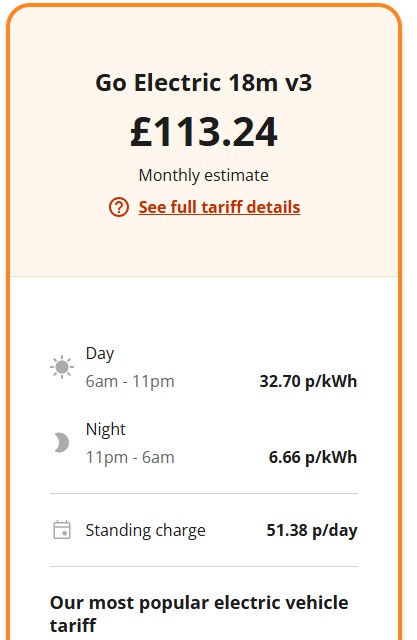
I am looking to change to EDF EV tariff as they give 6.6p off-peak & another 2 hours more off-peak than most other suppliers. So if i have to i will buy an MOT failure, as there are many out there for less than £200 to prove i have an electric car. Question is? How can they then say we can't give you an EV tariff? or take me off it. How can they know if i am charging a car or a home battery bank?
edf.jpg
 
If you would like an EV tariff at 8p pkwh, most suppliers want to know what charger you have & make & model of EV. Some even want to know your mileage. Plus your permission to take 1/2 hour meter readings. "Talk about Big Brother" I believe this is to get around charging your home battery up on an EV tariff & using your battery in the day, as you get well under 1/4 of the price of day-rate electricity. The company I'm with is "Good Energy" & when i joined them on an EV tariff, they said you can use the off-peak for anything, and I have this in an email:" Now my place is wired in separate areas & on separate fuse boards & the area i live in will be mainly on battery as i use the most electricity & have a 48v x 30kw bank.
I am looking to change to EDF EV tariff as they give 6.6p off-peak & another 2 hours more off-peak than most other suppliers. So if i have to i will buy an MOT failure, as there are many out there for less than £200 to prove i have an electric car. Question is? How can they then say we can't give you an EV tariff? or take me off it. How can they know if i am charging a car or a home battery bank?
View attachment 423996
Before we bought our new HEV hybrid car just over a year ago, I did briefly look at getting a PHEV so I investigated off peak charging tariffs before deciding it wasn’t worth it for us (the extra cost of a PHEV v HEV, low mileage plus the cost of a home charger). We were with OVO at the time and the way they worked it was that you paid for all your electricity at the standard rate, the car then sent data wirelessly to OVO (or it may have been a third party) telling it how much electricity it had used to charge it up and you were credited the difference between the full rate and the EV rate on that electricity used the following month. Maybe EDF and others do the same?
 
Before we bought our new HEV hybrid car just over a year ago, I did briefly look at getting a PHEV so I investigated off peak charging tariffs before deciding it wasn’t worth it for us (the extra cost of a PHEV v HEV, low mileage plus the cost of a home charger). We were with OVO at the time and the way they worked it was that you paid for all your electricity at the standard rate, the car then sent data wirelessly to OVO (or it may have been a third party) telling it how much electricity it had used to charge it up and you were credited the difference between the full rate and the EV rate on that electricity used the following month. Maybe EDF and others do the same?
Intresting & i might be better off where i am: One thing i noticed is the charges for an EV electric point. Its the same as a cooker/hob point pluss the EV plug & wall unit. The units are only £300, so they want £700 for basicly a 7kw cooker/hob point. They do ripp us off.
 
There are two EV rates with Octopus who I am with, the smart rate, requires details of the car etc, and they decide when you get the smart rate, the standard EV rate, they ask if you have an EV, and I answered yes I have two e-bikes, and that was enough.

So rate at moment 12p/kWh export, 66.38p/day standing charge, Day rate (05:30 - 00:30) 30.74p/kWh, and Night rate (00:30 - 05:30) 8.21p/kWh, (inc. VAT if applicable) I also looked at the tariff designed for solar and batteries, with that tariff, the off-peak was higher to the standard export rate, so to fully charge the battery every night would cost me money, and the peak rate (three rates through the day) was very high 16:00 to 19:00 and without my each day manually altering when batteries were charged and discharged, it would cost me a fortune if I ran out of battery early, so since I have no desire to work as a power station control room operative I did not want that tariff.

I also had 20 months after fitting solar with British Gas, we were auto moved to them when the one we were with went to the wall, we did not select them. They put us on an EV tariff without any questions, but we were locked in for a year, with a £75 exit fee if we left early, they promised us export payment, with back dating once sorted out, after leaving we realised they could not have back dated it, as the whole reason for not being paid, was the export side of the meter had not been registered, it seems you can get import and export from two different companies, although if you do the export rate is normally rather low, but to allow that the meter needs two MPAN numbers, one for import and one for export, we had not been assigned the export number.

So we need to have a company who don't tell lies, and so what ever the rate offered, for us British Gas have burn their boats, and we would never return to them.

The payment has always been a bit of guess work, when with Scottish Power many years ago, they sent us a CT coil to go on the incomer, with some socket adaptors to see what items used, and a in home display (IHD) so we could see in the house what we were using, which connected to the internet and sent Scottish Power info on what we were using, and bills we based on those reading, then corrected once a year, this was before the smart meter role out. On leaving the socket adaptors stopped working, but the IHD continued until damaged by leaking batteries.

Today Octopus have something similar, with their own special IHD which it seems has more functions to the standard IHD, however our solar software gives us solar output, battery input/output, grid input/output, consumption, and state of charge, which means the pink display from Octopus is rather pointless for us.

But as to tariffs from other suppliers, the big question which no one seems to answer, is what are our options, and what is the rate for my region, without actually going down rabbit holes filling in loads of information, I can do an AI search for standard domestic rate, and it says "(active from 1 October to 31 December 2026) is an average unit rate of 26.32 pence per kWh and a daily standing charge of 54.83 pence per day for standard variable tariffs paid by Direct Debit in England, Scotland, and Wales." but it does not seem to matter what supplier harder, So energy tells me "The current average electricity cost in the UK is 23.53p per kWh, with a daily standing charge of 60.12p." and this brings up the question of the standing charge.

I understand we need to pay for the infrastructure, it does not matter if we use just 1 kWh per year, it costs to get electric available, so a standing charge makes sense, but for it to vary company to company and tariff to tariff does not make sense. What ever it is, it should be fixed. Even if it varies home to home, as it may cost more to maintain a supply to a remote farm house, we should have one fixed cost for the standing charge.

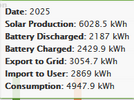
Since solar fitted 17.54 MWh generated and 15.81 MWh used, so on average I use less than I make. 1791714754497.png I also move off-peak to peak times with the battery, showing totals for last year. The sums show electric has cost me in total around £300 for the year, this is mainly the standing charge, 66.38p/day = £242.29 per year.

We have to do a balancing act with hands tied behind our backs, for me it is use oil or electric to heat the house, and if electric when to use it?

 
There are two EV rates with Octopus who I am with, the smart rate, requires details of the car etc, and they decide when you get the smart rate, the standard EV rate, they ask if you have an EV, and I answered yes I have two e-bikes, and that was enough.

So rate at moment 12p/kWh export, 66.38p/day standing charge, Day rate (05:30 - 00:30) 30.74p/kWh, and Night rate (00:30 - 05:30) 8.21p/kWh, (inc. VAT if applicable) I also looked at the tariff designed for solar and batteries, with that tariff, the off-peak was higher to the standard export rate, so to fully charge the battery every night would cost me money, and the peak rate (three rates through the day) was very high 16:00 to 19:00 and without my each day manually altering when batteries were charged and discharged, it would cost me a fortune if I ran out of battery early, so since I have no desire to work as a power station control room operative I did not want that tariff.

I also had 20 months after fitting solar with British Gas, we were auto moved to them when the one we were with went to the wall, we did not select them. They put us on an EV tariff without any questions, but we were locked in for a year, with a £75 exit fee if we left early, they promised us export payment, with back dating once sorted out, after leaving we realised they could not have back dated it, as the whole reason for not being paid, was the export side of the meter had not been registered, it seems you can get import and export from two different companies, although if you do the export rate is normally rather low, but to allow that the meter needs two MPAN numbers, one for import and one for export, we had not been assigned the export number.

So we need to have a company who don't tell lies, and so what ever the rate offered, for us British Gas have burn their boats, and we would never return to them.

The payment has always been a bit of guess work, when with Scottish Power many years ago, they sent us a CT coil to go on the incomer, with some socket adaptors to see what items used, and a in home display (IHD) so we could see in the house what we were using, which connected to the internet and sent Scottish Power info on what we were using, and bills we based on those reading, then corrected once a year, this was before the smart meter role out. On leaving the socket adaptors stopped working, but the IHD continued until damaged by leaking batteries.

Today Octopus have something similar, with their own special IHD which it seems has more functions to the standard IHD, however our solar software gives us solar output, battery input/output, grid input/output, consumption, and state of charge, which means the pink display from Octopus is rather pointless for us.

But as to tariffs from other suppliers, the big question which no one seems to answer, is what are our options, and what is the rate for my region, without actually going down rabbit holes filling in loads of information, I can do an AI search for standard domestic rate, and it says "(active from 1 October to 31 December 2026) is an average unit rate of 26.32 pence per kWh and a daily standing charge of 54.83 pence per day for standard variable tariffs paid by Direct Debit in England, Scotland, and Wales." but it does not seem to matter what supplier harder, So energy tells me "The current average electricity cost in the UK is 23.53p per kWh, with a daily standing charge of 60.12p." and this brings up the question of the standing charge.

I understand we need to pay for the infrastructure, it does not matter if we use just 1 kWh per year, it costs to get electric available, so a standing charge makes sense, but for it to vary company to company and tariff to tariff does not make sense. What ever it is, it should be fixed. Even if it varies home to home, as it may cost more to maintain a supply to a remote farm house, we should have one fixed cost for the standing charge.

Since solar fitted 17.54 MWh generated and 15.81 MWh used, so on average I use less than I make. View attachment 424008 I also move off-peak to peak times with the battery, showing totals for last year. The sums show electric has cost me in total around £300 for the year, this is mainly the standing charge, 66.38p/day = £242.29 per year.

We have to do a balancing act with hands tied behind our backs, for me it is use oil or electric to heat the house, and if electric when to use it?
It sound like i might stay put as i can get off peak at 8p for 5 hours & see if & how much this will charge my battery bank with a 35a charger & some sunny days. At least if i can charge at 8p its better than running at my new 34p peak rate. Will also look into a larger charger or a second one.
 
Last edited:
It was the batteries which limited my charge and discharge rate, the 3.2 kWh battery would charge at 2 kW and discharge at 3 kW, with my 5 kW inverter, I doubled up on batteries, so now charge at 4 kW and discharge at 5 kW.
 

If you need to find a tradesperson to get your job done, please try our local search below, or if you are doing it yourself you can find suppliers local to you.

Select the supplier or trade you require, enter your location to begin your search.


Are you a trade or supplier? You can create your listing free at DIYnot Local

 
Back
Top