Horizontal Radiator with metal disc 'baffle'

Joined
28 Feb 2008
Messages
97
Reaction score
8
Location
Cheshire
Country
United Kingdom
Hi
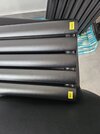
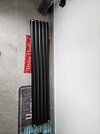
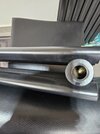
Bought a Radiator from Victorian Plumbing as a Horizontal Radiator. (I believe the radiator can used in either Horizontal or Vertical orientation) The drawing that came with the Rad shows the rad in Horizontal mode, and has a Note next to the end of the rad that a says 'Blocker - knock it off before installation'. The rad has 5 horizontal tubes and the drawing shows this 'blocker' is inside the end tube level with the middle tube, at the end nearest the Inlet/Flow connection. (See photo looking inside tube from Inlet hole) I am assuming that this blocker is for when the rad is used in Vertical mode and I need to knock it out using a hammer and a longish piece of doweling or something similar. Could somebody advise if possible? If it is to be knocked out of place isn't there a chance that this piece of metal disc could potentially cause a blockage if its floating around inside the rad? It looks too large a diameter for it to come out of the threaded inlet hole. Any advice welcome
 

Attachments

  • Rad Blocker.jpg
    Rad Blocker.jpg
    277.5 KB · Views: 172
  • Rad Inlet and Outlet.jpg
    Rad Inlet and Outlet.jpg
    345.5 KB · Views: 130
  • Whole Rad.jpg
    Whole Rad.jpg
    286.9 KB · Views: 112
I don't know the answer to your question... years ago a plumber told us that he could fit ours horizontally.

I doubted him given that the wall fittings used small grub screws (I was concerned that the fittings would not hold the rad up) . I emailed the manufacturer, they confirmed that it should not be fitted horizontally. They additionally mentioned the baffle (not removable).

Before doing anything, I would recommend that you contact the retailer. In my limited experience both firms with the VP initials buy in bulk from China and know little about the products.
 
Thanks Opps. I have sent a Support email to VP but it will take forever !! They are stating at least 72 hours for a reply !!
 
What kind of brackets came with the rad, if they are hooked brackets as in the pic then they are only designed to support the rad vertically via the top and bottom horizontal tubes.

1738944580058.png


What is the rad replacing, please also be careful, these rads will not replace normal convecting rads when their output is like for like. They will not heat the space in the same way and as efficiently, unless the room is on the smaller side.
 
Hi Madrab
The brackets supplied are the ones on the right ie NOT the curved ones !! So for the Horizontal mounting.
 
Hi Madrab
I calculated the BTUs required for the size of kitchen and added some margin for this. I've got a vertical double panel rad (1800 x 472mm) at one end and a Horizontal double panel rad (1600 x 295mm) at the other.
 
Hi Madrab
The brackets supplied are the ones on the right ie NOT the curved ones !! So for the Horizontal mounting.
sorry but I'm a little confused, all the brackets in that pic are for hanging the rad vertically they are all curved ones. if you have brackets though that are specifically design to carry the rad horizontally then great.

As far as rad output is concerned then unfortunately it's not about the rated output that is important when changing from convecting radiators to tubular designer columns rather the process whereby they transfer the heat into the space around them

Convecting rads use 90% convection and 10% radiation to heat the space that they're in, using mostly convection they are the most efficient at heating the actual air in the room. Tubular column rads use 30% convection and 70% radiation to heat the space they're in so they are great at heating things close to them but struggle with larger open spaces. That being the case tubular columns can take a lot longer to heat the same space, room size dependent and in larger rooms they can struggle to get the space up to the desired temp properly, if at all.

As far as the baffle is concerned, using a punch to knock it at one edge and you should be able to leave some of it connected so it will allow water to pass but won't be loose rattling about in the rad. Alternatively you can 3/4 size drill it but then needs flushed to get the swarf out.
 

DIYnot Local

Staff member

If you need to find a tradesperson to get your job done, please try our local search below, or if you are doing it yourself you can find suppliers local to you.

Select the supplier or trade you require, enter your location to begin your search.


Are you a trade or supplier? You can create your listing free at DIYnot Local

 
Back
Top