
How can I get well hung?

Joined
8 Feb 2015
Messages
241
Reaction score
7
Country
United Kingdom
Howdy all

I want to display a heavy marble resin sculpture on my wall, but I'm struggling to figure out the safest way to 'hang' it.

It weighs about 20kg, and - unfortunately - I can't drill into it or otherwise attach any other kind of fixing.

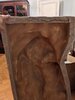
The picture shows the reverse of the piece; you can see the 'lip' at the top. The lip is about 40mm deep.

I was planning to simply hang the piece, by placing this lip on a wall-anchored batten of similar dimensions. (And perhaps adding some kind of very mild adhesive to ensure it doesn't move off the batten).

Any other suggestions!?

Thanks!!
 

Attachments

  • PXL_20220118_210018089.jpg
    PXL_20220118_210018089.jpg
    177.4 KB · Views: 122
Final option is to create a shelf to lean it on, rather than hoping it doesn't fall apart from it's own weight!
 
The inside face of the reverse side is an irregular shape (as it's from a mould), so I could only adhere a board to the inside sides which are straight. Would this be enough?
 
Lets see if I can explain this clearly.
Cut 2 french cleats, each one about a third of the width of the opening. Bore a suitable hole in one end of each cleat to a depth of one third the length of the cleat. I.E. a 'blind' hole. These will be to accept a length of threaded stud which needs to be just over half the width of the sculpture opening.
eg. drill a 8.5mm/9.0mm hole to accept a length of 8mm stud. The threaded stud should have 4 nuts run towards the centre of the stud. Next place 2 repair/penny washers on each end of the stud. The cleats are next slipped on to the stud and the whole set up inserted into the back of the sculpture. You then run the 2 outer nuts outwards towards each cleat so they push the cleats tight up against each side. The washers will act as 'load' spreaders against the ends of the cleats. Once you are happy you have a firm fix then run the remaining 2 nuts out to each end to lock the retaining nuts in place.
On the wall you can hang a 'near full width' support bar to hook the french cleats on to.

Hope I've explained that in an understandable way. If not the feel free to ask me to clarify any points.
 
I understand up to half way! Let me absorb it a bit, but - in the meantime - thank you!

Lets see if I can explain this clearly.
Cut 2 french cleats, each one about a third of the width of the opening. Bore a suitable hole in one end of each cleat to a depth of one third the length of the cleat. I.E. a 'blind' hole. These will be to accept a length of threaded stud which needs to be just over half the width of the sculpture opening.
eg. drill a 8.5mm/9.0mm hole to accept a length of 8mm stud. The threaded stud should have 4 nuts run towards the centre of the stud. Next place 2 repair/penny washers on each end of the stud. The cleats are next slipped on to the stud and the whole set up inserted into the back of the sculpture. You then run the 2 outer nuts outwards towards each cleat so they push the cleats tight up against each side. The washers will act as 'load' spreaders against the ends of the cleats. Once you are happy you have a firm fix then run the remaining 2 nuts out to each end to lock the retaining nuts in place.
On the wall you can hang a 'near full width' support bar to hook the french cleats on to.

Hope I've explained that in an understandable way. If not the feel free to ask me to clarify any points.
 
Fit timber baton too wall and hang sculpture on it, double sided foam tape will prevent any movement .
 
Foam tape is a great idea, thanks.

I'm now heading towards the shelf idea, simply because I'm worried the weight of it will tear the top off, if it's 'hanging' off something

Foam tape is really good idea though, if I can be more assured re coherency of the piece itself
 
I might consider going all traditional and making a corbelled wall shelf to sit it on in order to carry the weight, then using an epoxy foam tape to stick it to the wall behind and the top of the shelf to prevent it getting accidentally dislodged

Corbelled Shelf 001.jpg

Corbelled Shelf 002.jpg

Two bits of planed wood and not that difficult to form (admittedly a lot earier with a jigsaw to make the templates and a router to shape the edges) and if screwed and glued together it wouldn't matter if the screws were visible as they'd be beneath the piece when it was mounted
 
Foam a piece of plywood onto the back of it and affix whatever hooks you want.
 

If you need to find a tradesperson to get your job done, please try our local search below, or if you are doing it yourself you can find suppliers local to you.

Select the supplier or trade you require, enter your location to begin your search.


Are you a trade or supplier? You can create your listing free at DIYnot Local

 
Back
Top