How to reduce old floorboards to 50mm wide - table saw vs. bandsaw etc.

Joined
2 Dec 2013
Messages
4,922
Reaction score
814
Country
United Kingdom
I have a pile of old T&G pine floorboards that got damaged along one or both sides while being lifted. I’d like to slice off the broken edges to get something like a 50mm wide batten, which I can re-use in another project.

What’s the best way to do this? I only have a circular saw and jigsaw. I have been looking at cheap table saws and bandsaws. I have never used either. Some of the cheap ones have awful online reviews. What do you recommend?
 
What’s the best way to do this? I only have a circular saw and jigsaw.
You could do the job with the circular saw, working with a straight-edge guide clamped relative to the board being cut.
But first make sure there are no hidden bits of nails/screws/tacks in the wood.
 
You could do the job with the circular saw, working with a straight-edge guide clamped relative to the board being cut.
But first make sure there are no hidden bits of nails/screws/tacks in the wood.

I find that long cuts with a circular saw often require stopping to reposition clamps.

I am wondering whether I could construct some sort of jig for this job. Suggestions?
 
Chuck some insulation on the floor. Set depth. Use circular saw along straight edge.

Track saw would be better with 3m track


Table saw you need space either side so that's 6m
Plus you need to support boards.
Not Ideal. Use your circular saw
 
Screw the straight edge ( a strip of pre cut mdf) to the waste side of the board, having calculated the width between kerf and straight edge. Unscrew and re use for the remaining boards
 
Chuck some insulation on the floor. Set depth. Use circular saw along straight edge.

Sorry, I can’t quite imagine this; what sort of insulation?
Table saw you need space either side so that's 6m
Plus you need to support boards.
Not Ideal. Use your circular saw

I’d probably do it outside, with improvised supports.
 
He means to use a piece of insulation board as a base then place your wood on top. Set the blade just below the thickness of the wood. The insulation board just allows the wood to sit flat on something. Using the circular saw you may need to place a few boards next to next other to run the saw along

With a table saw you'll need a good edge to run through against the fence
 
Sheet of polystyrene cut in half and placed out on floor.
Chippies use any old kingspan or polystyrene.
Just set the depth of circular saw so it just touches. Cut 100s of times
 
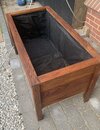
Have a 30year old basic table saw (no height or angle adjustment ) cost me less than £30.
Used it to cut down solid oak floorboards for a planter for one of my daughters, it coped easily . You don’t need an expensive machine , the blade quality is most important element .
 

Attachments

  • IMG_2252.jpeg
    IMG_2252.jpeg
    501.4 KB · Views: 30
i have all the mentioned saws as in jig/band/track/circ/table and by default i use the table saw but as said by others you need a strait edge on at least one side
if i had a specific job in mind i would reduce the planks to the length required with a say 20mm margin this makes the job much easier
you will need to pin/screw double sided taped to a strait edge and rip a strait edge

in your case a tracksaw may be by far the easiest in the mind but you need paired planks meaning no lumps or bumps in thickness no cupping or twisting between them and you need pairs as the track needs i would say at least 75% width support dependant on rubber positions underneath

i would avoid anything that uses a fence or edge guide other than the table saw
the ones i would discard would be jigsaw/band saw recip saw oscillating

if you do use a table saw do all actions the same first as in straiten one edge off all timber
then set up the fence to the say 45mm you need and assuming a 6 or 7" plank you may get 2 or 3 x45mm strips all identical
 
other thoughts
iff they are tongue and groove planks you may with the use off an undamaged plank be able to pair as long as you have at least 2 points on the tongue or groove to give parallel support to pass over a table saw but you would probably be cutting the inner edge off the damaged plank as table saw fences are perhaps 170-200mm from the blade
 
Last edited:

If you need to find a tradesperson to get your job done, please try our local search below, or if you are doing it yourself you can find suppliers local to you.

Select the supplier or trade you require, enter your location to begin your search.


Are you a trade or supplier? You can create your listing free at DIYnot Local

 
Back
Top