Increase rcd rating?

Good job you cant see the main board! It is an old split board...one half rcd protected, one half not!
That's how it used to be.

However, we no longer use the unptotected side! My logic was that the heating and water pump are stand alone,
It is nothing to do with the appliances.
RCDs are fitted to the circuits to protect people and must be 30mA.

no user access unless under maintenance
Irrelevant.
 
My logic behind the switch to an A curve is they are more tolerant of residuals caused by inductive loads (or so I believe).
Completely wrong.
Type A will trip on some types of fault involving pulsed DC and partial AC waveforms that AC types were not designed to detect.


MK do an A curve 100mA that may solve the problem.
100mA RCDs are not a substitute for situations that require a 30mA RCD.
 
Thanks all. My plan is replace like for like. If it recurs I will switch to rcbo for this vital services board. This will at least identify the specific service causing the fault. Thanks for all your advice.
 
Ive tested rcds before and they can test fine ive then replaced it and it sorted the problem
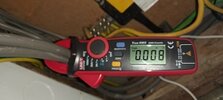
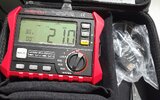
I have done the same, tested, and it showed A1, swapped and problem sorted. My original tester did not have a ramp test, the new one does, RCD tester ramp.jpg and also the new clamp-on Diffrence line neutral 8 Feb 24 reduced.jpg will measure down to 1 mA. So in the past did not really know how close to the wind I was sailing. Using the ½ test, and not tripping, one assumes you have 15 mA to spare before it trips, but the socket tested shows I have 21 mA to spare on that socket.
I have questioned how to test a few times, I know with a RCD the strain imposed by the wires can change the tripping point, so it needs testing with all wires connected, and re-testing if wires are disconnected and re-connected, and with a RCD easy enough to turn off the MCB's during the test, and although there can be a neutral to earth current, in the main you are testing the RCD on its own.

But with a RCBO that is not possible, one has to test with all loads connected, so one also needs to measure the back-ground leakage, the clamp-on is measuring all, where RCD tester only one circuit, but at 21 + 8 still below 30 so it will comply.

But we never test the MCB, so why do all the tests with the RCD? is it just because we can? I note recommended tests with a RCD have reduced, no longer need to test multi-times. But without the tester, measuring 40 mS with a stop watch is not really going to happen. Does the test button help or hinder? So easy to think all is working A1 when really there is a fault, I know the test button on our MK 10 mA socket, would also take out the 30 mA and 100 mA in main board, so a bit of a pointless exercise pressing it.

 
Same here. Nuisance tripping of a 100 mA RCD from the 80s, very sporadic. Two electricians tested the RCD and the installation, everything measured perfectly fine. Insulation resistance of two circuits was suspiciously low at around 8 MΩ but still well within limits and far above what would trip a 100 mA RCD. Replaced RCD with a new 30 mA, tested again, has been working fine for well over five years.
That doesn't mean you shouldn't get things tested, if there's a fault replacing the RCD won't get you anywhere.
 

If you need to find a tradesperson to get your job done, please try our local search below, or if you are doing it yourself you can find suppliers local to you.

Select the supplier or trade you require, enter your location to begin your search.


Are you a trade or supplier? You can create your listing free at DIYnot Local

 
Back
Top