Installing generator transfer switch

Essentially correct that the generator would have more trouble blowing a fuse (or circuit breaker, what do you actually have?) than the mains in the event of a fault.

I would challenge its statement that "your existing fuse box works fine day-to-day" - we don't care how well it works "day-to-day", we care about how well it works on the rare occasion when something goes wrong. Your non-RCD installation is (probably?) still legal but it's overdue for replacement.

As I said before, getting RCD protection should be a much higher priority for you than worrying about a generator.

I have circuit breakers, I now see that this is a much more involved process than I first thought. Thanks everyone for the input it really has helped with my understanding.

I think my short term plan is to use extensions cables to power essential stuff and lighting in the event of a power cut (which was my original plan). In the spring (when it is warmer and the days are longer) then look at getting an electrician in to inspect the wiring and update the consumer unit, at the same time look at putting a generator switch in.

As you have said it is overdue for replacement!
 
The whole point about a generator that turns off if it doesn't see any mains present, is that it can't be used as a backup generator.

Ah, yes.
1794596270140.gif


'Plug-in solar' can't. A basic generator such as Eric was describing (that doesn't turn off in the absence of mains) can, by definition.

I wonder what will happen when/if they allow people to add batteries to PIS.
 

Attachments

  • 1794596158694.gif
    1794596158694.gif
    2.3 KB · Views: 1
  • 1794596241252.gif
    1794596241252.gif
    367 bytes · Views: 2
Ah, yes. View attachment 426467


I wonder what will happen when/if they allow people to add batteries to PIS.
Not much, the inverter will still turn off without a grid connection. It’s already a thing in Germany and I haven‘t heard of any issues despite being in touch with some particularly paranoid sparks.

The German regs require a dedicated circuit and special connectors for PIS but I believe that’s mostly theoretical. The stereotypical German obedience to laws and regs is what it is - a stereotype.
 
My EPS (like UPS) is not part of the original house wiring, I have on FCU supplying the central heating, and two double sockets supplying the fridge and freezers, and for lighting rely on an emergancy torch to find items to light the house independent of main house lighting.

The battery in the main is to transfer off-peak to peak times, and to smooth out the solar supply so I can use a 3 kW appliance without drawing from the grid, 10% is reserved for power cuts, but 640 watt/hours would not last long, it is hoped we have more than 10% when the power cut happens.

The problem with manually turning over to a generator when one has a power cut, is how do you know when the power has returned?

In the main, a power cut is only a problem with heating and freezers, we can do without cooking, and use torches and candles for light, even heating, I still have an open grate, it has a board to stop drafts, and a spigot to allow the AC to vent through the chimney in summer, saves having a window open, but although I have never lit a fire, it is there should there be an emergancy.

So in the main it is freezers which need a back-up supply. A chest freezer can likely if well stocked last 24 hours without power, however the frost free upright freezer it depends when the last de-frost cycle was as to how long it will last, and also unlike the chest freezer, opening the door to get food would allow rapid heating up of rest of food.

So in the main, it is the freezer that needs emergancy power, and any manual generator will need as the name suggests, some one to manually turn it on.

I found out the hard way, losing 2 freezers full of food, while away from the house looking after my mother, the problem when manual intervention is required. The fault was simple, a RCD had tripped, so this house, the three freezers come from to independent RCD sockets, which only supply the freezers, so very unlikely they will trip, and even more unlikely for both to trip.

I will admit a red indicator lamp to show they are powered up, is not the best option, an emergancy torch would be better, one does not notice a light not lit, better for some thing to light up.

But if I did not already have battery back-up, then the portable battery packs with built in EPS seem to be best option, as they auto cut in with a power cut.

We did when working on the Falklands have a problem with generators failing, which powered to connection to UK, so was a major concern, so a large UPS system with a bank of lead acid batteries was installed in the offices, however by the time it was installed, the generator problem had be resolved, and there were more power cuts due to the UPS failure than generator failure.

This does need considering, I have looked at the plug in battery packs, they have a second use when going out, and by adding a plug in timer, I could charge with off-peak, and use during the day, reducing the load on the existing batteries, so they would last further into the winter evenings. By powering my fridge and freezers from them, AI says "A typical modern 60 cm fridge freezer uses about 0.3 to 0.8 kWh per day (averaging roughly 0.67 kWh per day)." so with three I could use 2 kWh per day, more to the point around 750 watt/hour during the time dusk to 00:30 when off-peak starts, I don't feel the gain is worth the money, so not getting one. However if I did not already have batteries, the situation would change.

Also looked at generators, petrol/TVO would be best option, then it could run on my central heating fuel, but my inverter can be used with either a generator or the grid, not both. With the grid it only uses grid power when batteries are down to 10% but with generator it will start it and run it to recharge batteries, so it is run at most economic rate, for as short of time possible.

It is bad enough watching fuel oil level for heating, without going totally off-grid. And with oil prices, that option is not really a good idea.

So basic point, it is good to look at the options, but in the main, stand-by generators are only for people living out in the country where power cuts are common, from around 1933 to 2008 we have slowly brought more and more homes onto the national grid supply, think the remote village of Abergeirw in Gwynedd, Wales was last on 19 December 2008, it does point to how long it may take to upgrade the grid, but to now look at going off-grid, does seem a bit silly.

 
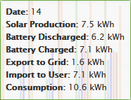
Looking at consumption v production even with 6 kW panels,
1794693011022.png
except where the DHW is being heated, the solar and consumption don't match. So the battery bridges the gaps.
1794693170698.png

So the battery does a number of things seen here, it is charged with off-peak to use latter, and it stretches the time when we are using either off-peak or solar, nearly 10 pm and I have 27% left (10% held in case of power cuts) and this time of year, my 6.4 kWh battery is not really big enough. It is the purple line I am interested in, it tells me if I need to wait until 00:30 to use washing machine, tumble drier, and dish washer, or if I have enough left not to need to wait. Today up to now 1794693613642.png it is the use of off-peak which is saving me the most money, but the discussion is more about covering for power cuts than using plug-in solar, or plug-in batteries, before some one tries to correct me, you are allowed plug-in batteries using a V2G EV charging point, but not a BS1363 plug and socket. However for batteries only it would seem a little pointless, may as well have a problem inverter and battery system. Unless you have an EV.

But the discussion is more about automation. To have an automated generator using petrol or diesel is very expensive, clearly large supermarkets have this, but for a domestic property it is eye watering expensive.

So looking at what can be done at a reasonable expense. So in essence because of noise, overnight you want batteries, and also to auto pick up load you want batteries, but for an extended time you want petrol or diesel.

So what we need to talk about is can they be combined? And at what cost.

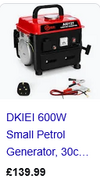
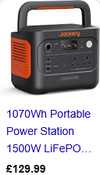
So let me consider a scenario, let me consider a battery pack of say 1000 watts, cheaper to get a caravan 750 watt kettle to getting a 3.5 kW output battery, so it will at 1000 watts run central heating, freezer, and lights, but likely only for around 4 to 6 hours, the generator to recharge the batteries can be small 1794694848229.pngand cheap, 1794694956377.pngas can the battery. But then we look at stage two, we can keep the house warm etc, but if we went a bit larger, then it may also be worth having an off-peak supply, but the day rate is higher than the standard rate, 1794695279074.png it seems it has gone up, I don't know the standard rate, but if not using off-peak then not worth having, so one has to do your own sums.
 
I believe that batteries are not allowed on plug-in solar.
No - but everyone on here, it seems, is talking like it's the next big thing. Within the concept of 'plug-in', I am skeptical.

For example, why does anyone even expect plug-in solar to produce any useful surplus energy?
 

If you need to find a tradesperson to get your job done, please try our local search below, or if you are doing it yourself you can find suppliers local to you.

Select the supplier or trade you require, enter your location to begin your search.


Are you a trade or supplier? You can create your listing free at DIYnot Local

 
Back
Top