

My first job after the new sill was installed was to fit an outside tap and socket:
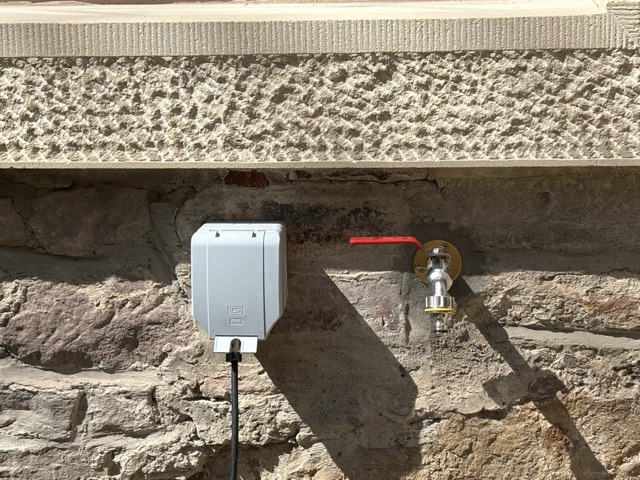
These outside sockets are amazingly badly designed. As reported by about a thousand screwfix reviews, the socket is off-centre because of the switch, but the waterproof flex outlet is central. No plug with any sort of strain relief has any chance of fitting. So why did I fit it? Well, SF have 4 brands for under about £10, all of which have the same issue. Then they have an MK one for £34.99 that also has this problem. There is an unswitched MK one for £24.99 that shouldn't have this problem, but people say its flap snaps off easily. Et cetera. So, since the extension lead that I use outside doesn't have a strain relief on its plug and does fit, I bought this one.
Inside:
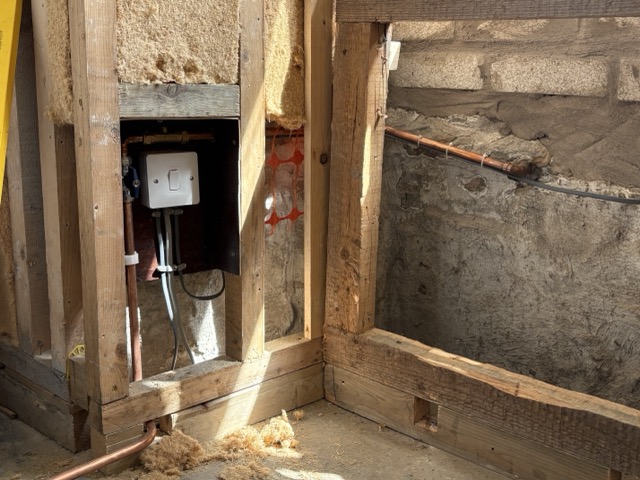
The isolation switch and valve are going to be behind an access panel when it's finished. Note my favourite cable installation method, "cable-tied to a copper cold water pipe".
The other thing I've fitted to the wall before the insulation and plasterboard goes on is this:
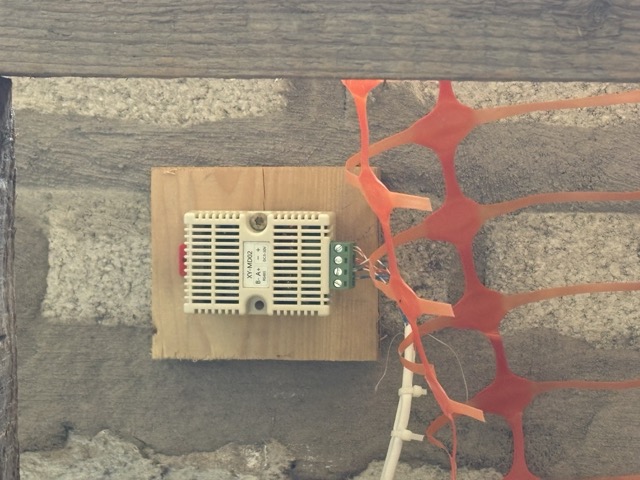
It's a temperature and humidity monitor. The idea is to be able to plot pretty graphs of the conditions inside, outside, and in the wall; then maybe I can worry less about whether the insulation is making the walls damp etc. The modules communicate using RS485 (MODBUS) which I'm running over two-pair phone wire, with 5V DC power on the other pair. At 9600 baud this works fine over the sort of cable lengths you get inside buildings.
These outside sockets are amazingly badly designed. As reported by about a thousand screwfix reviews, the socket is off-centre because of the switch, but the waterproof flex outlet is central. No plug with any sort of strain relief has any chance of fitting. So why did I fit it? Well, SF have 4 brands for under about £10, all of which have the same issue. Then they have an MK one for £34.99 that also has this problem. There is an unswitched MK one for £24.99 that shouldn't have this problem, but people say its flap snaps off easily. Et cetera. So, since the extension lead that I use outside doesn't have a strain relief on its plug and does fit, I bought this one.
Inside:
The isolation switch and valve are going to be behind an access panel when it's finished. Note my favourite cable installation method, "cable-tied to a copper cold water pipe".
The other thing I've fitted to the wall before the insulation and plasterboard goes on is this:
It's a temperature and humidity monitor. The idea is to be able to plot pretty graphs of the conditions inside, outside, and in the wall; then maybe I can worry less about whether the insulation is making the walls damp etc. The modules communicate using RS485 (MODBUS) which I'm running over two-pair phone wire, with 5V DC power on the other pair. At 9600 baud this works fine over the sort of cable lengths you get inside buildings.


