
You are using an out of date browser. It may not display this or other websites correctly.
You should upgrade or use an alternative browser.
You should upgrade or use an alternative browser.
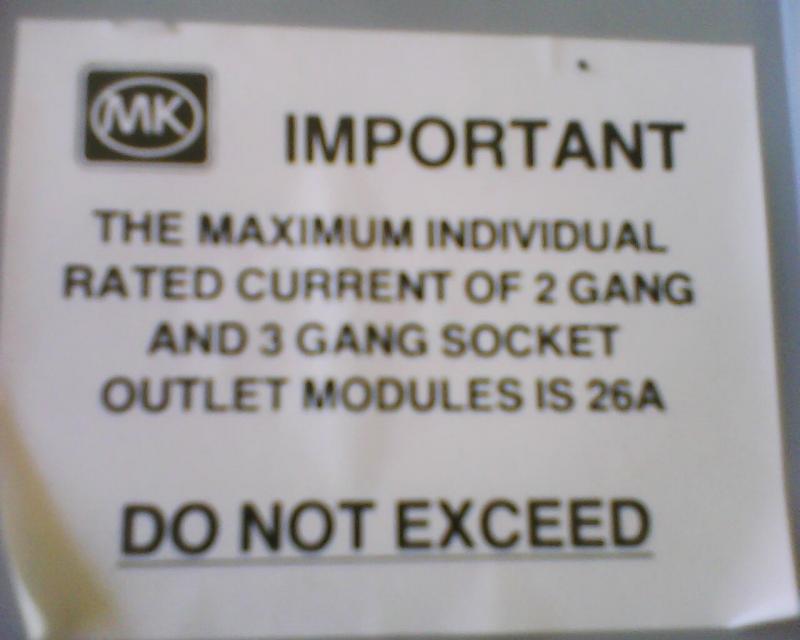
Is any more proof needed ?
- Thread starter ricicle
- Start date


Yes!
I need to see it written in both German and French!
I need to see it written in both German and French!
The days of the double socket on an unfused spur may be numbered (I wonder if they've written Amendment 2 yet?) 
Kind Regards, John.
Kind Regards, John.

- Joined
- 11 Jan 2004
- Messages
- 45,849
- Reaction score
- 3,513
- Country

The days of the double socket on an unfused spur may be numbered (I wonder if they've written Amendment 2 yet?)
Kind Regards, John.
In draft, yes. I spoke to a geezer at the IET and he said it's being prepared and will include details about supplies for EV's, but it's not been finalised yet.
- Joined
- 11 Jan 2004
- Messages
- 45,849
- Reaction score
- 3,513
- Country
3 gang 26A?
Can't remember whether the floortrack 3G sockets were fused or not.....I guess not.
No. Just looked at Powerlink track system 3G socket T61443: no fuse that I can see.
Can't remember whether the floortrack 3G sockets were fused or not.....I guess not.
No. Just looked at Powerlink track system 3G socket T61443: no fuse that I can see.

See if you can get ring finals deprecated...In draft, yes. I spoke to a geezer at the IET and he said it's being prepared and will include details about supplies for EV's, but it's not been finalised yet.
- Joined
- 11 Jan 2004
- Messages
- 45,849
- Reaction score
- 3,513
- Country
That would be a good Amd 2:
RF's die a quick, painless death.
As do 3036's.
Actually, haven't Wylex stopped making them now??
RF's die a quick, painless death.
As do 3036's.
Actually, haven't Wylex stopped making them now??
The interesting thing is that if/when ring finals (and maybe also 32A radial socket finals) do eventually 'go' (from current versions of BS7671), there could then be considerable pressure, not the least from global companies involved in accessory manufacture, to phase out BS1362/1363 and move towards closer alignment between ourselves and the rest of the world as regards plug and socketry (as well as wiring concepts/practices)!That would be a good Amd 2: RF's die a quick, painless death. As do 3036's.
Kind Regards, John.
Why is there an apparent obsession in this forum with outlawing ring finals?
Also, which concepts/practices should be be adopting and which should we be trhowing away?
Also, which concepts/practices should be be adopting and which should we be trhowing away?
Jolly good question. I certainly have no such obsession, although I do recognise the pros and cons. Of one thing we can be fairly certain - given that retrospective regulations are never likely to appear, there are almost certainly going to be ring finals still in UK installations long after most of us currently contributing to this forum (even the 'youngsters') are 'well dead and gone'.Why is there an apparent obsession in this forum with outlawing ring finals?
One imagines that there are almost as many answers (opinions) to that question as there are people prepared to offer answers! In reality, I suspect that the long-term answer is going to depend more on 'politics' than on engineerng considerations or personal views - i.e. the extent to which pressures arise over the decades for 'harmonsation' of practices, throughout the EU or perhaps even more widely.Also, which concepts/practices should be be adopting and which should we be trhowing away?
Kind Regards, John.
Deprecating is not quite the same as outlawing.Why is there an apparent obsession in this forum with outlawing ring finals?
IMO the drawbacks associated with ring finals outweigh the advantages. They were an expedient kludge introduced to work around a problem of a rapid increase in electricity usage which made 15A circuits undersized, coinciding with a post-war copper shortage which mitigated against replacing all the 7/.029 cables with 7/.036.
The ring final was never designed from the ground up to be the best way to supply sockets. Apart from places with a UK colonial influence (and now it seems, in Slovakia for god-only-knows-what-reason) it's never been seen as a good thing by the rest of the world.
We cling to it like we cling to so many things because that's the way it's always been done and/or because we don't believe Johnny Foreigner might actually have better ideas, and it's had it's day.
BAS, that's often quoted as the background behind our use of ring finals, but is there any evidence for that story?They were an expedient kludge introduced to work around a problem of a rapid increase in electricity usage which made 15A circuits undersized, coinciding with a post-war copper shortage which mitigated against replacing all the 7/.029 cables with 7/.036.
The ring final was never designed from the ground up to be the best way to supply sockets.
An elderly electrical engineer told me some decades ago that the converse was true, and that the 'great and good' within the IEE decided that the post-WW2 building boom was the ideal opportunity to design domestic installations that would owe nothing to history, and would be the envy of the world. Perhaps they were a little over-optimistic...
It seems so reasonable and so widely and oft cited as to be the truth.
I guess it was not just increasing the capacity of existing circuits but also minimising the use of copper for all the new circuits needed in all the post-war rebuilding..
I guess it was not just increasing the capacity of existing circuits but also minimising the use of copper for all the new circuits needed in all the post-war rebuilding..
That's not like you BAS - are you feeling unwell today?It seems so reasonable and so widely and oft cited as to be the truth.
Where's the evidence? I must ask the IET if they have archived minutes of the meetings around that time. When was JPEL/64 set up in BSI?
P
Paul_C
I believe that much of the background of the reasons for adopting rings can be found in the Post-War Building Studies No. 11 - Electrical installations book, published by H.M.S.O. around 1944. Unfortunately, I've never seen a full copy of this publication.
There are some quotes taken from it in an IET Wiring Mattersarticle a few years ago:
http://electrical.theiet.org/wiring-matters/18/plug-origin.cfm?type=pdf
There are some quotes taken from it in an IET Wiring Mattersarticle a few years ago:
http://electrical.theiet.org/wiring-matters/18/plug-origin.cfm?type=pdf

DIYnot Local
Staff member
If you need to find a tradesperson to get your job done, please try our local search below, or if you are doing it yourself you can find suppliers local to you.
Select the supplier or trade you require, enter your location to begin your search.
Please select a service and enter a location to continue...
Are you a trade or supplier? You can create your listing free at DIYnot Local
Similar threads


- Replies
- 21
- Views
- 3K
