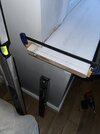
- Joined
- 6 May 2025
- Messages
- 219
- Reaction score
- 77
- Country

PART 1
They sometimes get called "ears", but maybe that's just local slang in this neck of the woods (?). Basically window boards are normally formed from a single piece of thicker timber or MDF (22 and 25mm are common thicknesses, but sometimes you get 30 or 32mm stuff). The profile is machined along the front edge and the window board is cut over length. Assuming the window opening at the wall inside face (DFR) is 1000mm and your ears need to be 50mm long at each side you need to cut the board to 1100mm long. Then measure the opening as shown in this sketch:
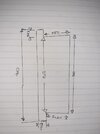
Key:
OAL = overall length (say 1100mm, or DFR + 2*EAR where DFR = 1000)
DFR = width of opening at inside face of reveal
DRR = width of window reveal at the window (may be different from DFR)
EAR = ear length (say 50mm)
ETH = ear thickness (say 30mm)
LLEN = depth of reveal on left side
RLEN = depth of reveal on right side
Start setting out your window board from the front or profiled edge you will need a large square and ideally a combi square to do this (a saw handle with a built-in square also works):
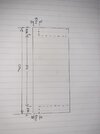
Pencil setting out lines are shown dashed.
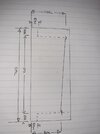
Measure back from the corners of the reveal to the window on both sides (LLEN and RLEN) then measure the actual width of the window (DRR). Hopefully this will be within a millimetre or two of DFR. Calculate the position of the rear of the board as follows:
LOAL = LLEN + ETH
ROAL = RLEN + ETH
Set out the rear points of the reveal sides LOAL and ROAL, measuring from the front edge of the board (this is more accurate). Join the points with a LIGHT pencil line:
Now check the angles of the reveals at the window. I'm going to assume for now that we are dealing with a solid board with a square orvpencil round edge, then discuss how to handle waterfall edgings or profiled edges at the end of my explanation - I think it'll make more sense that way
.
If your corner at the window are square and LLEN and RLEN are more or less the same you can finish marking out the cut outs then saw the waste away using a combination of portable circular saw, hand saw and jigsaw (whatevervyou have). The two short cuts for the back edges of the ears must be vertical and bang on the line. The three other cuts should leave an extra millimetre or so outside of the line and be undercut by 5 to 10 degrees (or so) to allow for trimming/scribing. a block plane and sharp chisel can be used to make any final adjustments
I'll describe how to deal with out of square reveals and waterfall/profiled edges in the next...
...thrilling..
...installment
TO BE CONTINUED...
They sometimes get called "ears", but maybe that's just local slang in this neck of the woods (?). Basically window boards are normally formed from a single piece of thicker timber or MDF (22 and 25mm are common thicknesses, but sometimes you get 30 or 32mm stuff). The profile is machined along the front edge and the window board is cut over length. Assuming the window opening at the wall inside face (DFR) is 1000mm and your ears need to be 50mm long at each side you need to cut the board to 1100mm long. Then measure the opening as shown in this sketch:
Key:
OAL = overall length (say 1100mm, or DFR + 2*EAR where DFR = 1000)
DFR = width of opening at inside face of reveal
DRR = width of window reveal at the window (may be different from DFR)
EAR = ear length (say 50mm)
ETH = ear thickness (say 30mm)
LLEN = depth of reveal on left side
RLEN = depth of reveal on right side
Start setting out your window board from the front or profiled edge you will need a large square and ideally a combi square to do this (a saw handle with a built-in square also works):
Pencil setting out lines are shown dashed.
Measure back from the corners of the reveal to the window on both sides (LLEN and RLEN) then measure the actual width of the window (DRR). Hopefully this will be within a millimetre or two of DFR. Calculate the position of the rear of the board as follows:
LOAL = LLEN + ETH
ROAL = RLEN + ETH
Set out the rear points of the reveal sides LOAL and ROAL, measuring from the front edge of the board (this is more accurate). Join the points with a LIGHT pencil line:
Now check the angles of the reveals at the window. I'm going to assume for now that we are dealing with a solid board with a square orvpencil round edge, then discuss how to handle waterfall edgings or profiled edges at the end of my explanation - I think it'll make more sense that way
.
If your corner at the window are square and LLEN and RLEN are more or less the same you can finish marking out the cut outs then saw the waste away using a combination of portable circular saw, hand saw and jigsaw (whatevervyou have). The two short cuts for the back edges of the ears must be vertical and bang on the line. The three other cuts should leave an extra millimetre or so outside of the line and be undercut by 5 to 10 degrees (or so) to allow for trimming/scribing. a block plane and sharp chisel can be used to make any final adjustments
I'll describe how to deal with out of square reveals and waterfall/profiled edges in the next...
...thrilling..
...installment
TO BE CONTINUED...
Last edited: