I'm not quite sure what you mean by that, particularly the "at last". The things that I "don't get" about LEDs which I just mentioned are things that I "haven't been getting" (despite a lot of pondering and wondering) for many years!Welcome to my world at last

You are using an out of date browser. It may not display this or other websites correctly.
You should upgrade or use an alternative browser.
You should upgrade or use an alternative browser.
Kitchen light suggestions
- Thread starter JohnW2
- Start date
Good question!How can the led elements lumens/watt be in the same ballpark as incandescent “and” fluoro
The measurements/claims might indicate that, so maybe it's down to totally bizarre perception/expectation on the part of human beings? As I said, both for incandescents and fluoros a wattage of say, 60-100 W, is commonly used as he sole light source in a medium-sized room.Fluoro puts out way more lumens/watt than incandescent. About 5 times as much.
Do you really believe that, say, the brightness of a 60 W (probably 58
 ) fluoro really would be perceived as "5 times brighter"than a 60W incandescent -OR that you would really need a hypothetical 300 W incandescent to match the light output of the 60 W fluoro?
I think we should not only be concerned about the amount of light but also the spread of that light , I think most would see that but also to consider the kind of light as it appears to the human eye and this feature is not the one everybody considers, sometimes because it is difficult to consider before the event of the light change and then we got to get some idea if that light will degrade over time (or even if it`s your eyes degrade over time).
By and large we had many years to get used to incandescants and fluorescents and thereby pretty conversant but with LEDs maybe not yet.
If it is not too inconvenient to do a quick temporary lash up for comparison in situ might bconsidered as a "suck it and see" approach.
By and large we had many years to get used to incandescants and fluorescents and thereby pretty conversant but with LEDs maybe not yet.
If it is not too inconvenient to do a quick temporary lash up for comparison in situ might bconsidered as a "suck it and see" approach.
I've just realised that there's another observation I didn't make about that ...Fluoro puts out way more lumens/watt than incandescent. About 5 times as much.
.... the designers of LED ('retrofit') tubes and 'long' integrated LED lights (like battens and some panels) are obviously free to include whatever number and size of LED elements they believe will result in an appropriate Wattage snd light output - and nearly all of them have decided to do it so that the total Wattage is roughly half that in a fluoro of the same length
However, 'roughly one half' is not quite the same as 'one fifth' (
), so do these people perhaps have rather different views/beliefs from you?- Joined
- 17 Mar 2011
- Messages
- 1,075
- Reaction score
- 278
- Country

If retrofitting an old fluorescent batten that has a cover you could be losing a ton of light at the old cover compared to a new led batten with a new diffuser
Im sure they don’t mention that it’s not all about the wattage
Im sure they don’t mention that it’s not all about the wattage
Yes, maybe, but the same would be true if you compared 'old' and 'new' diffusers without any change from fluoro to LED or vice versa.If retrofitting an old fluorescent batten that has a cover you could be losing a ton of light at the old cover compared to a new led batten with a new diffuser
I'm sure it's not, but they do seem to assume that for fluoros (or for LEDs) light output is roughly proportional to wattage.Im sure they don’t mention that it’s not all about the wattage
...and it doesn't explain why the design LED fittings to have roughly half of the light output (or Wattage) of a fluoro tube of similar 'length', whereas you would appear to think that it should be one-fifth, does it?
That's what I'd love to do, but it would involve a lot of purchases, and hence a lot of "inconvenience" if my plan were to try to 'return' most of them, even though it would probably be obvious that they had been at least 'unpacked', if not 'used'!If it is not too inconvenient to do a quick temporary lash up for comparison in situ might bconsidered as a "suck it and see" approach.
"If it is not too inconvenient to do a quick temporary lash up" by not too inconvenient I was thinking of the cost the hassle etc etc too obviously.
In fact one supplier I knew to trade and public alike developed a "hidden policy" whereas he would initially charge the pre VAT price then add VAT and then for returns to all except a few of the trades lads with almost no returns and a long trading history with him (other than faulty) he would credit the amount before VAT as a refund or money off their next purchase - in effect he was charging a 17.5% restocking fee but not calling it as such.
In fact one supplier I knew to trade and public alike developed a "hidden policy" whereas he would initially charge the pre VAT price then add VAT and then for returns to all except a few of the trades lads with almost no returns and a long trading history with him (other than faulty) he would credit the amount before VAT as a refund or money off their next purchase - in effect he was charging a 17.5% restocking fee but not calling it as such.

Everyone keeps throwing this one-fifth figure around but I personally have never found it to be valid.
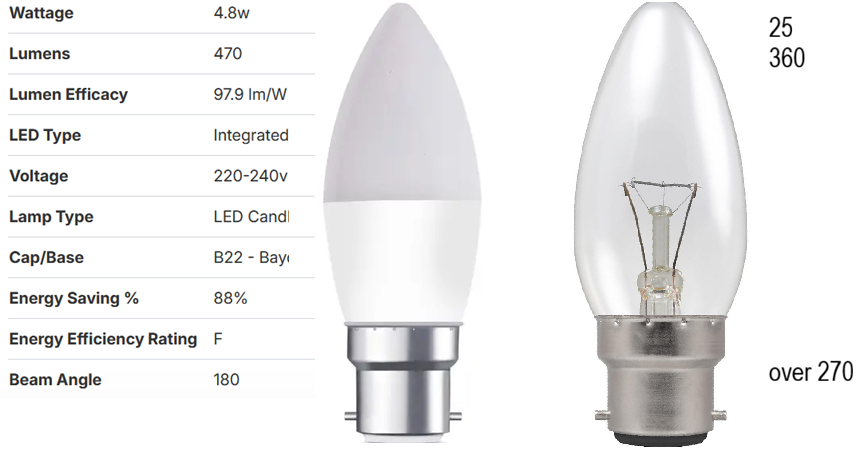
And I believe one drawback seems to be beam angles. for example comparing
We have a 5 fitting chandelier in our lounge
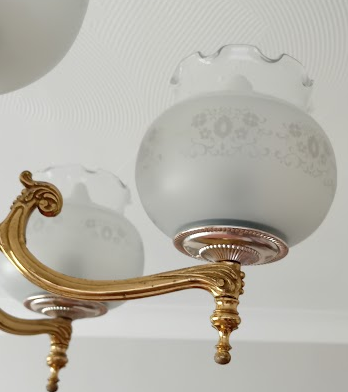 , originally we used 25W golfball bulbs as originally supplied with unit but they always had a very short life, eventually we had 2 blow at same time and fitted candle bulbs from stock. No obvious difference in light level and cheaper, they ran much cooler or rather the shades did and bulbs lasted longer - much longer, I concluded it's a ventilation issue.
Moving on and started replacing with LED, initially trying to do a colour match with the filament bulbs using 3.5W/2700K but far too dingy when all old bulbs had failed, we have worked our way up through colours and power to 4.8W/6000K.
The ratings shown are for the LEDs we have fitted and generic from internet for incandescent.
Yes sure we have a nice bright patch on the ceiling but the shade attenuates it soooo much there is very little to the sides and of course nothing below the horizontal. We also have some wall lights, similar sort of design but inverted, 7W and I'll guess around 5000K. We now habitually run with all lights on (52W) if it's anything requiring light (such as reading) and we tend to be in certain places for that where previously it would have been either/or and quite even.
Our hall lights have settled down, I think we got through about 4 or 5 full sets including expensive and highly recommended brands (>£3 each) in the first couple or so years but not yet had a failure in the current cheap things from Ebay in several years.
However it's not these sorts of styles of LED products I gripe about, I accept changes are afoot and it's where we are.
Comparing Fluo with LED is so different to incandescent and IMO at best it's a 1/2 rule but I still come back with lack of colour spectrum and beam angle.
And I believe one drawback seems to be beam angles. for example comparing
We have a 5 fitting chandelier in our lounge
Moving on and started replacing with LED, initially trying to do a colour match with the filament bulbs using 3.5W/2700K but far too dingy when all old bulbs had failed, we have worked our way up through colours and power to 4.8W/6000K.
The ratings shown are for the LEDs we have fitted and generic from internet for incandescent.
Yes sure we have a nice bright patch on the ceiling but the shade attenuates it soooo much there is very little to the sides and of course nothing below the horizontal. We also have some wall lights, similar sort of design but inverted, 7W and I'll guess around 5000K. We now habitually run with all lights on (52W) if it's anything requiring light (such as reading) and we tend to be in certain places for that where previously it would have been either/or and quite even.
Our hall lights have settled down, I think we got through about 4 or 5 full sets including expensive and highly recommended brands (>£3 each) in the first couple or so years but not yet had a failure in the current cheap things from Ebay in several years.
However it's not these sorts of styles of LED products I gripe about, I accept changes are afoot and it's where we are.
Comparing Fluo with LED is so different to incandescent and IMO at best it's a 1/2 rule but I still come back with lack of colour spectrum and beam angle.
Well, as you know, you can certainly count me out of that "everyone" - and, in terms of the discussants here, it's probably mikehammer, not me, that you should be 'engaging'Everyone keeps throwing this one-fifth figure around but I personally have never found it to be valid.

Having said that, if I understand correctly the comparison you show indicates a 5.2 : 1 ratio of Watts resulting in a 0.77 :1 ratios of lumens, which seems 'interesting'
I think it's bl**/y good the illuminating devices can't read the spec they're supposed to be working to, otherwise they'd all be having nervous breakdowns...Well, as you know, you can certainly count me out of that "everyone" - and, in terms of the discussants here, it's probably mikehammer, not me, that you should be 'engaging'
Having said that, if I understand correctly the comparison you show indicates a 5.2 : 1 ratio of Watts resulting in a 0.77 :1 ratios of lumens, which seems 'interesting'
Or perhaps they can read and they try too hard.
Well we certainly have reached the stage of a lot less electric required for lighting these days so that`s a good thing but it might take us another 50 to 100 years to get to the stage of knowing what lighting watts and configuration is best for what circumstances - "put the big light on" as that chap says 
That's what we all tend to think and say (and in some contexts it's clearly true).Well we certainly have reached the stage of a lot less electric required for lighting these days so that`s a good thing ....
However, if one is to believe what some people are saying in this discussion, and what the various specs say/claim, then it's not particularly true of a change from fluoro tubes to LEDs, since it appears to be being send that one needs much the same total Wattage (hence much the same "amount of electric" over a given period of time) of LEDs as one did with fluoro tubes to achieve a particulat degree of light output/illumination.
I'm definitely pretty confused!
Kind Regards, John
- Joined
- 17 Mar 2011
- Messages
- 1,075
- Reaction score
- 278
- Country
The major gain in lumens/watt seems to be from incandescent to led .As already said ,obvious enough when you upgrade bulbs.
Not so much from fluorescent to led batten as fluorescent was already fairly efficient
Way more light from a 2*58w fluorescent than a 120w incandescent lamp
Not so much from fluorescent to led batten as fluorescent was already fairly efficient
Way more light from a 2*58w fluorescent than a 120w incandescent lamp

- Joined
- 27 Jan 2008
- Messages
- 29,557
- Reaction score
- 3,638
- Location
- Llanfair Caereinion, Nr Welshpool
- Country
I must agree, last house, there was a gradual change, tungsten to CFL to LED, and part of the change was changing the fittings.Everyone keeps throwing this one-fifth figure around but I personally have never found it to be valid.
So living room, two ceiling roses, with 100 watt tungsten in each.
Moved to two 3 bulb chandeliers with either 40 or 60 watt bulbs, mainly as they came in packs, with a mixture, but 40 was a bit dim and 60 a bit bright.
Moved to 11 watt CFL which looked awful, so made a big mistake, changed to 5 bulb chandeliers, and 10 x 5 watt Philips globe CFL, which came on with a red glow and slowly got brighter, but the 50 watt was grossly inadequate, and the bulbs with an advertised life of 5 years+ did not last the year, we had also done dinning room to match, so 16 bulbs in all, and end of year only 10 left, used 6 cheap globe bulbs (SES) which were too big for shades in dinning area, and still the bulbs were failing.
So I had got two 1.8 watt LED candle bulbs from Lidi, as a test, and as a temporary measure they replaced failed 5 watt CFL, next batch Lidi got were 3 watt, so 8 more, all they had in stock.
The room looked a lot brighter, but realised this was colour temperature, as when I tried to read in the light I failed, mother also had 10 bulbs in her smaller room, so my bulbs reused in her house, and I got 5 watt LED bulbs to replace them.
So to recap.
200 watt tungsten did not look good.
300 watt tungsten worked well and looked good.
66 watt CFL did not look good, and sort of worked.
50 watt CFL not good enough, but looked OK.
27.8 watt LED not good enough, but looked OK.
50 watt LED this was OK. The bulb did poke out of shade, but OK.
So in real terms, LED can be ¼ size of tungsten.
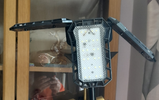
So then moved house, single ceiling rose in centre of room, would assume designed for one 150 watt tungsten bulb, the 100 watt not really bright enough. But only option was LED, this
 would have worked, at 48 watt, but looks hideous as a main light, so an 8 x 6 watt candle SES LED bulb chandelier, but it was not central so we had a dark side of the room, so we had fitted 5 Ikea Billy bookcases along the wall so fitted three LED strip lights
 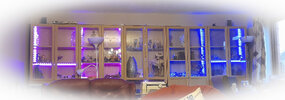 set to white, these could put out 60 watt, which would supplement the lighting, so 150 watt tungsten replaced with 108 watt of LED lighting, plus up lighters as you can see, so all in all no gain.
The problem with a mixture of light some from ceiling and some from the sockets, is walking out of the door and flicking the switch, does not turn them all off. So cure was to use smart lighting some socket adaptors, some smart lights, and a smart light switch, plus a pair of Google Nest Mini speakers, so hey google turn off living room lights, turns them all off.
However, if we were to add up the cost, it gets rather frighting, and we are using a variable amount of light depending on what we are doing, but running costs, LED has saved very little.
But move outside, we had to 150 watt quartz floodlights on a PIR, a bit useless, as PIR would switch them off at most inopportune moment. Replaced to three lamps, one on shed and two where the floodlights were, total 36 watts, controlled using smart bulbs and smart socket, and 100% better, not triggered by cats, squirrels etc. Don't switch off at inopportune moments, we turn on with phone, while in car, and off with a voice command, once in house, and they are better for security as intruders can't see the 5-foot sheer drops.
So using one tenth of the watts for outside lights. LED has worked very well, in the front of the house, we even turn the smart bulb green for Halloween.

DIYnot Local
Staff member
If you need to find a tradesperson to get your job done, please try our local search below, or if you are doing it yourself you can find suppliers local to you.
Select the supplier or trade you require, enter your location to begin your search.
Please select a service and enter a location to continue...
Are you a trade or supplier? You can create your listing free at DIYnot Local
Similar threads

- Replies
- 12
- Views
- 5K
