• Looking for a smarter way to manage your heating this winter? We’ve been testing the new Aqara Radiator Thermostat W600 to see how quiet, accurate and easy it is to use around the home. Click here read our review.

Loft insulation question

Joined
29 Apr 2012
Messages
291
Reaction score
0
Location
London
Country
United Kingdom
Hi, we have some fibre glass insulation on the loft however I am not sure if it can be improved
We are on a semi detached house with a standard pitched roof.

Should there be insulation "under the sloping section at the end". I don't know how to describe this properly but here are couple of pictures if it helps explain what I am trying to explain. Orange plastic on the picture shows current insulation in the floor of loft.

1000111720.jpg
1000111719.jpg
 
Normally board on inside 500mm up to stop insulation blocking off air flow.

You need vents in soffit to get the air blowing through
 
I can't make head nor tail of those pictures - but the insulation lies on top of your ceiling, the void above that should be well ventilated so no point insulating it
 
Could you add some labels to say what the surfaces are?

Is the dark grey board with a light grey top the soffit?

The loft insulation should meet the cavity wall insulation, to form a complete wrap around the house. It shouldn't overlap the outer wall, and there should be space to allow the air to circulate under the roof.
 
The insulation on the floor of your loft should be contiguous with the insulation in your cavity wall, otherwise you end up with a cold spot in the top edges of rooms where external walls meet ceiling boards, and that's where condensation and mold starts

Here is an explanation of the concept; it doesn't have to be implemented exactly like this, but this is a reasonable detail. See how the wall insulation and the ceiling insulation are continuous. You have to arrange it so that the ventilation to the loft space is not blocked by stuffing wool into the corner where it changes direction. There is no rafter drawn here because that would obscure the point being made; this is what you see if you slice your house in half between two adjacent rafters. The black thing is a device to ensure ventilation to the loft space is maintained

1733311940877.jpeg
 
Older houses don't have that vent board under the eaves, so you need to keep insulation well away from the corner. A cold(er) spot in the corner is just reality.
 
Not saying they do. I'm saying that ventilation must be maintained i.e. create something that achieves it
 
Thanks for your replies. I know photos were not adeaquate but it was the best I could do. The sketch shown by Robinbanks has helped me understand the ideal situation.

House doesn't have eves vent tray so I need to be careful as mentioned above. I can't see how or if the loft nsulation is upto cavity wall insulation so may just leave it as is and accept cold rooms especially in corner. Thanks.
 
House doesn't have eves vent tray so I need to be careful as mentioned above. I can't see how or if the loft nsulation is upto cavity wall insulation
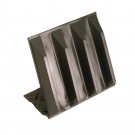
You could however, push refurbishment trays into the eaves, and fill behind with insulation, without blocking ventilation.

Example here...
1733348699057.jpeg


Hi, we have some fibre glass insulation on the loft however I am not sure if it can be improved
We are on a semi detached house with a standard pitched roof.

Should there be insulation "under the sloping section at the end". I don't know how to describe this properly but here are couple of pictures if it helps explain what I am trying to explain. Orange plastic on the picture shows current insulation in the floor of loft.

View attachment 365078View attachment 365079
The raked bit could be insulated (continuous) from below? This would afford you the benefit of alleviating rafter cold bridge whilst maintaining a venting gap. The venting gap will only be relevant however, if there are soffit or OFV's present.
 
The venting gap will only be relevant however, if there are soffit or OFV's present.

Are you sure? If there's no fresh air then perhaps there's more of a reason to let the air in the eaves mix with the rest of the air in the loft.

You don't want a closed-off space made of timber where condensation and perhaps the odd leak can gather. Especially not when that closed off space includes the ends of the timbers that hold the roof up.
 
Are you sure? If there's no fresh air then perhaps there's more of a reason to let the air in the eaves mix with the rest of the air in the loft.

You don't want a closed-off space made of timber where condensation and perhaps the odd leak can gather. Especially not when that closed off space includes the ends of the timbers that hold the roof up.
There needs to be decent airflow, as the OP has non-breathable membrane.
His best bet is to insulate from below, whilst adding a robust vapour check detail.
 

If you need to find a tradesperson to get your job done, please try our local search below, or if you are doing it yourself you can find suppliers local to you.

Select the supplier or trade you require, enter your location to begin your search.


Are you a trade or supplier? You can create your listing free at DIYnot Local

 
Back
Top