• Looking for a smarter way to manage your heating this winter? We’ve been testing the new Aqara Radiator Thermostat W600 to see how quiet, accurate and easy it is to use around the home. Click here read our review.

Main 'fuse' (RCD) tripping

It is not impossible that the overall picture gets further complicated by someone doing something daft too.
In my area I have noticed that some so called electrical contractors have noticed there that there appears to be no existing bonding.
Therefore instead they have taken an apparent short cut which could actually make the situation worse.
Existing has no discernible main , they directly Earth to connect to.
The original supply was TNS but it probably should now be considered to be more like TNC-S because of repairs subsequently carried out in the street nearby.
Anyway whichever type it actually is, there is (or does not appear to be) a main earth or bonding point.
So rather than taking Earthwires to create Main Bonding which might run thru a few rooms bonded the new pipework to an earth rod in the neaest part of the ground.
Result, the house might then have two different earthing systems with some "earths" attached to one and some other "earths" attached to the other and also not that much in the way of good continuity between those two earths - meaning you could have differing voltages between the two.
So some stuff could be on a TN system and other stuff on a TT system and be at differing voltages.
So any Earth Rod you might find may be one of those and not an original (which may or may not actually exist, it might have never existed or it might have been lost).
Really you need a decent Electrician with sufficient knowledge to take a look at your system.
 
From pictures, I assume a TT supply. 1760437415723.pngThe system relies on the RCD to work, as the earth loop impedance can be 200 ohms, in theory 460 Ω, but a value exceeding 200 ohms may not be stable.
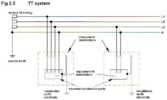
But the main point is, neutral can be up to 50 volts away from earth, so far easier to have earth to neutral faults which will trip the RCD. It is also important the RCD works as designed, as not secondary protection as with many homes, but the primary protection.

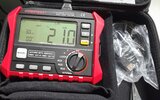
It is easy to test, with the correct tester RCD tester ramp.jpg I simply plug it in, select the test on the dial, and press the button, the problem is the testers cost upwards of £100, so cheaper to employ an electrician to do the testing, we are told with owner-occupier homes should be tested every 10 years, rental every 5 years.
I don't like saying get an electrician to test it, but in your case that does seem to be the best option.

 
Have you turned off the red 40A yet?
Hiya,

Yes, turned the B40 off first thing this morning. So far not detected anything not working (although I'm not in currently - will come back and confirm that this evening).

I'm happy to get an electrician in for a check. I may as well attempt via the guy whose name is on the stickers since perhaps he'll recall any specifics about this installation that may be pertinent.

Cheers all for your help so far :)
 
Have you bought or do you rent?

If you've got test stickers, there must be paperwork too.

Whether you have it of course is another matter!

As for the 40A breaker, it could be an outbuilding?

Cooker?

Shower?
 

If you need to find a tradesperson to get your job done, please try our local search below, or if you are doing it yourself you can find suppliers local to you.

Select the supplier or trade you require, enter your location to begin your search.


Are you a trade or supplier? You can create your listing free at DIYnot Local

 
Back
Top