One for the Old Sparks (maybe)

Joined
18 Nov 2005
Messages
282
Reaction score
1
Country
United Kingdom
Hello All,
I am doing some work on a bungalow, the wiring is very old and brittle,the house was rewired in 1952 the elderley owner tells me. My work involves an ensuite extension where i put radials to fusebox, never tapped into anything.

I had to remove a mirrored light that was on the main circuit, (new doorway) everything is run in steel conduit,
all the wiring only seems to have 2 wires, 2 wires at the switch, 2 wires at the old roses both singles.

I cut out the wire from the lights, 1 black wire was pulled from the switch, the other red was cut and terminated above the switch drop in the loft, now 2 lights in the house wont work.

This happened at end of play yesterday, so before i go back i am just looking for any pointers on how this
2 wire lighting circuit works and any suggestions, thanks all..
 
wiring in conduit is different , since it relys on the conduit for its earth and you do not loop in / out at light fittings.

you take the live to the switch (es) and loop her.

I would gues the red you cut off is the reason the other lights do not work
 
Thanks Breezer, like you said its not a system i am familiar with, any suggestions how to get things working again please?
 
Considering the age of the property and the likely corrosion the conduti has undergone in that time, relying on the conduit for your earth path alone is fraught with hazards.

I would suggest that perhaps you, if you know how, do a full PIR on the property as will highlight any deficiencies in the installation earthing and also whether there is a breakdown in the insulation resistance of circuit cables. To confirm no breaks in the conduit, it should be tested from point to point to ensure continuity of connection. ie, one leg at the board, the other at the furthest point of the circuit. But an Earth loop as a minimum is something that should be done as a matter of course.

Considering it was last worked on in 1952, there is a real chance that the cable is VIR (Vulcanised Insulating Rubber). Left alone this stuff is ok, although being so old a rewire should be considered for safety sake as the installation is now being worked on.

However it may be a different type, are you able to identify the cable?
 
BASEC have recently announced that, in their opinion VIR (Vulcanised India Rubber) or VRI (Vulcanise Rubber Insulated) cable is now beyond its acceptable life and should be replaced at the earliest opportunity, regardless of the apparent condition.

Considering that, in the eighties, twenty-five years was considered to be the normal life of an electrical installation, you could persuade the owner by explaining that s/he's had twice the expected amount of service, that a rewire is now well overdue.
 
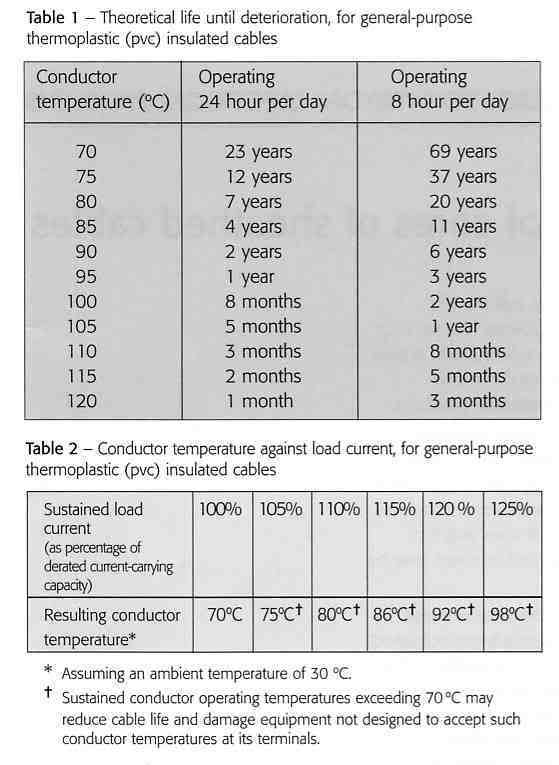
Not sure Ding, but that 25 years thing, that i'd guess would be meaning cables coming upto that age in the '80s? modern pvc is longer lasting, and there are some tables in one of the 'wiring matters' publications IIRC looking into how PVC cables age and expected life, thats not to say that an 80's installation would not need re-wireing, loads have increased since then

But either way, the 25 year thing, certainly applies to a VIR installation, but if undesturbed and the IR is ok, it can probably wait till at least after tea break :wink: (but shouldn't really be left for years, etc)

On the plus side for the OP, luckily as its steel conduit, a rewire shouldn't be too difficult :) , though it'll be imperial sizes, so any required alterations to it might be bit trickly, not sure how close the sizes are, whether you can force a metric thread on it and join to metric if need be :?
 
Adam, the expected life of VIR cable was 25 years. In the early eighties (when I first started messing about with property) PVC cable was still relatively new, so the general advice was to rewire every 25 years.

It is now accepted that PVC/PVC cable is good for forty years at least... but most installations are way out of date because of the massive increase in the use of electrical appliances. And many have been rendered unsafe by the do-it-yourself provision of those extra sockets. (Boy, do you have a treat in store when you get out there!)

Until recently BASEC's advice on VIR was to carry out no modifications and recommend a rewire at a convenient opportunity. Their latest pronouncement, however, is to the effect that VIR installations are now beyond their useful life and should be replaced as soon as practically possible.
 
I'm possibly wrong, but I thought the cable that was being intalled in the 80's was pretty similar to modern pvc... but most of the cable that was already installed was probably quite 'unstable'

PVC first came in in the 60's didn't it, and they started off using a pvc outher sheath with VIR insulated conductors, and then when they got that sorted out, they had the green slime issue, etc as well as the thing about conductors, metric/imperial, stranded/non stranded, alu/copper, but I thought by the 80's it had almost been all resolved :?

I know what kind of bodges are out there :lol: , I have seen them show up on forums often, I have sorted them sometimes, and can even recall doing some of them in my more ignorant days :oops:
 
Adam/Ding, PVC cables were first used in the mid 1950's and they had a shelf life of 25 years, as did the VIR type.

PVC cable is manufactured in a slightly different way now and is more UV stable and heat resisting over time, thus it's life expectancy has increased as a result, HOWEVER, the recommendation is still that an installation be rewired after a period of 25 years, although to be honest in a small cottage or similar installation there is likely no need unless cables are damaged or undersized.

Regarding the VIR, personally I always recommend replacing them, and I come across them often in old buildings being refurbed. So far I have never had a problem in this respect, but then I do not do domestic work anymore so recognise that a lot of clients may not be financially able to have a total rewire undertaken.
 
Seen this??

Cable-Life.jpg
 

If you need to find a tradesperson to get your job done, please try our local search below, or if you are doing it yourself you can find suppliers local to you.

Select the supplier or trade you require, enter your location to begin your search.


Are you a trade or supplier? You can create your listing free at DIYnot Local

 
Back
Top