• Looking for a smarter way to manage your heating this winter? We’ve been testing the new Aqara Radiator Thermostat W600 to see how quiet, accurate and easy it is to use around the home. Click here read our review.

Outside lighting tripping

In which case, I would be wondering if they were in the wrong job..
Ohhh I can assure you; I wasn't wondering and not only that I pressed that point home to the site manager.

He had run 2 * 3C&E along the route and the half he had been able to wire he'd swapped back and forth between wires within the cables, like he'd use 4 greys at one switch, 4 browns at another and the continuous strapper flipped colour at every switch. He must have got his willy in real state if he got his knickers in only half the twist he got the wiring in. I re-did it for the site manager as I stated (in writing, earlier in the day) we'd pull off site until it was done and we were already several days behind schedule to be in those rooms.
 
Although I agree with all of the above comments one really does have to take a step back sometimes and take a look at the inabilities of some recently qualified electricians, for a start a number either can't read or can't read English and the lack of understanding of Ohms law and power calculations is scary, several times I've been told I can't power 230V devices from 110V as they will draw double the current.

I assume I've posted about the 'best electrician on site' spending a day and a half attempting to wire about a dozen switched in a 2 way system along a corridor, that really was one I wish I'd taken pics of.
Recently, I was talking to a "qualified electrician" about electric shocks and I had to criticize where he said "I've got shocked from lighting circuits multiple times but luckily it was limited to 5/6A and I survived.

I had to remind him how much mA it takes to kill.
 
This all makes me feel like a scientist if this is an electricians problem and is struggling with it.
 
Although I agree with all of the above comments one really does have to take a step back sometimes and take a look at the inabilities of some recently qualified electricians, for a start a number either can't read or can't read English and the lack of understanding of Ohms law and power calculations is scary, several times I've been told I can't power 230V devices from 110V as they will draw double the current.
Quite, particularly when some sort of 'qualifications' can sometimes be very easy to acquire, even by people who have little understanding and little, if any, competence to do whatever they claim to be 'qualified' to do.

It obviously all wrong, unfortunate and unsatisfactory - but that's how it can be (and far from restricted to just electricians).
 
I think lacking understanding of the basic rules of electricity post training is one thing, but fault finding is largely learned by experience in the field.

Theory is all very well, but nothing beats practical experience.

IME, fault finding in the classroom was based on conventional installation methods, whereas real life, as we all know, is very different.
 
I would try not to be hard on someone asking for help, who may not have that experience.
 
I think lacking understanding of the basic rules of electricity post training is one thing, but fault finding is largely learned by experience in the field. .... Theory is all very well, but nothing beats practical experience.
I'm not so sure about that, particularly in relation to fault finding.

Whilst I agree that experience is a crucial factor, it is of limited value (in situations like fault finding) if one does not understand what/why one is doing. One can be very experienced in doing something 'cookbook style'.

One can learn repetitive 'mechanical' tasks, like installing a CU, choosing appropriate cable and device sizes etc. When it comes to fault finding, one can also learn what to inspect, and how to undertake tests, but interpreting the results of such inspections and testing in terms in order to identify of a fault can be difficult, or even impossible, if one does not have a reasonable understanding of underlying electrical principles - particularly if the fault is complex or unusual.
 
, I have had a look at what boxes I can get to and there is no sign of water getting in, does anybody have any ideas what could be going wrong

Might be water in one of the boxes you didn't look in, or some other connection.

More rarely, a cabie damaged by chafing or wildlife.

External lighting, look for water first.
 
Recently, I was talking to a "qualified electrician" about electric shocks and I had to criticize where he said "I've got shocked from lighting circuits multiple times but luckily it was limited to 5/6A and I survived. I had to remind him how much mA it takes to kill.
Indeed. In fact, even if it weren't for that "how much mA it takes to kill", it would still be wrong to think that a 5/6A OPD limits the current to 5/6A - as with any protective device, it limits the duration, not the magnitude, of current flow..

We see this quite often in relation to RCDs. It seems quite common, even amongst some 'properly qualified' electricians, to find people who believe that a "30 mA RCD" limits the current (e.g. through a person) to 30 mA - which it clearly does not do.

Turning to the more general issue of lack of understanding of basic electrical principles, I've often told the story about the (well 'qualified') electrician who "I showed the door" when he persisted in strongly insisting that an additional RCD was needed 'close to an electrical shower' because 'the RCD in the CU was quite a long way away, so any residual current arising at the shower 'would have become too small to trip the RCD in the CU by the time it got to it' !
 
One can learn repetitive 'mechanical' tasks, like installing a CU, choosing appropriate cable and device sizes etc. When it comes to fault finding, one can also learn what to inspect, and how to undertake tests, but interpreting the results of such inspections and testing in terms in order to identify of a fault can be difficult, or even impossible, if one does not have a reasonable understanding of underlying electrical principles - particularly if the fault is complex or unusual.

Nowt wrong with seeking a second opinion, once you have delved into a fault - but this OP seemed not to have a clue how to even begin investigating, what they described as a basically straight forward fault, in a straight forward circuit.
 
I have had senior moments, where something I should know, I have forgotten. Thévenin's theorem, for example, I had to Google "electrical theory beginning with Th" to find it. But after that I realised it was Norton's Theorem I was thinking about.
OK, this is a bit more run-of-the-mill, but sometimes one simply misses the point, I have had a report of a socket not working, and assumed they had already checked the MCB.
One looks at a typical garden system 1743761972555.pngso we go armed with the clamp-on, and we find this 1743762172146.png and realise there is no way I am getting my jaws around any wire in that box. Also, faced with these 1743762501570.pnggood as I am sure they are, getting test probes in them to find the problem is not the easiest of tasks. I am more into the homemade approach 1743762665814.png but here in Wales that is an expensive route to DIY within the law, the whole idea of the Blagdon system was to get around the Part P law, the bit about outside being a special location may have been removed in England, but not here in Wales.

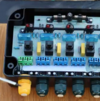
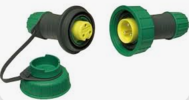
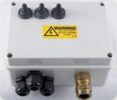
So they look good, 1743762939369.pngbut the whole idea is plug and play, so the DIY guy does not make any connections, which leaves us with a problem.

Often assembled without petroleum jelly, and the plugs and sockets are not going to undo without damage, so although the split in half normally works, and find which half is OK, often it is a case of split where it will split without damage.

I know with this type of outside lamp
1743765800821.png
one small strategically hole can stop the build up of water in the lamp, the heat of the halogen tube, will force air out, and when it cools draw in any water which capillary action will place around the seals, only needs 1/16th inch hole and air and water go in out of bottom, and it does not build up in the lamp.

 
Nowt wrong with seeking a second opinion, once you have delved into a fault -
Of course there's nothing wrong with that. That's what 'we' (including the most clever and most competent amongst us) sometimes have to do. A 'new pair of eyes' often works wonders
but this OP seemed not to have a clue how to even begin investigating, what they described as a basically straight forward fault, in a straight forward circuit.
Exactly.
 

If you need to find a tradesperson to get your job done, please try our local search below, or if you are doing it yourself you can find suppliers local to you.

Select the supplier or trade you require, enter your location to begin your search.


Are you a trade or supplier? You can create your listing free at DIYnot Local

 
Back
Top