
Padstone on outer wall

Joined
30 Jul 2025
Messages
13
Reaction score
0
Country
United Kingdom
Hi

In situations where a side extension is being built, I have seen a number of plans where the padstone appears to sit on the external wall of the existing house (and then the other end of the steel sits supported on the new internal skin at the other end)

In these scenarios, is the fact that the padstone is allowed to be built into the external wall (rather than the load bearing internal wall) as a result of SE calculations to show that the existing foundations are satisfactory? or are other factors used to determine that this is satisfactory?

Cheers
G
 
In a typical house the outer skin is brick so stronger than the inner skin, usually lightweight block. Both sit on same foundation.

So the answer to your question is yes. FWIW we rarely consider the foundations at all unless we're dealing with proper big steels.
 
Hi

In situations where a side extension is being built, I have seen a number of plans where the padstone appears to sit on the external wall of the existing house (and then the other end of the steel sits supported on the new internal skin at the other end)

In these scenarios, is the fact that the padstone is allowed to be built into the external wall (rather than the load bearing internal wall) as a result of SE calculations to show that the existing foundations are satisfactory? or are other factors used to determine that this is satisfactory?

Cheers
G
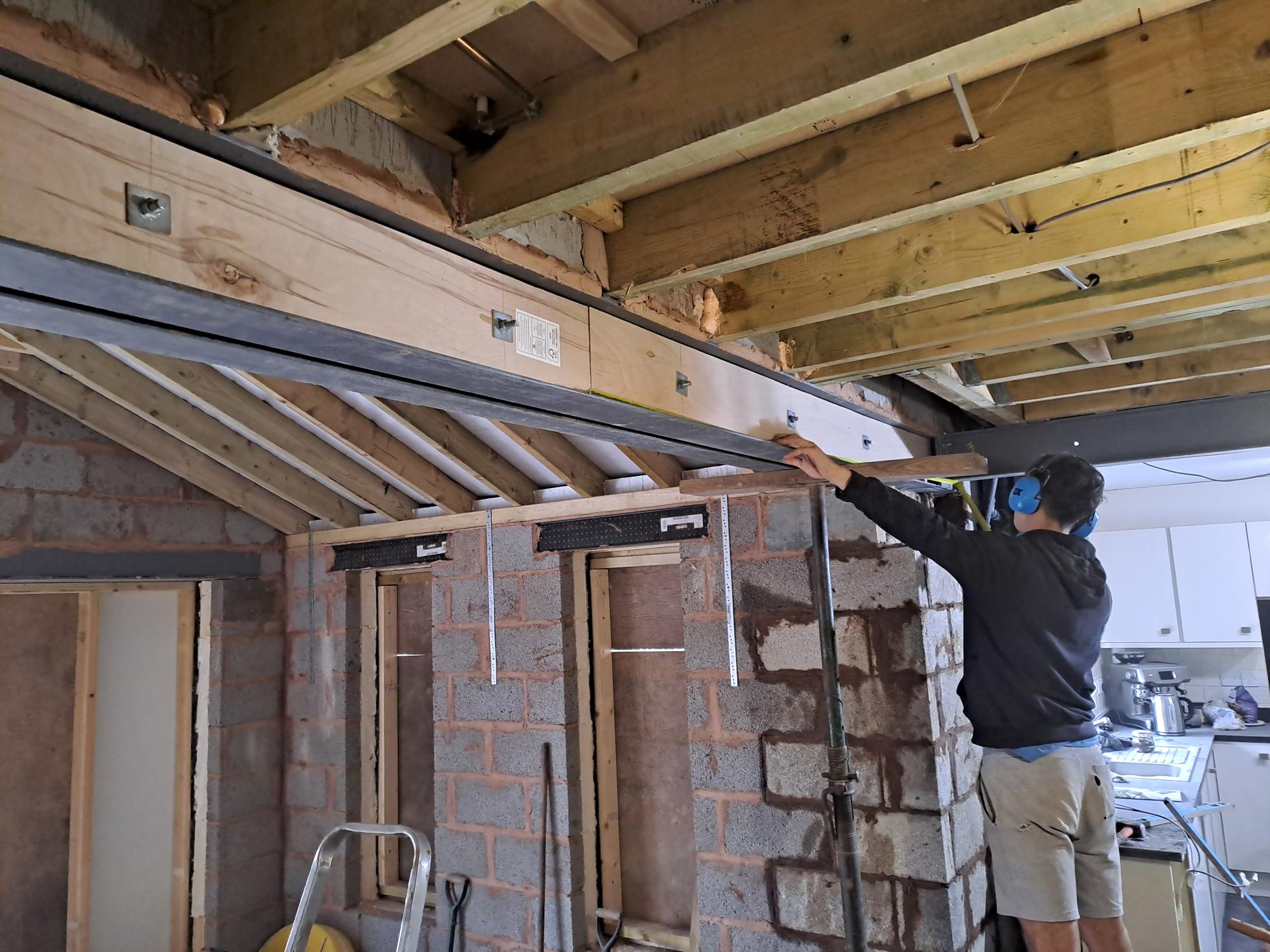
Both walls sit on the same foundations. The only difference being load wise, is the brick outer skin often possesses a better crushing/impact strength than the inner blockwork. Seems like an odd concept considering the inner leaf carries the greater load. In wholly block built rendered structures of course, the issue is moot.
 
Thanks both, replies much appreciated and makes sense now!

Yes my outer skin is brick and steel will be around 4.3m long, so the pad stone sitting on the external wall makes sense


One final question, will it be the SE who also designs the load bearing pillars for the other end of the steel to sit on?
(From initial research looks like these would be built on pad foundations, but are these columns generally built out of engineering bricks for instance)

Just trying getting my head around things before I find a SE to calculate all this.

Cheers
G
 
That decision comes from the engineer, not just a rule of thumb. They check the load path, wall type, and foundation size to see if the existing external wall can take it. If it can’t, they’ll usually call for a spreader plate, a pier, or a post down to new footing.
 
Thanks both, replies much appreciated and makes sense now!

Yes my outer skin is brick and steel will be around 4.3m long, so the pad stone sitting on the external wall makes sense


One final question, will it be the SE who also designs the load bearing pillars for the other end of the steel to sit on?
(From initial research looks like these would be built on pad foundations, but are these columns generally built out of engineering bricks for instance)

Just trying getting my head around things before I find a SE to calculate all this.

Cheers
G
Steel end bearing piers or column design will be sorted by the SE. Stand alone masonry columns we have built out of both brick and block. On a couple of aerated block jobbies we did recently the engineer (same for both jobs) insisted that the masonry immediately beneath the steel bearing zone be 7n blockwork even though the remaining blockwork was 3.5n


The SE follows a logical path here.

First he determines the loads acting and this together with the opening width determines the beam size.

Next step is to ensure that the bearing stress under the end of the beam is less than the allowable for the material it's sitting on and this is uually a concrete padstone either plain or reinforced (I favour sections of PSC lintel), but may be a steel bearing plate or a section of engineering brick.

Next he looks at the wall under the beam end to make sure that is strong enough. Oftentimes this will be a pier left over by the removal of the adjoining wall. This can be analysed to justify what is proposed (sometimes we'll rebuild a pier with stronger brick) but there are guidelines within the building regs of 1/6 of the opening with a minimum IIRC of 760mm. This is effectively a deemed to satisfy.

Removing an external wall (and some internals) the pier remaining has to be assessed for its buttressing effects on the remaining walls so sometimes a steel "goalpost" will be required which will provide lateral support as well as the obvious vertical.

When steels are added they will have their support assessed: the existing foundation may be enough as is, or perhaps a section of beam will be added as a spreader, or perhaps a new pad foiundation.

What is important is that the SE give consideration to how the pretty drawing will be put together on site when the pair of lines on the computer screen go exactly where they're told are large, heavy, unhelpfull lumps of steel.

Finally a bit of judicial thought can sometimes allow for a smaller span (a post hidden inside kitchen units for instance) which makes life a lot easier. A 10% increase in span requires approx 50% increase in beam strength.
 

If you need to find a tradesperson to get your job done, please try our local search below, or if you are doing it yourself you can find suppliers local to you.

Select the supplier or trade you require, enter your location to begin your search.


Are you a trade or supplier? You can create your listing free at DIYnot Local

 
Back
Top