Plastic KETER sheds

Joined
6 Jan 2018
Messages
14
Reaction score
0
Country
United Kingdom
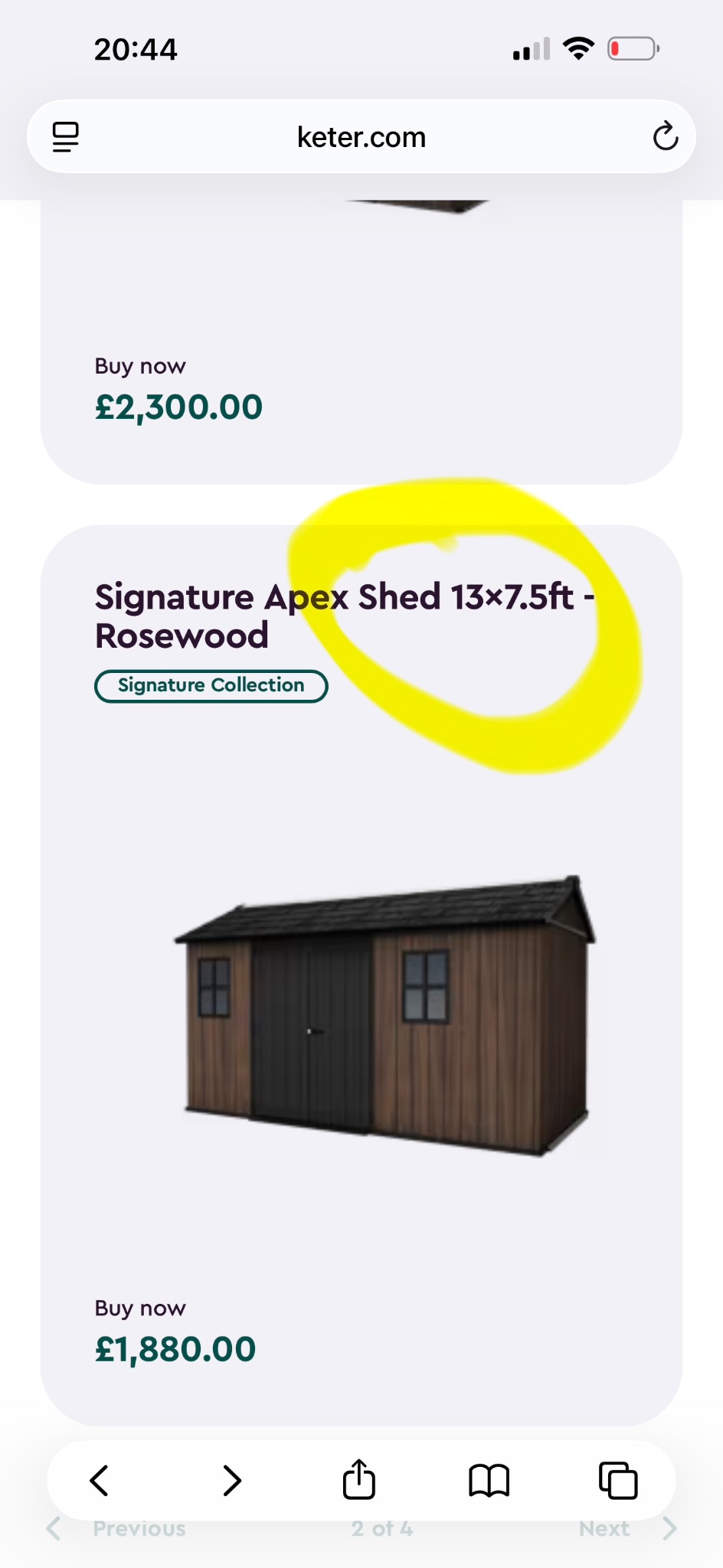
I’m thinking of getting a plastic/Keter-style shed, but I would need to install electrics as I want to keep a freezer in there and also have a light.

Has anyone had a socket and light installed in a plastic shed before? Is it practical and safe long-term, especially with a freezer, or would I be better off getting a wooden summerhouse/log cabin instead?

I’d really appreciate any advice or experiences.
IMG_4072.jpeg
 
My "plastic shed" though not Keiter was not very strong structurally and had to be reinforced to cope with high winds. You may be OK in a sheltered location. It also suffers a lot from condensation which make tools and other ferrous products rust quickly. You may have the same problem with appliances. No other particular reason why you should not have socket and lights installed as long as it is done properly.
 
My shed 1781779609321.png I brought the SWA up into an outside socket and other side of the shed skin is an inside socket box and socket, so rather than screwing into the shed skin, they pull against themselves.

Also means it enters the shed high up, so less likely a way in for creepy crawlies.

For a freezer ensure there is not too much volt drop.
 
We have a Beko chest freezer in the attached unheated garage which is designed to be used in unheated outhouses down to -15°C.
 
We have a Beko chest freezer in the attached unheated garage which is designed to be used in unheated outhouses down to -15°C.
Yes, a bit odd there is a minimum temperature, I'd have thought the colder the ambient the less work for the freezer! But apparently not. Minimum varies between brands, deffo worth checking before buying. OP's shed likely to get cold.
 
Yes, a bit odd there is a minimum temperature, I'd have thought the colder the ambient the less work for the freezer! But apparently not.
I'm no expert in these matters but is not at least part of the issue related to the fact that the sort of refrigeration appliances we're talking about depend upon 'phase changes' - i.e.. repeated changes of the refrigerant from liquid to gas and then back to liquid again - 'absorbing' ('latent') heat when it goes from liquid to gas (within the fridge or freezer) and then 'releasing' that ('latent') heat when it next goes from gas back to liquid (outside of the fridge or freezer). It is a combination of temp and pressure that governs those phase changes.

That being the case, if the ambient temp outside of the fridge or freezer is too low, then the compressor may not be able to increase the pressure enough to liquify the gaseous refrigerant - so the 'cooling cycle' will grind to a halt.

However, as said, I'm no expert, so may be wrong - but what I've just suggested seems to make sense in terms of basic physics.

I can but presume that if one wants an appliance which will work satisfactorily at low ambient temps one probably has to either use a refrigerant with a lower boiling point (for a given pressure) and/or have a system capable of generating and using higher pressures?
 
I'm no expert in these matters but is not at least part of the issue related to the fact that the sort of refrigeration appliances we're talking about depend upon 'phase changes' - i.e.. repeated changes of the refrigerant from liquid to gas and then back to liquid again - 'absorbing' ('latent') heat when it goes from liquid to gas (within the fridge or freezer) and then 'releasing' that ('latent') heat when it next goes from gas back to liquid (outside of the fridge or freezer). It is a combination of temp and pressure that governs those phase changes.

That being the case, if the ambient temp outside of the fridge or freezer is too low, then the compressor may not be able to increase the pressure enough to liquify the gaseous refrigerant - so the 'cooling cycle' will grind to a halt.

However, as said, I'm no expert, so may be wrong - but what I've just suggested seems to make sense in terms of basic physics.

I can but presume that if one wants an appliance which will work satisfactorily at low ambient temps one probably has to either use a refrigerant with a lower boiling point (for a given pressure) and/or have a system capable of generating and using higher pressures?
I don't know if relevant but one of the problems with single unit aircon chillers of the style designed to fit through a large hole in the wall with minimal protuberance both sided has been the radiating matrix has insufficient heat to prevent frost forming and a big block of ice will form preventing the fans airflow. possibly even building sufficiently to stall the motor.
This can happen very quickly in the winter when the sun stops shining on the unit.
 
I don't know if relevant but one of the problems with single unit aircon chillers of the style designed to fit through a large hole in the wall with minimal protuberance both sided has been the radiating matrix has insufficient heat to prevent frost forming and a big block of ice will form preventing the fans airflow. possibly even building sufficiently to stall the motor.
This can happen very quickly in the winter when the sun stops shining on the unit.
That may well be true (I have minimal experience of aircon) but, if it is, it's obviously a totally different issue from the interference with the 'refrigeration cycle' I was talking about.
 
£1900 seems very expensive for a plastic shed that as JJ said are not very strong. A wooden one would be my choice.
A lot depends on the shed. A while back a friend purchased a property which had a plastic workshop which was basically a decent garage sized structure. The main issue with it was the galvanised steel base plates had rusted, however over the years various botches had been attempted to keep it stable there was other damage. When he contacted the supplier (by adding a '1' to the phone number on the plate) to see if parts were available they immediately identified the delivery date which was something like 25 years before.

The system was still current and they were able to supply any parts but doing the assessment of work involved to support a whole side remove and replace the wall then the costings it wasn't much easier and actually not much cheaper than replacing it. The driver mentioned the base was bigger than the structure so the water ran under the corrugated cladding so recommended using a damp course.

Rather than rip the old building down due to the equipment still inside it we carefully unscrewed and dismantled it then erected the new frame on the edge of the base as the instructions showed but as the base is about 4ft wider than the building that only dealt with 2 sides. Over a COT we started pondering using the old parts to build an additional much smaller shed which turned into extending the new building to the width of the base. Sorting through the old parts we had enough usable baseplate bits to create the pair of 4ft's so moved the new baseplate 4ft to the edge and fixed those middle uprights with L brackets to the base. There were plenty of roof parts to re use and uprights to cut off the rusted parts to new height (The extended side was simply a whole side of old parts cut down to something under 6ft to continue the roof line sitting in a new baseplate). We used all new panels for the roof, starting at the back as instructed and getting near the front we realised there was no reason we shouldn't add another old 3ft 'bay' by repositioning the new corner posts/door frames further forwards. We ended adding something like 1.5 bays on one corner and nearly 2 on the other corner which took it right to the front of the base. Cladding the sides meant using a lot of the old panels so there was an element of screwholes in wrong places and we finally bit the bullet by ordering I think 3 or 4 panels and a gutter section (This is a 'special part' to cope with roof panels being cut out of square where corrugations stop part way along the panel and replaces the facia parts) also a door part to remake one of the old doors rather than panel in the front of the 4ft extension (which in hindsight was probably silly as I suspect it has not not been opened since). Plus some baseplates as there was still quite a pile of bits laying there which did become a 'garden shed.

I'll say this happened about 20 years ago and cost something like £800-900 other than some incidents of physical damage (Branch blowing off a tree in high wind, things falling against the cladding from inside etc) it is still in excellent condition, strips were added around the doors to improve weatherproofing and the shed was fitted with a used double glazed UPVC door to make it more weatherproof.

Probably about the same time another friend purchased a 6x4ft plastic shed for something like £30 and it has been replaced at least twice where the panels degenerate in the weather, very recently I purchased a 5x3 of the cheap variety (to house radio equipment) which was £200 but is has been reinforced by banging steel angles into the ground and the whole thing has been 'painted' with a flat roof rubbery compound which so far looks to have been a good choice


When the second delivery was made the driver took lots of pics of the conversion of what I assume started as a 24x15ft garage to ~29x19ft and it was framed on their office wall as a custom build

The original company ceased trading in 2020

As to prices; if a cheap 6x4 was £30 and the biggy was £900 that's 30x
If it's now £200 then the biggy would be £6000 and OPs quote is £1900 for something 1/4 of the size seems to be about right to me for a better quality shed... oh and vastly less maintenance than a wooden shed.

 
Last edited:
That may well be true (I have minimal experience of aircon) but, if it is, it's obviously a totally different issue from the interference with the 'refrigeration cycle' I was talking about.
Indeed and I'll add I'm a controls person not HVAC trained
 

If you need to find a tradesperson to get your job done, please try our local search below, or if you are doing it yourself you can find suppliers local to you.

Select the supplier or trade you require, enter your location to begin your search.


Are you a trade or supplier? You can create your listing free at DIYnot Local

 
Back
Top