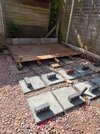
preventing a shed base from rotting, engineering bricks ?

So we started saying that a plastic DPC would cause rotting, but now we're looking at various other forms of plastic?

I thought the engineering bricks were a pretty good idea. Slate possibly better IMO. Shims would eventually sink into the wood, they're too small. Anything plastic that's flat and sheet-like will encourage rotting.

The problem with a plastic DPM is that it is typically wider than the timber. Additionally, it is very thin. We have no way of knowing how much standing water there might be when it rains.

I see your point about shims sinking into the wood, but I have never experienced that and I have used them for 4-5m long log cabins (2.4m tall). That said, I have only installed a couple, but they weigh much more than a regular shed.

If the OP were to use the glazing shims that I linked to, I would recommend putting them face up (i.e. the smooth face up). Additionally, place the shims perpendicular to the timber, trimming as required and using a sufficient amount (i.e. next to each other).

I am a tad confused though... earlier you said that engineering bricks were not suitable because of the timber shrinking into the holes in the bricks. I agree that slate would be fine, but it needs to be cut so that it is thinner than the width of the timber. IMO plastic shims would be easier to work with. The shims in my first link are available in varying thicknesses. Slate will be more uniform in thickness.

I could be wrong though.
 
Thanks but want to avoid the work and cost of putting a concrete slab down. I have to fund a 2 story extension after moving the shed

If you’re worrying about the cost of a shed based suggests you don’t have a realistic budget for your extension plus contingency
 
If you’re worrying about the cost of a shed based suggests you don’t have a realistic budget for your extension plus contingency
Err I don’t want to put a slab down because it’s not necessary, ott, expensive and time consuming. I’ve worked in the construction industry 42 years self employed 37 years. There’s multiple successful ways of doing just about everything if you have the inclination to plan ahead and use your initiative. Also it’s good to use what you have available instead of wasting money. I’m not sorry if you don’t agree and frankly perplexed by your thought process to bother to make that comment on a diy help forum
 
If you're not having a ground slab, you will need a shed floor, and to raise the whole shed off the ground.

It can be done with dwarf walls, or you could lay paving slabs and space your bearers off them. This will not be as stable.

The base or paving will be damp, but position it inside the footprint of the shed so rain cannot fall on it. Use gutters and downpipes to prevent rainwater from the shed roof collecting round the shed. You can run DPC to separate the timber from the base, but it must be done so that water cannot lie on the DPC strip

Rainwater will splash up, and wet weeds or grass will make the bottom of the shed walls wet. You can use a protective sacrificial skirting, spaced off.
 
Wood is porous. Even if the plastic is narrower than the wood, the water will still get through the wood and sit on top of the plastic, within the wood. If you put a 3" strip of plastic under a 4" width of wood then that middle 3" of the wood will be wet underneath.

Slate will stop rising damp, but isn't totally waterproof. If water sits on top of it then it will eventually wick away.

Get some old roofing slates, they'll cost next to nothing. Cut them to whatever width strip you want with an angle grinder.
 
Wood is porous. Even if the plastic is narrower than the wood, the water will still get through the wood and sit on top of the plastic, within the wood. If you put a 3" strip of plastic under a 4" width of wood then that middle 3" of the wood will be wet underneath.

Slate will stop rising damp, but isn't totally waterproof. If water sits on top of it then it will eventually wick away.

Get some old roofing slates, they'll cost next to nothing. Cut them to whatever width strip you want with an angle grinder.

Presumably the timber stretchers for the base will be protected from rain and will only get wet because of standing water.

Perhaps the OP can clarify.
 
The only waterproof wood I've ever seen was on a wood kayak. That had multiple coats of epoxy and varnish, it looked like woodgrain coloured plastic.

All wood absorbs water, unless it's pickled in plastic. Shed paint is little more than colouring these days. It used to contain toxic stuff to kill the rot but most effective ingredients have been banned now. I painted our fence with B&Q's finest a few years ago. You could see where a snail had eaten it all along its path shortly after. You might as well use gravy granules.
 

If you need to find a tradesperson to get your job done, please try our local search below, or if you are doing it yourself you can find suppliers local to you.

Select the supplier or trade you require, enter your location to begin your search.


Are you a trade or supplier? You can create your listing free at DIYnot Local

 
Back
Top