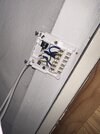
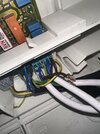
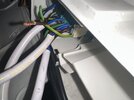
In general, there are two ways to zone central heating. One to use zone valves, as one would have done before the days of the modulating boiler, which gain the latent heat from the flue gases, and two in the main far better idea, is to use the TRV (thermostatic radiator valve) with electronic heads, so each room becomes its own zone.
It seems rather pointless to use both, the main advantage with the electronic head on a TRV, is it is analogue, so it slowly opens and closes, so the boiler which is also analogue, can also increase or decrease output to suit.
Unless using a connection to the boiler's ebus, using Opentherm for example, wall thermostats tend to just switch on/off, so we are left with a system which does not really work as efficiently as it should, and one can debate until the cows come home, as to what is really the best method.
If a wall thermostat turns on/off twice a day, no problem, but if it turns on/off 20 times an hour, then clearly there is, and the old method to stop an area overheating was to use a mark/space system, where, as the room approached the target, the thermostat would turn off/on slowly increasing the off time, to prevent a hysteresis, but these very clever thermostats with today's boilers, completely mess up the boiler's software which is trying to modulate the boilers output.
We also have a problem where the radiator is on an outside wall, as the TRV is colder than the room in general, until heating turns on, so sometimes we need wall thermostats due to where the radiator is.
So the likes of Drayton Wiser with all linked TRV heads and no wall thermostats can work A1 with one home, but can fail with another, in other words there is no one system fits all. An engineer is someone who in the main is more educated as to the tradesman, in the main he has gone to University and has over level 3 qualifications that one would get going to collage, and as a result he wants paying for his skill, but in the domestic market we are in general not willing to pay for an engineer, in fact we often use someone not even trained as a heating and ventilation guy, and select a plumber or electrician instead.
Even worse still, we try to DIY, and the control of the central heating system, can, if done correctly, half the fuel bill.
I as an electrical engineer have to admit I have made many mistakes working out of my skill set, I am not a heating and ventilation engineer, and I have clearly read old books, not the up-to-date books, and made mistakes like heating the DHW with oil, which is more expensive in the main to use electric in the summer.
Also, one has to look at near enough engineering, if fitting a XYZ with cost the same as a tank full of oil, it will take a very long time to get one's money back, so we can look at the super systems available today
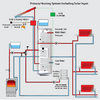
but when it costs £12k to fit it, it is clearly only an option with a new home, it is not really a system one can consider for an existing home. Personally I would use PV solar panels not water type, but point is, there is a limit to how much one wants to spend on the heating system.
The other point costs change, 2019 when I came to do this house, an eQ-3 electronic TRV head was costing me £15 each, now nearly double the cost, but cost of a Wiser TRV head has dropped, so would not repeat what I have done, if starting again. I have also been led astray, where the internet told me Energenie TRV heads would work with Nest, that is not the case, or at least not Nest thermostats, it does work with Nest Mini speakers (similar to Alexa) but they do not link as expected.
I have learnt from this forum, the Honeywell EvoHome uses the mark/space control if not using OpenTherm, it is an old system, so not surprising, but Hive a few years ago did not have an OpenTherm option, it does now, and it would stop taking a demand for heat if wall thermostat was over 22°C, don't know if that has changed.
So I have got programmable TRV heads in all rooms in the main house, not the flat under the main house, and I have one room with a linked TRV head, and three wall thermostats two in main house, one in flat. It is not a perfect system by any stretch of the imagination, but it is near enough. And the only way I found out what does not work, is I tried it first, so it cost money using stuff which did not do what it said on the internet, and I will admit my Nest Gen 3 thermostat is rubbish when compared to the Wiser system.
But I fitted Nest as son had fitted Nest, and told me how good it was. People are loathed to admit they have made a mistake, also the home fitted in changes things, my last house, open plan, heating worked A1 with single thermostat, however was a smaller house to this one, used gas not oil, and heating cost twice as much to run, as to why, we this house in a valley and last house on the top of a hill, this house has internal doors, last house open plan, so what works in one house maybe rubbish in another.