Quick check please guys

Status
Not open for further replies.
The reality is that it is the IEE who is giving this advice. I presented an example of applying diversity to a post which appeared not to have considered diversity.

As far as diversity is concerned, is more diversity applied anywhere than on a socket final circuit?

To worry, without engineering facts, about diversity seems pointless.

The potential for overload is never greater than on a socket final ciruit. So how much diversity is 'assumed' on the average socket final circuit.

The IEE explicitly state that the rating of a cooker circuit is determined by the assessment of the current demand in accordance with Table 1A.
 
And the Bible says God created Adam & Eve who had 2 sons, Cain & Abel.
Where did their wives come from?

The IEE is not gospel it is advisory.
Woe betide you if you take no notice of that advice but as I said earlier, err on the side of caution.
 
I'm not doubting what it says in the OSG but would this be a typical 6.2kW cooker installation for you? Would you walk away happy?

You can't compare this to 'tight' shower circuits as a correctly designed circuit would have a design current less than the rating of its OPD. Even if it's 1 Amp, it's still within spec and will never overload if the circuit is electrically sound.
 
You can compare because that it what the IEE are saying you can do. Either you agree with the principles of diversity or you don't.

The 6mm cooker circuit is a throwback to the days of old. The usual excuse is for future upgrading. But anything can happen in the future. The future is likely to bring about reduced loads if anything.

There is plenty of slack in the OSG design advice. Plenty of slack in cable design. So plenty of slack and erring on the side of caution all round.

I understand what you are saying, but I wonder how much of it is due to the 'herding' principle and harking back to the good old days?

For the record, I wouldn't install anything less than 2.5mm (Ref methods permitting). It is economical as it's tied in with socket final cable purchasing. But then, I seldom install anything greater than 2.5mm unless it's a CCU with a socket outlet (ref methods permitting).

As an aside, I generally don't approve of 1mm cable even for lighting. The reason is that in my opinion it is too delicate for general house bashing plus I've seen too many over-tightened connections with 1mm.
 
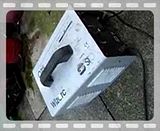
Use 1.0mm, over-ride the thermostats for each element, turn all rings, grill and oven full on and see how long it takes for the fireworks to start!!

Gwon, gwon, you know you want to!! :lol: :lol:

I did :D


Clicky:

 
Why are you accusing the IEE of not being sensible?
I'm not - I'm asking you if you think it would be a sensible design.


Can you base an answer on engineering?
For how long will a B16 pass 26-27A?


If you came across it on a PIR, for example, what would you do?
Give it a 2.


And what would you do if the person ordering the PIR took the issue further?
Point out to them that they'd engaged me to provide my professional expertise. It's up to them what they do with any advice I give.
 
RF,

my point exactly. Put that under someones floorboards, take away the sound of the welder and imagine all the dust, shavings bits of paper etc and you have a time bomb!

1min 14seconds! :shock:
 
1min 14seconds! :shock:
So probably ..

Probably....how very scientific :lol: :lol: :lol:

Has anyone actually bothered to clamp their cooker circuit yet? Perhaps few have clamp meters :)

And if we are going to do 'experiments', let's stick to something like for like please. Otherwise serious people will just laugh. :D :D :D

And someone please offer an objective argument against the IEE, based on engineering :)
 
I am happy to use diversity for cooking appliances. However, I would still always use 6mm as a minimum. I tend to think of the diversity arrangements being there for the obscenly large cooking appliances used in domestic dwellings.
 
Probably....how very scientific :lol: :lol: :lol:
Why the laughter?

"Probably less time than..." is a valid observation to make.

If you were asked to install a circuit to supply a 6.2kW cooker, would you put in 1.0mm² on a B16?
If you observe something, you note it - you don't say 'whilst I was observing, such and such probably happened, but I have no idea if it actually did or didn't'. :lol:

Why are you accusing the IEE of not being sensible?
I'm not - I'm asking you if you think it would be a sensible design.
Why do you think the IEE OSG in not sensible?

Can you base an answer on engineering?
For how long will a B16 pass 26-27A?
The IEE have deemed it to be long enough. Hence their explicit guidance on the matter in App. 8 and Table 1A of their OSG. Do you have any empirical evidence regarding the actual current whilst a cooker is switched on and then every function is turned on?

If you came across it on a PIR, for example, what would you do?
Give it a 2.
So, for a circuit which complies with the Design criteria of App. 4 and the requirements of Chap. 1 to 6 of BS7671 and complies with the explicit guidance of App. 8 ch.8.4 and App.1 Table 1A (diversity) of the IEE OSG, you would give a Code 2 on a report which you have signed to declare has been carried out in compliance with BS7671?

Which comment or observation would you associate with the Code 2?
 

If you need to find a tradesperson to get your job done, please try our local search below, or if you are doing it yourself you can find suppliers local to you.

Select the supplier or trade you require, enter your location to begin your search.


Are you a trade or supplier? You can create your listing free at DIYnot Local

 
Status
Not open for further replies.
Back
Top