- Joined
- 13 May 2026
- Messages
- 3
- Reaction score
- 0
- Country

Working my way through renovating a Victorian terraced house atm, and have progressively discovered issues with the floors in every single room. Nothing too crazy so far with most of the joists - replacing some rotten ones here, jacking up and sistering some sagging ones there - but the final upstairs bedroom has me scratching my head.
The overall floor area involved is exactly 3m wide, and around 7m long. It was originally split into a bedroom and a box room, but at some point a previous owner converted the box room into a shower en suite for the bedroom, and of course that's been leaking for years and now a bunch of the joists are rotting away and need replacing. I've taken everything out, including the stud wall between the two rooms, so I could lift every floorboard and check everything over. Why not, right? Only going to do this once, plus it gives me a chance to level everything off since the whole thing is about an inch and a half higher on one side than the other (which is very noticeable over 3m).
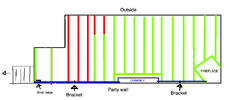
The joists are old 7x2s at an average of 12" centres (the spacing is wildly inconsistent), spanning the 3m width. Here's a diagram I made with my best primary school-level art skills:
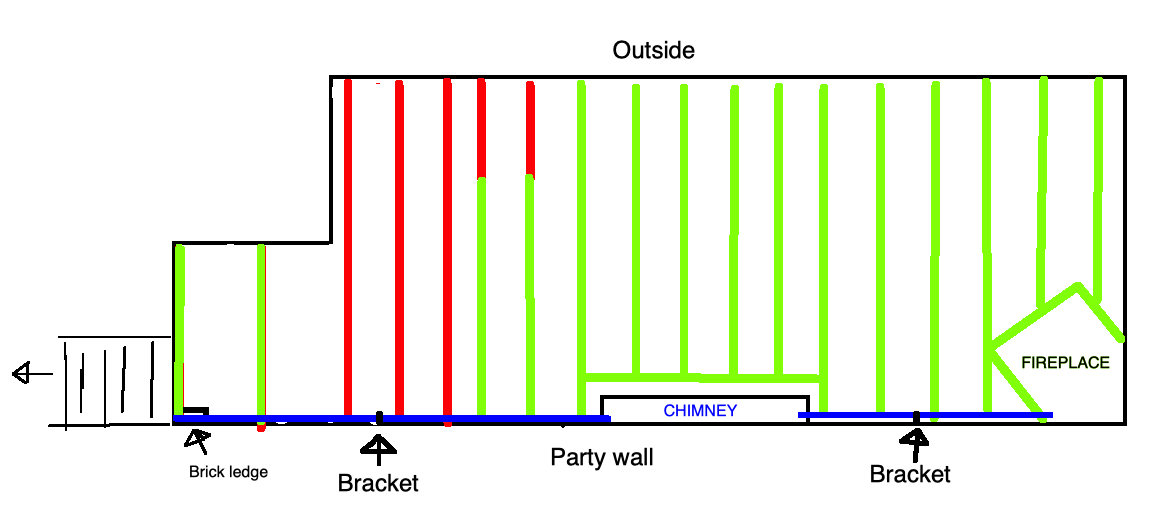
Red indicates rotted timber, green no rot, and there's a trimmer going around the chimney. Both sides of the room have some questionable design choices:
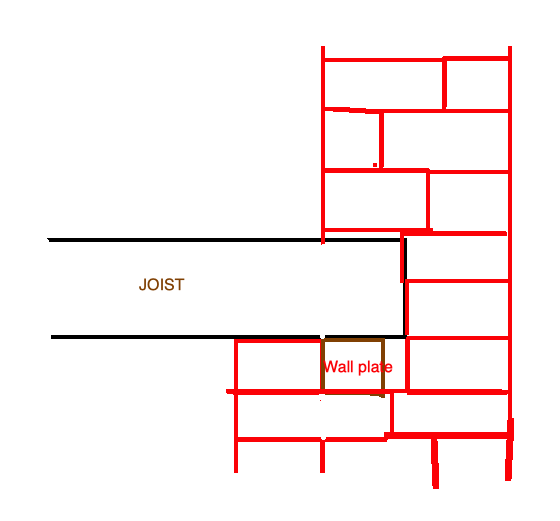
- The joists are going into pockets in the external wall (top), which is solid brick, two bricks thick. Throughout the house the original builders embedded 3x2 timber plates within the wall for pocketed joists to rest on, and this is one of several rooms where that plate has also started to rot thanks to long-term exposure to water and humidity... but, the weird thing here is that the wall is actually three bricks thick in the room below, so the joists are also resting directly on top of the final row of bricks for that course, with the timber wall plate encased between bricks on either side. Like this:
I don't really understand why they even bothered with the pockets when instead they could have made the inner brick shelf one course lower and put the wall plate on there. Where I need to replace joists, either wholly or in part, I intend to simply rest the ends on the brick shelf, shim up/grind down to the right height, and clean out and mortar up the redundant pockets, but I'm perturbed that the middle of part of my brick wall is timber without any direct exposure to air. I can only see obvious signs of rot where the joists have also rotted away - I can't tell how it is along the rest of the wall since I'd need to remove each joist out of the way to check, which I really don't want to do as they're still holding up the ceiling of the room below (though worth saying the joist ends themselves seem absolutely fine). Other than spraying in some wood protector through any gaps I can find around the edges of the joist ends before I seal them up for airtightness with lime mortar I'm not sure there's much else I can do, but if anyone has any better ideas for giving them their best chance of long-term health I'm all ears.
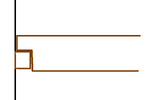
- The other (party) wall is only a single brick thick, and I was expecting something like shared pockets between my and my neighbour's joists (as in some other rooms), but instead there are two 3x2s running along the length of the wall. One is on a small brick ledge at one end and pocketed into a chimney breast in the middle of the wall at the other, while the other also starts in a pocket in the chimney and then disappears under the mortar bed for a fireplace hearth in the corner of the room (I assume to rest in either a pocket or on another small ledge). Other than that, there's a small metal bracket mortared into the wall mid-span - like a playing card-sized bit of flat steel sticking out of the wall, the kind of size of bracket you might use for a bookshelf. The joists have the bottom halves of their ends notched so they can then rest on the 3x2s:
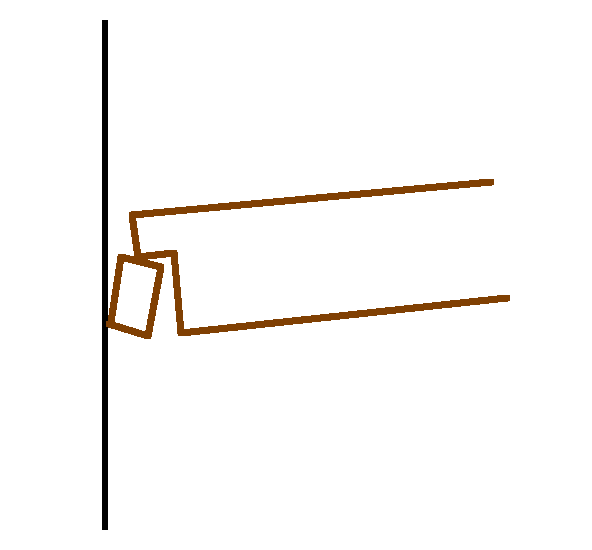
This is why the floor is so out of level. Not only have the 3x2s themselves sagged along their length, but they've also gradually rotated away and downwards from the wall. And because of the size of the notches, all of the joists now have cracks of varying degrees of severity along their central horizontal axes - they're effectively being split into pairs of 3x2s/4x2s as time goes on.
I had been planning to do what I'd been doing in other rooms - sister in 7x2s to both strengthen and level the existing timbers, or, if the joists were too far gone, replace them entirely with doubled-up 7x2s bolted together. But I don't really like the idea of continuing to use the 3x2s as the end bearing board - as much as I try to adhere to the old wisdom of "if it's kept a house up for more than a century, it's probably fine", this looks to me like something which will eventually, even in the best case scenario, continue to cause further sagging in the floor (and especially with the extra imposed dead load that doubling the amount of timber in the floor will cause).
In an ideal world I think I'd prop the floor up from below, cut the notch nubs off the ends of each joist, remove the 3x2 altogether, and install a new ledger board with the existing joists sitting in hangers... but the notches go so deep along the length of each joist that the ledger board would need to be something crazy like a 7x4 to make up the depth. Oh, and of course one of them is apparently also holding up the fireplace in the corner, and having to remove that, and an unsupported chimney on the roof above as well, is another whole can of worms I do not want to open at all.
So, yeah... I'm kind of stumped. At best I'm thinking I could drill some holes in the 3x2 and put into some extra anchors along its length to stop it pulling away from the wall any more in future, but that still leaves me with the problem of how to put new joists in where I need to entirely replace old joists. Regs state that joists can be notched at the ends at most a quarter of their height, and I don't want to put in new timber that's just going to split like the olds one are.
Any help or ideas much appreciated!
The overall floor area involved is exactly 3m wide, and around 7m long. It was originally split into a bedroom and a box room, but at some point a previous owner converted the box room into a shower en suite for the bedroom, and of course that's been leaking for years and now a bunch of the joists are rotting away and need replacing. I've taken everything out, including the stud wall between the two rooms, so I could lift every floorboard and check everything over. Why not, right? Only going to do this once, plus it gives me a chance to level everything off since the whole thing is about an inch and a half higher on one side than the other (which is very noticeable over 3m).
The joists are old 7x2s at an average of 12" centres (the spacing is wildly inconsistent), spanning the 3m width. Here's a diagram I made with my best primary school-level art skills:
Red indicates rotted timber, green no rot, and there's a trimmer going around the chimney. Both sides of the room have some questionable design choices:
- The joists are going into pockets in the external wall (top), which is solid brick, two bricks thick. Throughout the house the original builders embedded 3x2 timber plates within the wall for pocketed joists to rest on, and this is one of several rooms where that plate has also started to rot thanks to long-term exposure to water and humidity... but, the weird thing here is that the wall is actually three bricks thick in the room below, so the joists are also resting directly on top of the final row of bricks for that course, with the timber wall plate encased between bricks on either side. Like this:
I don't really understand why they even bothered with the pockets when instead they could have made the inner brick shelf one course lower and put the wall plate on there. Where I need to replace joists, either wholly or in part, I intend to simply rest the ends on the brick shelf, shim up/grind down to the right height, and clean out and mortar up the redundant pockets, but I'm perturbed that the middle of part of my brick wall is timber without any direct exposure to air. I can only see obvious signs of rot where the joists have also rotted away - I can't tell how it is along the rest of the wall since I'd need to remove each joist out of the way to check, which I really don't want to do as they're still holding up the ceiling of the room below (though worth saying the joist ends themselves seem absolutely fine). Other than spraying in some wood protector through any gaps I can find around the edges of the joist ends before I seal them up for airtightness with lime mortar I'm not sure there's much else I can do, but if anyone has any better ideas for giving them their best chance of long-term health I'm all ears.
- The other (party) wall is only a single brick thick, and I was expecting something like shared pockets between my and my neighbour's joists (as in some other rooms), but instead there are two 3x2s running along the length of the wall. One is on a small brick ledge at one end and pocketed into a chimney breast in the middle of the wall at the other, while the other also starts in a pocket in the chimney and then disappears under the mortar bed for a fireplace hearth in the corner of the room (I assume to rest in either a pocket or on another small ledge). Other than that, there's a small metal bracket mortared into the wall mid-span - like a playing card-sized bit of flat steel sticking out of the wall, the kind of size of bracket you might use for a bookshelf. The joists have the bottom halves of their ends notched so they can then rest on the 3x2s:
This is why the floor is so out of level. Not only have the 3x2s themselves sagged along their length, but they've also gradually rotated away and downwards from the wall. And because of the size of the notches, all of the joists now have cracks of varying degrees of severity along their central horizontal axes - they're effectively being split into pairs of 3x2s/4x2s as time goes on.
I had been planning to do what I'd been doing in other rooms - sister in 7x2s to both strengthen and level the existing timbers, or, if the joists were too far gone, replace them entirely with doubled-up 7x2s bolted together. But I don't really like the idea of continuing to use the 3x2s as the end bearing board - as much as I try to adhere to the old wisdom of "if it's kept a house up for more than a century, it's probably fine", this looks to me like something which will eventually, even in the best case scenario, continue to cause further sagging in the floor (and especially with the extra imposed dead load that doubling the amount of timber in the floor will cause).
In an ideal world I think I'd prop the floor up from below, cut the notch nubs off the ends of each joist, remove the 3x2 altogether, and install a new ledger board with the existing joists sitting in hangers... but the notches go so deep along the length of each joist that the ledger board would need to be something crazy like a 7x4 to make up the depth. Oh, and of course one of them is apparently also holding up the fireplace in the corner, and having to remove that, and an unsupported chimney on the roof above as well, is another whole can of worms I do not want to open at all.
So, yeah... I'm kind of stumped. At best I'm thinking I could drill some holes in the 3x2 and put into some extra anchors along its length to stop it pulling away from the wall any more in future, but that still leaves me with the problem of how to put new joists in where I need to entirely replace old joists. Regs state that joists can be notched at the ends at most a quarter of their height, and I don't want to put in new timber that's just going to split like the olds one are.
Any help or ideas much appreciated!