Reuse existing circuit

Joined
16 Dec 2025
Messages
6
Reaction score
0
Country
United Kingdom
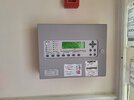
I have recently moved into a property that was used as a small care facility. It has a fire alarm system and hochiki low voltage sensors in every room. For me this is overkill and the control panel is in the hallway and ugly, so I want to get rid of it.

My question is can I reuse the the existing circuit for domestic mains alarms? The interconnecting cables for the sensors are red twin and earth, would need to check the cable for rating. The control panel has a dedicated connection to the consumer unit, if I remove all the exsisting sensors can I connect this to the mains mains supply?

Thanks
 
Pictures are good, one would need to inspect and test, to ensure no faults, but most domestic alarms are not low voltage (230 volts) but extra low voltage (12 volts) and normally 4 wires used to each sensor, two to detect someone in the room and two anti-tamper, so it seems unlikely you have enough wires?
 
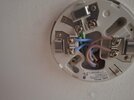
Hi. I will supply some photos. The sensors are analogue addressable Hochiki sensors and have a +ve and -ve and an earth and rated at 17V-40V DC. They are daisychained throughout the house. I will check for ratings on the cabling.

20250617_110100.jpg20251111_132751.jpg
 
Pictures are good, one would need to inspect and test, to ensure no faults, but most domestic alarms are not low voltage (230 volts) but extra low voltage (12 volts) and normally 4 wires used to each sensor, two to detect someone in the room and two anti-tamper, so it seems unlikely you have enough wires?
I think that information is a bit out-of-date and in some senses not completely correct.

The OP is talking about 'fire alarms', and they rarely, if ever, have any 'anti-tamper' facility (or wires).

I think the increasing tendency (and what is recommended, actually 'required' in some situations) for fire alarms (smoke/heat) to be mains powered with battery backup, and to be wired with 3-core (3 functional cores) cable two the mains (LV) supply, and the third an ELV 'interconnect' wire (referenced to the LV neutral) - hence, if one wants to also run a 'not-required' CPC, 3C+earth 'flat' cable or 4-core flex.
 
hence, if one wants to also run a 'not-required' CPC, 3C+earth 'flat' cable or 4-core flex.
Even if we didn't care about the BS7671 requirement to run a CPC, there is the slight problem that 3 core mains-rated cable/flex without an earth core seems to be very difficult, if-not impossible to obtain.
 
Even if we didn't care about the BS7671 requirement to run a CPC, there is the slight problem that 3 core mains-rated cable/flex without an earth core seems to be very difficult, if-not impossible to obtain.
Agreed- which is why I implied that, in practice, one would us 3C+E or 4-core flex.

To be clear, when I wrote "a 'not required CPC" I meant 'not required by the alarms'. As you imply, there remains a BS7671 requirement to run a CPC to 'every point', although the reason they give for that is presumably never actually going to apply to the circuit we're talking about, since I cannot believe that anyone is ever going to replace the fire alarms with ones which require an earth connection :-) However, that does not alter the fact that 'regs are regs' (even if 'non-mandatory' ones!).
 
So I had a look at the cable and it says BS7629-1 300/500V. The base blocks of the alarms have L E N and an I interconnect, but the alarms I am looking at can interconnect wirelessly so the fourt connection not needed. Having investigated further there is a radial connection from the consumer unit from a 6 amp breaker connecting to the control unit. The original sensors appear to be connected in a ring, am I able to connect the lives, neutrals and earths together or should I break the ring and connect it radially?
 
So I had a look at the cable and it says BS7629-1 300/500V. The base blocks of the alarms have L E N and an I interconnect, but the alarms I am looking at can interconnect wirelessly so the fourt connection not needed. Having investigated further there is a radial connection from the consumer unit from a 6 amp breaker connecting to the control unit.
That's all fine then - you can just use the existing wiring, 'ignoring the core which was being used for interconnection - but you really should do something 'safe' with that unused core, like put the end into a little bit of connector block or something like a Wago connector, at each alarm
The original sensors appear to be connected in a ring, am I able to connect the lives, neutrals and earths together or should I break the ring and connect it radially?
It doesn't need to be a ring, but it doesn't matter if it is, so you can just do whatever is the most convenient.
 
Having investigated further there is a radial connection from the consumer unit from a 6 amp breaker connecting to the control unit. The original sensors appear to be connected in a ring, am I able to connect the lives, neutrals and earths together or should I break the ring and connect it radially?

You are saying it's a radial, at the consumer unit, but the radial appears to connect to a ring? It seems a bit unlikely, they would use a ring, but maybe you have yet to find the final unit on the radial?

Either way, even if as you describe, it will work absolutely fine.
 
You are saying it's a radial, at the consumer unit, but the radial appears to connect to a ring? It seems a bit unlikely, they would use a ring, but maybe you have yet to find the final unit on the radial? ... Either way, even if as you describe, it will work absolutely fine.
As we've both said to the OP, it will work fine, 'either way'.

I was wondering whether, when the OP referred to 'a ring', he might possibly have meant an 'incomplete ring' - i.e. with the cable 'daisy-changed from one alarm to the next (without any connection of the 'ring' back to the CU), rather than each alarm having a separate 'radial' connection back to the CU ... but, again, any of that would work fine for his new alarms.
 
That's all fine then - you can just use the existing wiring, 'ignoring the core which was being used for interconnection - but you really should do something 'safe' with that unused core, like put the end into a little bit of connector block or something like a Wago connector, at each alarm

It doesn't need to be a ring, but it doesn't matter if it is, so you can just do whatever is the most convenient.
The existing cable is twin and earth, there was no interconnect used on the original circuit, each alarm was addressed.
 
As we've both said to the OP, it will work fine, 'either way'.

I was wondering whether, when the OP referred to 'a ring', he might possibly have meant an 'incomplete ring' - i.e. with the cable 'daisy-changed from one alarm to the next (without any connection of the 'ring' back to the CU), rather than each alarm having a separate 'radial' connection back to the CU ... but, again, any of that would work fine for his new alarms.
The original alarms were connected in a daisy chain using the twin core and earth. So connecting the radial from the CU to this daisy chain will be ok?
 
The existing cable is twin and earth, there was no interconnect used on the original circuit, each alarm was addressed.
Oh, OK. That's fine, since you only need twin and earth for your wirelessly-connected ones.

What do you mean by "each alarm was addressed"?
 
The original alarms were connected in a daisy chain using the twin core and earth. So connecting the radial from the CU to this daisy chain will be ok?
I'm a bit confused. If the existing alarms were working, the daisy-chained alarms surely must have been connected to the CU, presumably via what you are calling 'the radial'? Am I misunderstanding something?
 

If you need to find a tradesperson to get your job done, please try our local search below, or if you are doing it yourself you can find suppliers local to you.

Select the supplier or trade you require, enter your location to begin your search.


Are you a trade or supplier? You can create your listing free at DIYnot Local

 
Back
Top