
This video from 10 years ago today is one of those but this one has a T&E 'tail', in the kitchen which was a round enclosed fittingwell at least it's done with JB's and not chocbloc, My daughter purchased a house where the lighting circuit where a piece was screwed to a joist at every light position and the 2 core flex for the pendant drop was knotted to stop it pulling through the PB Annoyingly each simply passed through a rose so it appeared to look correct.
And they were well painted in so not a selling action.

You are using an out of date browser. It may not display this or other websites correctly.
You should upgrade or use an alternative browser.
You should upgrade or use an alternative browser.
Ring final spurred off from a JB to each socket
- Thread starter bhm1712
- Start date

- Joined
- 11 Jan 2004
- Messages
- 47,063
- Reaction score
- 4,077
- Country

I forgot to say that another common method of wiring a ring final in the 60s was to do the GF as you would normally, but the upstairs sockets were just spurs off the GF RF.
- Joined
- 11 Jan 2004
- Messages
- 47,063
- Reaction score
- 4,077
- Country
Yes. Way back to the 14th in 1966. Before that, the 13th, in 1955 only allowed half.Wasn`t there some rule with a Ring Final that no more spurs than points on the ring?
Or you'd take the ring round the "core" of the house, and spur off for sockets on the perimeter. I think that's the way it was sold as reducing the amount of copper needed vs. other methods (esp. multiple radials as this was when the "standard" was perhaps one 15A on it's own radial per room (if you are lucky.)I forgot to say that another common method of wiring a ring final in the 60s was to do the GF as you would normally, but the upstairs sockets were just spurs off the GF RF.

A Ring Final or three might serve some installtions very well and ditto to Radial Final circuits too (in both cases with or without spurs both fused or not fused) it depends, often a mixture of both for gen power circuits and I even know one person who used to wire lighting circuits as a Ring Final topology too!
There is no gen right or wrong but there is usually a choice of one or the other or both, rings and radials both have their own pros and cons when compared one versus the other.
Sensible planning for either must be used though and not merely because you happen to be in one camp or the other.
And I will not mention the "Lollipop Circuit" Either.
There is no gen right or wrong but there is usually a choice of one or the other or both, rings and radials both have their own pros and cons when compared one versus the other.
Sensible planning for either must be used though and not merely because you happen to be in one camp or the other.
And I will not mention the "Lollipop Circuit" Either.
He said Jehova, stone himAnd I will not mention the "Lollipop Circuit" Either.


- Joined
- 18 Apr 2022
- Messages
- 7,445
- Reaction score
- 1,138
- Country
And I will not mention the "Lollipop Circuit" Either.
I've got one. Nowt wrong with them, as long as the lollipop stick is short.
Why not?And I will not mention the "Lollipop Circuit" Either.
I know there has been lots of discussion and dissent about them but they are quite common, especially if there is a local isolator..
Why short?And I will not mention the "Lollipop Circuit" Either.
I've got one. Nowt wrong with them, as long as the lollipop stick is short.
I've known some with up to around 50m.
Yes I had wondered why short too, in comparison to what? and to what end?Why not?
I know there has been lots of discussion and dissent about them but they are quite common, especially if there is a local isolator..
Why short?
I've known some with up to around 50m.
Not saying theres no truith in what you say but we do not usually specfifically mention it in a ring final or a radial too much, off course once we learn the limits that suit all (and suit all subsequent ammendments too) we usually find that maximums are not usually approached anyway.

- Joined
- 27 Jan 2008
- Messages
- 29,563
- Reaction score
- 3,641
- Location
- Llanfair Caereinion, Nr Welshpool
- Country
At one point, electricians would design a circuit, not just do it that way, as that's the way we have always done it.
So I was given a job, a large fridge for storing cheese, you could have fitted at least two of my houses inside the fridge, it was large, with fork lifts running around inside it.
It needed cleaning, so they wanted a load of 13 amp sockets, so the cleaners could be plugged in, the walls were around 20 foot high, so to run a ring final in a conventual method, the drop to each socket would be 35 foot, so we used 6 mm² junction box to junction box, with 2.5 mm² drops to each socket, every socket was a radial from a junction box, which the diagram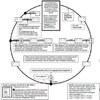 permits shown about 11 o'clock. The volt drop was not quite within limits, centre of ring, we swapped some of the drops to using 4 mm² we had not actually calculated it all first, but the scrubbers etc, were not that dependent on voltage, so it did not matter too much.
With another job we did get caught out on volt drop, it seems shrink wrap machines do not like volt drop, but domestic wise, very little will have a problem with volt drop, if within the current limits to work the magnetic part of the MCB.
So I was given a job, a large fridge for storing cheese, you could have fitted at least two of my houses inside the fridge, it was large, with fork lifts running around inside it.
It needed cleaning, so they wanted a load of 13 amp sockets, so the cleaners could be plugged in, the walls were around 20 foot high, so to run a ring final in a conventual method, the drop to each socket would be 35 foot, so we used 6 mm² junction box to junction box, with 2.5 mm² drops to each socket, every socket was a radial from a junction box, which the diagram
permits shown about 11 o'clock. The volt drop was not quite within limits, centre of ring, we swapped some of the drops to using 4 mm² we had not actually calculated it all first, but the scrubbers etc, were not that dependent on voltage, so it did not matter too much.With another job we did get caught out on volt drop, it seems shrink wrap machines do not like volt drop, but domestic wise, very little will have a problem with volt drop, if within the current limits to work the magnetic part of the MCB.
- Joined
- 27 Jan 2008
- Messages
- 29,563
- Reaction score
- 3,641
- Location
- Llanfair Caereinion, Nr Welshpool
- Country
I was told when doing the C&G 2391 to check for fig of 8 and lollipop, but I can't find a regulation banning them. The "and if, under the intended conditions of use, the load current in any part of the circuit is unlikely to exceed for long periods the current-carrying capacity (Iz) of the cable." Means that the fig of 8 needs to cross near the centre of the circuit which supplies it, but it seems not forbidden. The problem with the lollipop circuit to the likes of a kitchen, is the cable from JB to first socket, can be overloaded, but if you use 4 mm² from JB with 6 mm² feed, then after the first socket, unlikely to get an overload.And I will not mention the "Lollipop Circuit" Either.
However, with domestic there seems to be a lack of wiring diagrams passed to the inspector doing an EICR, so we see results which don't seem to make sense, as to if we should make further investigations, seems to be a point of contention. I feel a FIR should only be used where there is a locked door, or missing loft hatch etc.
- Joined
- 18 Apr 2022
- Messages
- 7,445
- Reaction score
- 1,138
- Country
Why short?
I've known some with up to around 50m.
Yes I had wondered why short too, in comparison to what? and to what end?
I just think it makes testing easier if the ring part of the lollipop starts in the vicinity of the CU, not several 10's of m away.
Well yes if it is only a metre or three away all the better.
If it is "long" (relatively speaking) it might probably makes it a little or even a lot more difficult.
Plus - the normal standard lengths (as in the guides) do not interpilate very easily to give us an quite idea if each ring/radial combination is likely to be on or beyond the limits as readily as standard cicuits might do.
Personally I have only ever once needed to convert one unused cooker circuit into a lolipop circuit and have only ever come across about three of them already existing that I was aware of at the time.
This one time I used it as an example to be overseen on my yearly "Snake and Mongoose Event" with my Incompetent Person Scheme - Therefore I explained the reasons for this and demonstrated retesting to confirm compliance and scored a Yes.
But just because it is not a "Standard Circuit" I can not claim it is "Not Allowed" so still needs testing where appropriate and that includes before and after any addition/alteration.
Even in this day and age I still come across those with a mindset of "It is not a standard circuit listed in the On Site Guide therefore not allowed!" Oh Deary deary me! LOL.
If it is "long" (relatively speaking) it might probably makes it a little or even a lot more difficult.
Plus - the normal standard lengths (as in the guides) do not interpilate very easily to give us an quite idea if each ring/radial combination is likely to be on or beyond the limits as readily as standard cicuits might do.
Personally I have only ever once needed to convert one unused cooker circuit into a lolipop circuit and have only ever come across about three of them already existing that I was aware of at the time.
This one time I used it as an example to be overseen on my yearly "Snake and Mongoose Event" with my Incompetent Person Scheme - Therefore I explained the reasons for this and demonstrated retesting to confirm compliance and scored a Yes.
But just because it is not a "Standard Circuit" I can not claim it is "Not Allowed" so still needs testing where appropriate and that includes before and after any addition/alteration.
Even in this day and age I still come across those with a mindset of "It is not a standard circuit listed in the On Site Guide therefore not allowed!" Oh Deary deary me! LOL.

DIYnot Local
Staff member
If you need to find a tradesperson to get your job done, please try our local search below, or if you are doing it yourself you can find suppliers local to you.
Select the supplier or trade you require, enter your location to begin your search.
Please select a service and enter a location to continue...
Are you a trade or supplier? You can create your listing free at DIYnot Local
Similar threads


- Replies
- 50
- Views
- 6K
