
• Looking for a smarter way to manage your heating this winter? We’ve been testing the new Aqara Radiator Thermostat W600 to see how quiet, accurate and easy it is to use around the home. Click here read our review.

Sleeving on switch live

Joined
30 Mar 2015
Messages
4,377
Reaction score
78
Country
United Kingdom
Most of my lights are looped at the ceiling. My switched live cable at the ceiling and switch is a blue wire with a brown sleeve for identification purposes. I think this is the correct convention?

I do have a couple of lights that are looped at the switch and have this configuration:
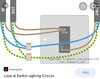
1CEDB2D7-7B5B-4F84-8D95-E2DF6CEA0028.jpeg
@flameport these images are absolutely awesome and I use them all the time. Thanks!

Is the wire in L1 still know as the switched live? And does it require any sleeving for identification purposes?

Thanks in advance.
 
The sleeving is only used to denote its a Live cable rather than its function, therefore if its Brown cable it needs no sleeving.
However it is worth marking to assist terminating the switch now or in the future but not no reg to say you need to indicate its purpose as a Switchline.
A switchline is basically the term used for the wire from an output of a switch to the fittings lamp termination or similar load.
 
Is there a defined method for this?
No not really, some mark with tape but can get sticky and messy, personally if i am replacing a broken switch i tend to just put one to whatever dots on the switchlines with a black permanent marker, however with just two browns or two reds, your marking convention will only be of use to you as you knew what you marked and without testing you can not take for granted what one of the pair is actually the switchline, not that it usually matters.
The same goes for Blue cores at switches, you can not always assume they will be the Switchline as opposed to the live.

Marking, in this case is more use when there is multiple switch lines really.
As you know the Regs mainly cover marking cables when the colour is not used for its intended purpose and the most common occurence is the Blue in lighting circuits being designated for a different purpose other than Neutral
 

If you need to find a tradesperson to get your job done, please try our local search below, or if you are doing it yourself you can find suppliers local to you.

Select the supplier or trade you require, enter your location to begin your search.


Are you a trade or supplier? You can create your listing free at DIYnot Local

 
Back
Top