My son called about 4 weeks ago saying his fridge freezer had stopped working. Single socket, only one cable unsure where it is fed from. He tried another appliance in socket but didn't work either. He plugged fridge into extension reel and has worked ok since then. Nothing tripped in consumer unit. No lights come on when socket tested with plug in socket tester. New faceplate fitted on socket but still no power. Is this ok to leave with fridge plugged into extension cable?

You are using an out of date browser. It may not display this or other websites correctly.
You should upgrade or use an alternative browser.
You should upgrade or use an alternative browser.
socket no power
- Thread starter rego
- Start date

- Joined
- 27 Jan 2008
- Messages
- 29,540
- Reaction score
- 3,636
- Location
- Llanfair Caereinion, Nr Welshpool
- Country

The worry about using an extension cable with a refrigeration unit is the volt drop will mean the pressure builds up, before the motor has reached full speed, and it will cause the motor to stall.
For this to happen the extension would need to be very long and for the voltage to home to be on the low side to start with. So in real terms unlikely to happen.
If the unit starts up OK, then there is no problem.
For this to happen the extension would need to be very long and for the voltage to home to be on the low side to start with. So in real terms unlikely to happen.
If the unit starts up OK, then there is no problem.

Fixing the faulty socket is probably the best bet.
- Joined
- 27 Jan 2008
- Messages
- 29,540
- Reaction score
- 3,636
- Location
- Llanfair Caereinion, Nr Welshpool
- Country
I do remember in my parents house, hunting for why a socket did not work, I found my dad had fitted a fused connection unit (FCU), feeding another FCU and one was under the counted hard to see.
So I can see how hard it is to find the problems sometimes.
The worry is if part of a ring final and the fault is breaking the ring. This can cause an overload in one leg, so unless we know that is not the case, we do tend to spend a lot of time inspecting and testing to make sure no danger.
So as @pete01 says, fixing the socket is best. But you asked about use of an extension lead, and there is no real problem other than what I have already said, and the trip hazard.
I would remove the socket, and see how many cables feed it, if only one, then not likely part of a ring final, if two then more worrying, and you need to look further. Since a freezer, it was common to fit switches to sockets supplying freezers so it could be turned off without moving the unit, where the unit its self was in front of the socket, to get 20 amp rated switches, it was common to use grid switches, these also allowed on to get switches with a legion on them.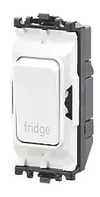 It could also combine a fuse holder and switch. Or a row of switches
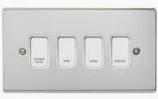 supplying other items which are in front of their sockets, it was considered important with washing machines, as there was a fault where the weights we made slightly undersize, and the fact was masked by flashing on the concrete, when this flashing powered off, the washing machine could vibrate around the room, so wanted a way to turn them off, without touching it. Today they have out of balance sensors so auto turn off.
So I can see how hard it is to find the problems sometimes.
The worry is if part of a ring final and the fault is breaking the ring. This can cause an overload in one leg, so unless we know that is not the case, we do tend to spend a lot of time inspecting and testing to make sure no danger.
So as @pete01 says, fixing the socket is best. But you asked about use of an extension lead, and there is no real problem other than what I have already said, and the trip hazard.
I would remove the socket, and see how many cables feed it, if only one, then not likely part of a ring final, if two then more worrying, and you need to look further. Since a freezer, it was common to fit switches to sockets supplying freezers so it could be turned off without moving the unit, where the unit its self was in front of the socket, to get 20 amp rated switches, it was common to use grid switches, these also allowed on to get switches with a legion on them.
It could also combine a fuse holder and switch. Or a row of switches Theoretically, perhaps - but, as you go on to say ....The worry about using an extension cable with a refrigeration unit is the volt drop will mean the pressure builds up, before the motor has reached full speed, and it will cause the motor to stall.
... which I think probably translates to it being extremely unlikely that there would be any problem in the real world.For this to happen the extension would need to be very long and for the voltage to home to be on the low side to start with. So in real terms unlikely to happen.
Thanks for replies. Only one cable feeding the socket in question. I suspect it may be a spur off another socket. I am visiting my son in 3 weeks time and will try to find out. Do you think its ok to leave for now?

In a modern kitchen appliance sockets for fridge , DW, WM etc are switched from another accessible location . May have accidentally been turned off, I was always being called to a “broken fridge” in the office , staff just kept stacking heavy boxes against the isolation switch turning it off .
D
Deleted member 310928
What about a spur, supplied from the furthest point away from the ring, being several meters away?The worry about using an extension cable with a refrigeration unit is the volt drop will mean the pressure builds up, before the motor has reached full speed, and it will cause the motor to stall.
D
Deleted member 310928
Extension reel plugged into the same socket, or extension reel plugged into a different socket?He plugged fridge into extension reel and has worked ok since then.
different socket
D
Deleted member 310928
With the socket now replaced, assuming it was done correctly, it’s either a FCU, which controls the fridge, accidentally switched off, or the fuse blown, or a loose wire.different socket
But there is no guarantee that it’s supplied from a FCU, or if it’s been spurred off the ring. Just by seeing one cable supplying the socket can indicate that it’s the final socket on a radial circuit.

- Joined
- 5 Nov 2024
- Messages
- 5,748
- Reaction score
- 2,709
- Country
I don’t think there’s a mention of the “faulty” socket being replaced. I’m of the same opinion with it being an fcu that’s inadvertently been turned offWith the socket now replaced, assuming it was done correctly, it’s either a FCU, which controls the fridge, accidentally switched off, or the fuse blown, or a loose wire.
Last edited:
- Joined
- 27 Jan 2008
- Messages
- 29,540
- Reaction score
- 3,636
- Location
- Llanfair Caereinion, Nr Welshpool
- Country
We are required when installing a socket to test it, for the volt drop we are looking for a line - neutral loop impedance increase of less than 0.6 Ω to the incoming supply with a ring final, but the line - earth for a ring final or any spur from a ring final should not be more than 1.44 Ω even before the drop to 1.38 Ω, with a radial again we have limits.What about a spur, supplied from the furthest point away from the ring, being several meters away?
So any installed socket must comply with the regulations, but an extension lead is not installed, there are still limits, this may have changed, but 2008 the max loop impedance for a 13 amp fuse was 2.42 Ω, so we should have a limit of 1 Ω for an extension lead, however if we are using RCDs then the line - earth loop impedance can be higher, but we all know these
So with an installed socket we can be reasonably sure it was tested when installed, even if just a simple socket tester
D
Deleted member 310928
I don’t think there’s a mention of the “faulty” socket being replaced. I’m of th same opinion with it b in an flu that’s inadvertently been turned off
Did rego mean socket when he said that?New faceplate fitted on socket but still no power.
Or did it mean that he tested another device, and that faceplate, which is what he referred it to, was for a different plug? But looking at this, I don’t think that’s what it was.
He tried another appliance in socket but didn't work either.

DIYnot Local
Staff member
If you need to find a tradesperson to get your job done, please try our local search below, or if you are doing it yourself you can find suppliers local to you.
Select the supplier or trade you require, enter your location to begin your search.
Please select a service and enter a location to continue...
Are you a trade or supplier? You can create your listing free at DIYnot Local
Similar threads

- Replies
- 13
- Views
- 2K
