The problem with a looped supply questions.

Joined
14 Mar 2004
Messages
76
Reaction score
7
Country
United Kingdom
I understand that a looped supply involves two or more properties and the supply going into and back out of the cut out fuse and onto the the next property(s) such as shown here https://commercial.nationalgrid.co.uk/downloads-view-reciteme/430885

We've recently had an EV charger installed and we were identified as being at the end of a looped supply sharing a live and neutral with our neighbour. The DNO gave the go ahead subject to retrospective works and they've just been out to survey.

The friendly surveyor said it's not a looped supply as even though the properties share a single live and neutral supply each property has an individual live and neutral cable split from the main supply going to their cutouts (not easy to inspect from outside).

He thought the supply cables were sufficient for both properties but took photos and will report back to the DNO and they can decide if it needs upgrading.

Is the problem with looped supplies the max potential current to the properties on the shared supply cables and/or the fact that the connections for the loop are done at the cutout in a property?


Secondly anyway to identify the size of the black incoming supply cables from this photo, they look to be the same diameter as the external cables supplying the two properties?
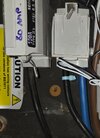

cutout1.jpg cable1.jpg

The black supply cables are at least 25 years old and for reference the blue cable which has a larger outer diameter than the black looks to be double insulated and I think it's 25mm2 as each of the 7 strands look to be just over 2mm diameter.

We have a TT system so there is no earth supplied with the black cables.

The DNO seem happy and will make any changes they deem needed so the above is just my curiosity.
 
Last edited:
The issue with looped supplies is that as you said, the total load is limited, not really designed to be supplying more than 60a each. This used to be ok but with all this extra load these days things can get pushed too far and cause overloading which can damage cables and cutouts etc.
There are instances where say 4/5/6 terraced houses are supplied off one single phase service (.0225”-around 16mm) and all have a single cable and cutout so looks ok in terms of being looped, the rest is buried underground!
 
As you say there is often a risk of overloading with a looped supply because the supply cable (and indeed the terminals in the cutout) is usually not rated to the full load current of both fuses at the same time, but there would also be a risk of overloading with a supply that split to feed two properties.

So why are looped supplies considered more of an issue than split supplies? I suspect the answer is that overloaded stuff underground carries little real-world risk, and even overloaded overhead stuff is relatively low risk in our damp climate. Overloaded stuff indoors poses a higher risk and cutouts in particular are often installed under the stairs, which is about the worst possible place for a fire to break out.
 
I would think a fault underground is not likely to set your house on fire, where the same fault in the house may. When this house was built, we had the old Wylex fuse box, with a main isolator rated 60 amps, and the DNO fuse was also 60 amps. Today most consumer units rated 100 amps, (can go up to 125 amp but never seen one) but as long as the DNO fuse suits the supply, be it looped or split, it should not matter, where it does matter is where an inappropriate DNO fuse has been fitted.

In theory, I now could have an 80 amp DNO fuse fitted, to fit a 100 amp fuse, would need some modification as the solar can supply 20 amps.

But the supply pattern has changed, I look at my own
1773750523230.png
and that is without an EV.
 
Thanks for the replies and it all makes sense.

In our case the supply is overhead so the cables exit our properties where they connect to each other and are then clipped to the neighbour's brickwork.

While not desired if they caught fire then there should it shouldn't cause much damage as there is little flammable near the.

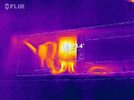
When the charger had been on a few hours and the house pulling abut 7.5kw I checked the cutout and meter with a thermal camera and the hottest part was the meter at 24C and the ambient temperature in the room was about 18C at the time.

Meter with 7_5kw load.jpg

The most I've seen pulled at one time was 12kw briefly so about 52A when the charger, washing machine and dishwasher were all on. If that happens again then I'll try and check the temperature of the cables inside and out and see what they're like.

We've got an 80A fuse so unlikely to trouble that and the charger is set to turn itself down if the house pulls more than 60A but that obviously only measures our house usage and doesn't include our neighbour's usage hence me wondering about what the supply cable can take. At the moment the neighbour doesn't have much with a high electric demand so it shouldn't be an issue.

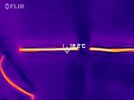
Amusingly when the charger is on you can also see the whole 10mm2 charger supply cable light up with a thermal camera (taken before being covered up above ceiling/below floor) although again the max temperature is about 23C and about 6C above ambient so perfectly acceptable.

10mm charger cable under load.jpg
 
I would think a fault underground is not likely to set your house on fire, where the same fault in the house may. When this house was built, we had the old Wylex fuse box, with a main isolator rated 60 amps, and the DNO fuse was also 60 amps. Today most consumer units rated 100 amps, (can go up to 125 amp but never seen one) but as long as the DNO fuse suits the supply, be it looped or split, it should not matter, where it does matter is where an inappropriate DNO fuse has been fitted.
The problem is lets say you have a 100A cable feeding two properties, each with a fuse of say 60A. No one property can overload the supply, but if both draw full power at the same time the cable would be overloaded. If the fuses are 80A or if there are more than two properties then the potential for overload is even greater.

Historically the DNOs worked on the assumption that such loading was unlikely, and if it did happen it would likely be in the middle of winter when ambient temperatures were at their lowest. Modern loads can upset that assumption.
 

If you need to find a tradesperson to get your job done, please try our local search below, or if you are doing it yourself you can find suppliers local to you.

Select the supplier or trade you require, enter your location to begin your search.


Are you a trade or supplier? You can create your listing free at DIYnot Local

 
Back
Top