
To RCD or not.

Joined
28 Jul 2010
Messages
5
Reaction score
0
Location
Bristol
Country
United Kingdom

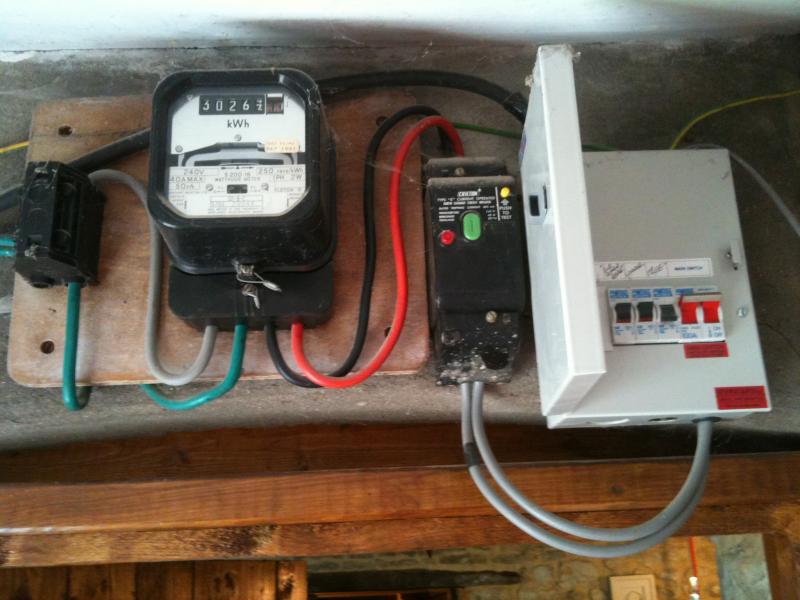
I live at the end an overhead feed in a rural location and hence have an earth rod. Attached is the current setup which as you can see is not exactly complex. Our only source of hot water is a 10K shower in the downstairs bathroom. Also I'm not sure what edition everything was installed under but it wasn't 17. :D

It is my understanding that where a earth rod is used all circuits must run off a RCD. However we get regular power cuts and I want the freezer on when the power comes back. 17th edition combined with a TT system appears to mandate the use of RCDs on all circuits. Which would prove to be a pain.

We don't have any high draw equipment except the shower. i.e. no TV, stereo, etc. Our bill averages £12 a month...

How do other people get around this? Put all socket circuits on a 30mA RCD, light circuits on a 100mA RCD and keep the freezer on a MCB. Will Regs understand that in my situation all RCBs isn't a good idea?
 
You don't have a choice. If you're on a TT installation you MUST have RCD protection on ALL circuits as the Earth Fault Loop Impedance is too high to cause enough current to flow under fault conditions to operate the OPD (ie cause the MCB to trip)

However, this calls for 100mA RCD, not the 30mA that is required for protection from electric shock.

Get a split load CU with an 100mA Type S (time delayed) RCCB incomer, and a 30mA RCCB for circuits that need it. Put the lights and freezer on the non-30mA side. (although depending on concealed wiring they may need 30mA RCD protection to meet the 17th anyway, in which case RCBOs are the best solution)

Anyway, your problem is RCDs per se, it's the fact that your crappy old trips off when there's a power cut or power is resored, if it didn't do that there'd be no problem.

--------Edit
With only 3 circuits, just get a straight CU with 100mA type S incomer and 30mA RCBOs for the circuits.
 
With only 3 circuits, just get a straight CU with 100mA type S incomer and 30mA RCBOs for the circuits.
Or a main switch CU with 3x 30mA RCBOs

Don't you need double pole RCD protection on a TT, even if it's at 100mA rather than 30mA? I've not seen many DP RCBOs, not in the UK anyway (common in Johnny Foreigner Eruotown though).

And if there's a 100mA incomer the OP has the option of MCBs if conditions allow.
 
Yes you're right. Single pole RCBOs would be no good here.
 
You don't have a choice. If you're on a TT installation you MUST have RCD protection on ALL circuits as the Earth Fault Loop Impedance is too high to cause enough current to flow under fault conditions to operate the OPD (ie cause the MCB to trip)

However, this calls for 100mA RCD, not the 30mA that is required for protection from electric shock.

Get a split load CU with an 100mA Type S (time delayed) RCCB incomer, and a 30mA RCCB for circuits that need it. Put the lights and freezer on the non-30mA side. (although depending on concealed wiring they may need 30mA RCD protection to meet the 17th anyway, in which case RCBOs are the best solution)

Anyway, your problem is RCDs per se, it's the fact that your crappy old trips off when there's a power cut or power is resored, if it didn't do that there'd be no problem.

--------Edit
With only 3 circuits, just get a straight CU with 100mA type S incomer and 30mA RCBOs for the circuits.

I'm lucky as I only have two MCB in use and they don't trip when the power fails. Something which does effect my neighbors. Thing is one supplies the shower and the other supplies the lights and sockets. Difficult to see in the picture but the third is marked as free.

If I replace the CU I will need to purchase an active 100mA RCD so that it won't trip when the power fails? The sockets would need to be active as well? On one hand I want to update it on the other hand leave well alone.

Just like to understand what would happen if it was changed.
 
I rather think that the black box with the yellow button on it is one of the old type voltage leakage breakers. If so this provides you with no protection whatever.

It is easy enough to engineer - you'll need two double pole 30mA RCBOs to replace the two working MCBs. Put them in a new enclosure with a main switch, job done.
 
I am sure the existing ELCB is the voltage type which have been discontinued as so easy by-passed. Under 17th Edition buried cables also have a RCD and these will be 30ma. The standard consumer unit has two all pole RCD's which are passive. Passive means don't trip with power cuts. The lawn mower plug will have an active that trips every time you unplug.

The RCD's although rated 30ma are not all the same. You can get auto resetting very expensive and also versions that give a warning light before the tripping current is reached and don't trip until at least 90% of the 30ma is being leaked but most will trip anywhere between 15ma and 30ma.
The is also the A type and AC type the former tend to be better resisting spikes on the supply.

The three phase boards will take all pole RCBO's but the normally domestic one used in UK can only be used with the single width RBCO's with a TN supply and since you have a TT supply they are not really an option.

The older 100ma RCD will be a lot better than the ELCB-v fitted but will not give the required protection from electric shock when used with buried cables less than 50mm and socket outlets under 20A so although better than nothing would not likely cure the problem.

However with only three fuses using three RBCO's all double pole would likely cure the problem but the enclosure would need changing for an insulated one. The old ELCB-v could be left as an isolator the trip function would then not be required.

The problem is to use type tested enclosures called consumer units will always pass but where building ones own enclosure to take twin pole RBCO's I am unsure of if allowed where a non skilled person is to use it. I can have one in my house as skilled but if I put one in daughters house then the door should be locked and only an electrician should reset and breakers. Not sure how strictly this is complied with?
 
Don't you need double pole RCD protection on a TT
Not in a house.
They are required in caravans because there is the possibility of the supply being connected with reverse polarity (due to wrong wiring at the site, or faulty extension leads being used etc).

Single pole RCBOs could be used with a 2 pole main switch.
However they should not be used where there is an RCD incomer, time delayed or otherwise.
 
...Anyway, your problem is RCDs per se, it's the fact that your crappy old trips off when there's a power cut or power is resored, if it didn't do that there'd be no problem..
:?:
"...Anyway, your problem is not RCDs per se, it's the fact that your crappy old voltage-operated ELCB trips off when there's a power cut or power is resored, if it didn't do that there'd be no problem.."
:?:


If I replace the CU I will need to purchase an active 100mA RCD so that it won't trip when the power fails?
No - tripping on power failure is what active RCDs do, not what they don't do.

But in any event, I don't think you can get active RCDs for CUs.


The sockets would need to be active as well?
No.

The only time you'd want an active RCD would be if you had equipment that you didn't want to come back on when the power was restored.
 
Removing the VOCB and replacing with a 100mA time-delayed RCD incomer would probably be a good start. You're under no obligation to upgrade the existing consumer unit or add 30mA protection to any other circuits unless you want to, as you wouldn't be doing any work on the CU or associated final circuits.
 
...Anyway, your problem is RCDs per se, it's the fact that your crappy old trips off when there's a power cut or power is resored, if it didn't do that there'd be no problem..
:?:
"...Anyway, your problem is not RCDs per se, it's the fact that your crappy old voltage-operated ELCB trips off when there's a power cut or power is resored, if it didn't do that there'd be no problem.."
:?:

Yep. That's exactly what I wanted to say. Dunno how it appeared like that... :oops:


Anyway, Eric's suggestion is the simplest, and they are often the best. :)
 
Whatever he does, he needs 30mA RCD protection on that shower. At present he has SFA.

And
emoving the VOCB and replacing with a 100mA time-delayed RCD incomer
will not provide the protection needed.
 
Whatever he does, he needs 30mA RCD protection on that shower. At present he has SFA.

And
emoving the VOCB and replacing with a 100mA time-delayed RCD incomer
will not provide the protection needed.

Again, OP is under absolutely no obligation to update the existing installation. If the installation is pre-16th as the OP suggests, then unless stipulated by the shower manufacturer, there would have been no requirement for 30mA RCD protection on the shower circuit. That is not to say it wouldn't be a good thing to have, but not a necessity at the time. Replacing the incoming VOCB with an RCD doesn't change anything in that respect.

I'm not sure where all this has come from.. the OP is having problems with an old voltage operated circuit breaker, not problems with his/her shower circuit.
 
I'm not sure where all this has come from.. the OP is having problems with an old voltage operated circuit breaker, .

I am not sure where you got that impression. At no point has the OP said he is having any problems with anything at all. All he asked is should he RCD it. To which the answer is yes.

The discussion has been a general one re the existing layout.

Would you use an electric shower knowing there is an EFLI of 60 ohms or more with no 30mA RCD in place? I wouldn't.
I doubt that any equipotential bonding has been carried out. that would mean that fault current could light up the copper pipework.
 

If you need to find a tradesperson to get your job done, please try our local search below, or if you are doing it yourself you can find suppliers local to you.

Select the supplier or trade you require, enter your location to begin your search.


Are you a trade or supplier? You can create your listing free at DIYnot Local

 
Back
Top