• Looking for a smarter way to manage your heating this winter? We’ve been testing the new Aqara Radiator Thermostat W600 to see how quiet, accurate and easy it is to use around the home. Click here read our review.

Top Mounted Vertical Immersion

Joined
15 May 2022
Messages
4,699
Reaction score
1,232
Location
Cork
Country
Ireland
Does anyone have any views /experience on/of the above re unstable HW outlet temperatures even with a perfectly operating thermostat which is the same length as the heating element.
My views.
With this top mounted immersion you will only heat the full immersion length of the cylinder from a fully cold cylinder.
20/25% of the HW must then be drawn off before the stat will cut back in, for example, with a stat setpoint of 60C and assuming 50C cut in, (hysteresis of 10C), and a cold mains of 15C then ~ 22% of the HW must be drawn off to enable the stat to cut in. If 22% of the HW is drawn off, enough to get the the stat to start calling at 50C then the top 78% will/can still be at 60C with the remaining 22% at 15C then the actual final HW temp will/can be higher than 60C because the vertical element will heat the cylinder without any destratification and you may end up with 78% at 70C and the remaining 22% at 25C on stat cut out. Finally if say 60% HW is then drawn off leaving 40% at 70C (and 60% at 15C) then if the cylinder is reheated its possible to have 40% at 87C and 60% at 42C, very close to the hi limit stat trip but the control stat should still have cut out at a average of 60C?. (0.4*87)+(0.6*42).

I have a 53 year old dual element top mounted immersion but only use the shorter element which heats 30L, it doesn't have the rod type stat but has a surface mounted one on top of the immersion so I can't carry out any tests, almost the full 30L has to be used before the stat cuts back in but it does give a very stable HW temperature of 65C.
 
Last edited:
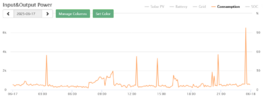
I have just had a 9" swapped for a 27", and I can see when the unit likely turns on. 1750230868761.pngI will guess short spikes are making coffee, and longer ones the immersion heater, but depends if it uses full 3 kW or some lower amount, I will guess this
1750231050205.png
first thing in the morning is still the immersion but lower output as not enough sun. It is set to use off-peak as well, so the
1750231195105.png
will be the off-peak. The whole reason for changing lenght is so on dull days there is hot water left, I know if I use the oil boiler the tank can last nearly 3 days, I suppose one can press the button and see how much used today, yesterday, and last 7 days, with the short immersion I was using less than 5 kWh per week, not had long one in for long enough for the record to show much.

Not sure what the results are when the CT coil batteries become discharged, I have changed them once, but did not look to see what used, and at that point had not set up the off-peak bit of the controller.

What are you controlling the immersion heater with? I am using an iboost+, the graph from solar software, the smart meter is in the main useless, as only shows energy used 00:30 to 05:30 when on off-peak, rest of time shows zero or export, so no real help.
 
Is there any way you can monitor the HW temperature at the cylinder top?, or even just run off say 5L of HW just after or soon after using a off peak top up and measure that temperature with a household thermometer, if its reaching the very high temperatures I reckon it can, then even feeling it with your fingers should give a good idea.

I'm just using a timer (very occasionally) or just a one hour boost if required.
 
I have brewing gear so could measure temperature, but from turn on after repairs, it took 4.22 kWh to heat from cold, that is a lot of energy, and I know from using oil to heat DHW, the tank can stay hot for 3 days.

One would expect the immersion would cause thermal flow up the centre and down the outside. So there should be some mixing.
 
Cold (mains) here now is 19C, by calculation, the heated volume of water to 60C (27" of cylinder), is 4.22*860/(60-19), 88.5L. and the cylinder will heat uniformly and the whole 27" should be at 60C, as the 27" element (3.0kW?) will release 111watts/inch., also the vertical thermostat should be measuring the same temperatures for its full length. The problem/challenge is if you draw off even 25% (22L) of the vol. just enough to get the stat to close, 75% (66L) of the stat will be sensing 60C & 25% will be sensing 19C which is a average of 50C, so now the element is again emitting 111watts/inch from top to bottom so IMO the HW temp has to rise substantially to reach a average 60C cut out, by calc, 66L will reach 71C and 22L will reach 26C, 35L of HW would then have to be drawn off to get the stat to cut back in at 50C, so 35L of HW will then have to be drawn off to get the stat to cut in and on cut out its theoretically possible that this 35L will reach 28C but the remaining 53L will reach 81C. Even though there is some mixing going on there has to be a substantial differences in the HW temperature depending on the usage pattern, the only way to guarantee a full cylinder at a constant 60C HW temperature IMO is to use up the whole 88.5L or whatever and start from cold again, that's my story at any rate.
You might consider monitoring the HW temperature with that brewing gear.
 
Last edited:
...the cylinder will heat uniformly and the whole 27" should be at 60C...

No, the top will be hottest, and the bottom coolest.

The thermostat will be at the top and will turn off the element when the stat reaches temp.
 
the only way to guarantee a full cylinder at a constant 60C HW temperature IMO is to use up the whole 88.5L or whatever and start from cold again,

Putting the element at the bottom is better

Though the bottom will always be cooler than the top.
 
One would expect the immersion would cause thermal flow up the centre and down the outside. So there should be some mixing.

Hot water will always float on top of cold.

There is not a convection current to make hotter water circulate down into cold.

Kettles are different because the heat comes from below.
 
No, the top will be hottest, and the bottom coolest.

The thermostat will be at the top and will turn off the element when the stat reaches temp.

A top mounted single element vertical immersion will have a rod type thermostat of the same length as the element which will measure the average temperature of the whole cylinder and because of virtually no destratification (IMO) during the heating phase can have HW temperatures like I showed above even though the stat is switching in at out at 50C/60C or whatever based on the average temperature, I did carry out tests years ago on one of those stats and it does seem to work that way.
THe first type of safety stat that I saw on these top mounted immersions was/is completely separate to the control stat and is bolted on to to the top of the immersion (and wired in series with the control stat) so it will trip based on the highest cylinder temperature and will do so even if the control stat is still seeing a average temperature below its SP (60C), the newer type combine the control and HL stat so presumably the HL "stat" is seeing the same average temperature as the control stat. My vetern immersion does not have a rod type stat, it just measures the temperature from the immersion top so gives a consistent cut out temperature but almost all the HW has to be drawn down to get the stat to cut in.
 
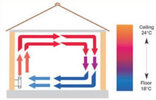
I looked for a diagram showing the currents within the cylinder while heating, loads for central heating circulation.jpg and there must be a similar flow when heating water. I would guess hot water goes up the centre and down the outside, but likely not much lower than the bottom of the element.

The odd one out is the Willis, seems only the Irish understand that, rest of us are a bit tick.

What interests me is how the power alters the flow, there must be a difference when one puts 300 watt into the immersion, to putting 3000 watt into it.
1750345454326.jpeg
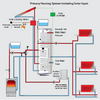
The Willis seems great, one should be able to select how much, hot water is produced, but the diagrams tend to over simplify, I have seen this Torrent pipe example.PNG up and running, it was not a single tank, it was two massive tanks on a special reinforced floor, the main concern was a power cut, and how to keep the wood burner cool enough, with warning gauges etc.
 

If you need to find a tradesperson to get your job done, please try our local search below, or if you are doing it yourself you can find suppliers local to you.

Select the supplier or trade you require, enter your location to begin your search.


Are you a trade or supplier? You can create your listing free at DIYnot Local

 
Back
Top