

Your far better off replaceing the old TRVs with new ones. The cost difference is really buttons but one of the main benefits of TRVs ,aside from temp control,is that you can use the valve without it leaking which happens all of the time with rad valves that haven't been used in a long time.

You are using an out of date browser. It may not display this or other websites correctly.
You should upgrade or use an alternative browser.
You should upgrade or use an alternative browser.
TRV's - Why ?
- Thread starter Estrella
- Start date
Not so. The hall is chosen because it is the coolest room in the house, and the rad should be sized and balanced to suit. When the hall is up to temperature, the rest of the house should be up to temperature before the hall.
The hall is not "representative of the entire building", at all. Far from it.
BB aka Dr. Drivel disagrees just for the sake of making a post. He is a troll who loves to post his drivel all over the internet. Best to ignore him.
The thermostat (commonly fixed in the hall) turns the heating to the entire building on & off as required to maintain the hall temperature, so it is taken as representing the entire area served by the heating system. The radiator in every room, including the hall, should be sized to provide the design heat loss at the design outside temperature; the hall would reach it's design temperature no faster or slower than any other room.
As others said, the problem is with your system, not the TRVs. It could be lots of things, undersized rads/boiler/pipes, sludge, defective boiler/pump, etc., etc,.
There is no point in removing the TRVs, they will not reduce the heat output. You could use them to reduce the temperature in some rooms and provide more heat to the main room. They will be useful on less-cold days when the system can deliver sufficient heat to the building.
B
BigBurner
Not so. The hall is chosen because it is the coolest room in the house, and the rad should be sized and balanced to suit. When the hall is up to temperature, the rest of the house should be up to temperature before the hall.
The hall is not "representative of the entire building", at all. Far from it.
BB aka Dr. Drivel disagrees just for the sake of making a post. He is a troll who loves to post his drivel all over the internet. Best to ignore him.
Insults come along when are proven 100% wrong. Pathetic.
I totally understand what you are driving at , but I'm afraid I disagree with a lot of it.
Thats an incredible statement considering what scant information I have provided. If you take what I call our 'kids lounge' as an example. The room dimensions are 12ft x 11ft - height 8ft. The rad is a 210mm x 75mm, which is a pretty big rad and gets very hot when the heating is on. The room has a suspended wooden floor but has underlay and carpet fitted.But the room is never anything more than aired. How much bigger should the rad be? This things bloody enormous and I dont have any other walls I can add additonal rads too.
One has the top missing (my fault) and the other doesnt smoothly wind in and out.
What happens in spring is that we rely on the one open fire we have.
Currently our heating is turned on when we come in from work and turned off when we go to bed. The timer is never used. The heating is never left on when we are out or in bed. It is rarely used during the day when we are in unless it really is bitterly cold. I dont get up and down to the heating as I put it on once then turn it off.
Fair comment.
Trust me they all need it.
My TRV's dont have temp marks on them , they are just numbered 1 - 6.
I don't know if this tells you anything or not, but my rads get to about 60 centigrade when up to temp.
Fair comment. And Ben would appear to agree, I'm just not sure where I could put additional rads in some rooms. My other plan in feb/march was to fit a good sized woodburner in place of the inefficient open fire we currently have.
Thanks for your comments fellas.
this one is unsersized, poorly designed, poorly installed and poorly maintained by the sound of it.
Thats an incredible statement considering what scant information I have provided. If you take what I call our 'kids lounge' as an example. The room dimensions are 12ft x 11ft - height 8ft. The rad is a 210mm x 75mm, which is a pretty big rad and gets very hot when the heating is on. The room has a suspended wooden floor but has underlay and carpet fitted.But the room is never anything more than aired. How much bigger should the rad be? This things bloody enormous and I dont have any other walls I can add additonal rads too.
presuming that by: " a bit old" you mean: valves are not working properly or leaking
One has the top missing (my fault) and the other doesnt smoothly wind in and out.
when spring comes, sometimes you turn it on, and sometimes (due to your wrongly-set TRVs) you are putting heat into rooms when they don't need it.
What happens in spring is that we rely on the one open fire we have.
Currently our heating is turned on when we come in from work and turned off when we go to bed. The timer is never used. The heating is never left on when we are out or in bed. It is rarely used during the day when we are in unless it really is bitterly cold. I dont get up and down to the heating as I put it on once then turn it off.
aside from temp control,is that you can use the valve without it leaking which happens all of the time with rad valves that haven't been used in a long time.
Fair comment.
and sometimes (due to your wrongly-set TRVs) you are putting heat into rooms when they don't need it.
Trust me they all need it.
there is no point in setting TRVs to "Max", it doesn't put any more heat out than if you set them to 18C
My TRV's dont have temp marks on them , they are just numbered 1 - 6.
I don't know if this tells you anything or not, but my rads get to about 60 centigrade when up to temp.
As others said, the problem is with your system, not the TRVs. It could be lots of things, undersized rads/boiler/pipes, sludge, defective boiler/pump, etc., etc,.
There is no point in removing the TRVs, they will not reduce the heat output. You could use them to reduce the temperature in some rooms and provide more heat to the main room. They will be useful on less-cold days when the system can deliver sufficient heat to the building.
Fair comment. And Ben would appear to agree, I'm just not sure where I could put additional rads in some rooms. My other plan in feb/march was to fit a good sized woodburner in place of the inefficient open fire we currently have.
Thanks for your comments fellas.
Certainly undersized and poorly designed as you told us that you live is a stone cottage in North Wales which is very cold. The fact that the house cannot reach a satisfactory temperature is surely sufficient proof that the heating system is undersized. I would agree, however, that to say the system was poorly installed and maintained is not easy to justify.I totally understand what you are driving at , but I'm afraid I disagree with a lot of it.
That's an incredible statement considering what scant information I have provided.this one is undersized, poorly designed, poorly installed and poorly maintained by the sound of it.
I think you means 210cm x 75cm!The rad is a 210mm x 75mm, which is a pretty big rad and gets very hot when the heating is on.
It may be very big and may get very hot, but is it giving out sufficient heat to counter the heat lost through the walls, floor and roof?
You are not allowing your cottage to stabilize its temperature. Stone walls hold a lot of heat, but they take a long time to warm up. You are warming the place up for a few hours each evening - most of the heat will be absorbed by the walls - and then letting the whole place cool right down overnight and for most of the next day. Not a very efficient way of heating the cottage. Read up about thermal mass.Currently our heating is turned on when we come in from work and turned off when we go to bed. The timer is never used. The heating is never left on when we are out or in bed. It is rarely used during the day when we are in unless it really is bitterly cold.
That's nit-picking. 1 = low temperature 6=high temperature.My TRV's don't have temp marks on them , they are just numbered 1 - 6.there is no point in setting TRVs to "Max", it doesn't put any more heat out than if you set them to 18C
Try turning the TRV down one number at a time and see what happens. If the radiator is providing sufficient heat the TRV will turn off and the rad will cool down. If the rad does not go off until the TRV is at 1 or 2, it is not supplying sufficient heat.
But, as said, setting the thermostat to 6 will not make the room heat up any faster. The thermostat is just a temperature controlled switch which stops the flow of water through the radiator when the air temperature reaches the setting on the TRV
That's low. I would have expected a temperature of about 70°C, though condensing boilers may have a lower temperature, say 65°C. The temperature will depend a bit on the outside temperature.I don't know if this tells you anything or not, but my rads get to about 60 centigrade when up to temp.
It might be worthwhile comparing the output of your boiler with the total output of the radiators to make sure the boiler is not undersized.
It might be worthwhile comparing the output of your boiler with the total output of the radiators to make sure the boiler is not undersized.
Thanks I will do as you suggest.
Is there a way of working out my current rads output ?
Is there a way of working out my current rads output ?
If they are standard flat panel rads, you could use the Stelrad Elite Catalogue. The difference between manufacturers' products is fairly insignificant.
Come back with the results and details of your boiler.
Many thanks
I have measured all rooms /rads and taken a pic of the boiler for good measure. I can’t find the exact model of boiler on the net for specs, only what I assume is a newer version?
I have a vented, gravity fed oil fired central heating system.
The house is constructed of brick /slate /stone and anything else I thing that was lying around. Oddly the walls are approx 3ft thick downstairs but taper as they travel up. Not sure what the reason for this is. The walls in the upstairs bathroom are only 18 inches thick. There obviously isn’t a cavity. All internal walls are brick. The front elevation has UPC double glazing, the rear has wooden double glazing, and it’s crap!
The loft has 20cm of insulation in two runs of 10cm at 90degrees to each other.
The room dimensions and rads are as follows.
Lounge (with operational open fire) 12 x 12 - 800 x 600 double rad – 4853 BTU
Hall 28 x 6 1200 x 600 double rad – 7280 BTU
Kids Lounge 12 x 12 2100 x 750 single rad – 5000 BTU
Kitchen 12 x 12 1100 x 400 single rad 1600 BTU
Dining room 12 x 12 1100 x 550 double rad 5288 BTU
Master bed 13 x 13 1740 x 750 single rad 3330 BTU
Bed 2 13 x 13 2300 x 600 single rad 4995 BTU
Bed 3 13 x 13 1600 x 600 single rad 3330 BTU
Bed 4 8 x 6 No rad
Landing No rad
Main Bathroom 8 x 10 800 x 600 double rad 4853 BTU
Separate WC 10 x 4 No rad
Total BTU - 40529
EDIT: All ceilings are approx 8ft high.
Kids lounge, Master and Bed 3 have sealed up fireplaces. The downstairs hall has open stairs off to the upstairs landing.
The boiler is an oil fired Worcester Danesmoor 15 / 19 . I have no idea of its power output, and would guess at an age of 15 – 20 years.
Hope that helps.
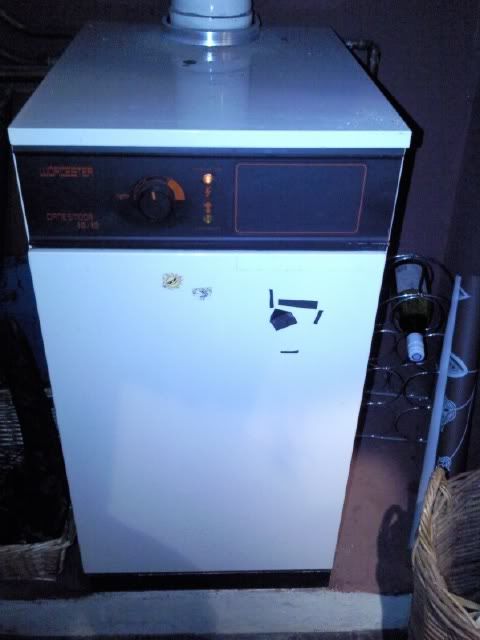
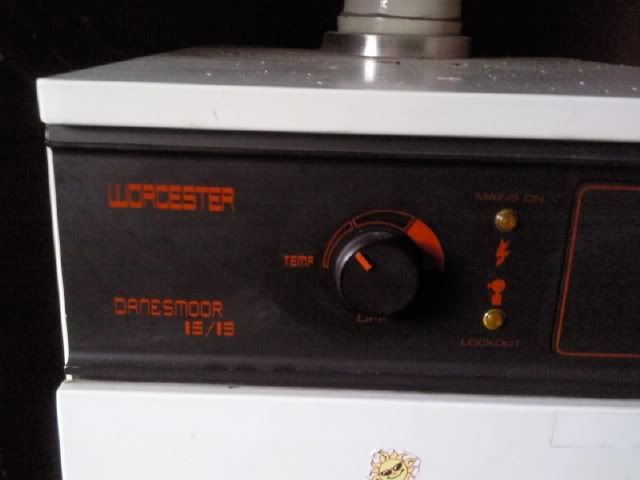
I have measured all rooms /rads and taken a pic of the boiler for good measure. I can’t find the exact model of boiler on the net for specs, only what I assume is a newer version?
I have a vented, gravity fed oil fired central heating system.
The house is constructed of brick /slate /stone and anything else I thing that was lying around. Oddly the walls are approx 3ft thick downstairs but taper as they travel up. Not sure what the reason for this is. The walls in the upstairs bathroom are only 18 inches thick. There obviously isn’t a cavity. All internal walls are brick. The front elevation has UPC double glazing, the rear has wooden double glazing, and it’s crap!
The loft has 20cm of insulation in two runs of 10cm at 90degrees to each other.
The room dimensions and rads are as follows.
Lounge (with operational open fire) 12 x 12 - 800 x 600 double rad – 4853 BTU
Hall 28 x 6 1200 x 600 double rad – 7280 BTU
Kids Lounge 12 x 12 2100 x 750 single rad – 5000 BTU
Kitchen 12 x 12 1100 x 400 single rad 1600 BTU
Dining room 12 x 12 1100 x 550 double rad 5288 BTU
Master bed 13 x 13 1740 x 750 single rad 3330 BTU
Bed 2 13 x 13 2300 x 600 single rad 4995 BTU
Bed 3 13 x 13 1600 x 600 single rad 3330 BTU
Bed 4 8 x 6 No rad
Landing No rad
Main Bathroom 8 x 10 800 x 600 double rad 4853 BTU
Separate WC 10 x 4 No rad
Total BTU - 40529
EDIT: All ceilings are approx 8ft high.
Kids lounge, Master and Bed 3 have sealed up fireplaces. The downstairs hall has open stairs off to the upstairs landing.
The boiler is an oil fired Worcester Danesmoor 15 / 19 . I have no idea of its power output, and would guess at an age of 15 – 20 years.
Hope that helps.
Total BTU - 40529
The boiler is an oil fired Worcester Danesmoor 15 / 19 .
That's 15-19kW Output, which is 51,000-65,000BTU/hour in old money.

If we allow 3kw (approx 10,200BTU) for hot water, you would need a 50,700BTU boiler. So your existing boiler is up to the job, so far as the existing rads are concerned. Fortunately your boiler has spare capacity of 14000BTU (it might need the burner nozzle changed), if you wanted to install more radiators.
1. The upstairs walls don't have to carry so much load, so they can be thinner.The house is constructed of brick /slate /stone and anything else I thing that was lying around. Oddly the walls are approx 3ft thick downstairs but taper as they travel up. Not sure what the reason for this is.
2. Thicker walls retain more heat, so they act like a crude storage heater.
Something else to absorb the heat. Modern houses usually have internal walls of timber studding with plasterboard facing - negligible heat retention.All internal walls are brick
Have you considered changing it?the rear has wooden double glazing, and it’s rubbish!
That's goodThe loft has 20cm of insulation in two runs of 10cm at 90degrees to each other.
You said that you don't have a wall thermostat, what is the boiler temperature control set to?
How do you control the times when the heating is on and at what times does the boiler go on and off?
Have you considered changing it?
Yes, it's on a very long list of things we have to do next year. This house is a bit of a project as you may have gathered
If we allow 3kw (approx 10,200BTU) for hot water, you would need a 50,700BTU boiler. So your existing boiler is up to the job, so far as the existing rads are concerned. Fortunately your boiler has spare capacity of 14000BTU (it might need the burner nozzle changed), if you wanted to install more radiators.
Superb info , thanks. Can I assume that replace some of the existing singles with doubles may also warrant a nozzle change ?
You said that you don't have a wall thermostat, what is the boiler temperature control set to?
See pic below , I did run it on max once for a few hours to get a handle on what rad temp difference there would be. It was around 10 centigrade.
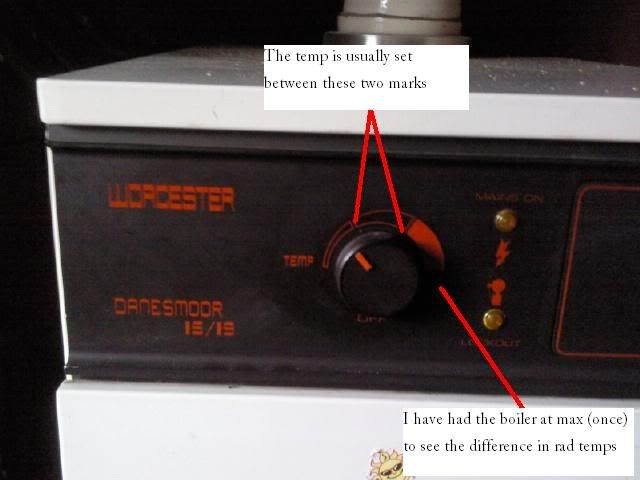
How do you control the times when the heating is on and at what times does the boiler go on and off?
The boiler is either switched on or off. We do not use the honeywell timer other than to shift the sliders to 'constant' to turn it on and to 'off' to turn it off. Pics below.
does the boiler go on and off?
Not sure what you mean by this. It isn't constantly firing if thats what you mean. It seems to act as I imagine it should, i.e when its up to temp it fires when return drops to a certain temp.
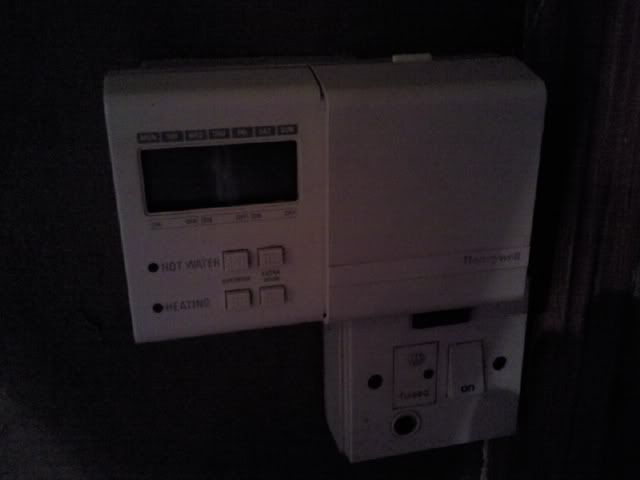
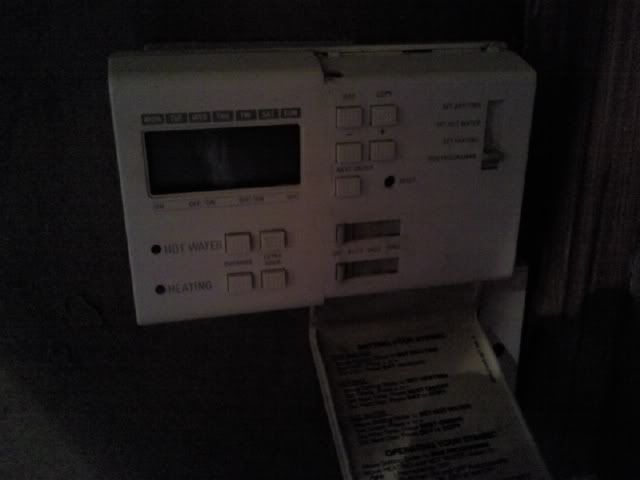
Appologies for the dire piccy quality and many thanks again for the wisdom

Can I assume that replace some of the existing singles with doubles may also warrant a nozzle change?
Double rads will give higher output, so will need more heat from the boiler. I assumed, earlier that your boiler was set to the minimum output of 51,000BTU. If this is the case, you will needs the burner nozzle changed to increase the output to max (65,000BTU). Only your boiler engineer will be able to tell you which nozzle is installed.
A 10-11°C temperature difference is what you should be getting. Why didn't you leave the boiler set to max?I did run it on max once for a few hours to get a handle on what rad temp difference there would be. It was around 10 centigrade.You said that you don't have a wall thermostat, what is the boiler temperature control set to?
I was asking what times were set on the clock for the boiler to go on and off. But as you do not use the clock, the question is irrelevant. Your comments do beg the question: why don't you use the clock?The boiler is either switched on or off. We do not use the honeywell timer other than to shift the sliders to 'constant' to turn it on and to 'off' to turn it off.
Not sure what you mean by this.does the boiler go on and off?
Your house, due to its construction, will take a long time to get up to temperature. But once there, it will take a long time to cool down. It would probably be best to run the system almost continuously until it was up to temperature and then set it to timed periods. All you will be doing then is to replace the heat lost getting the house up from 16/17°C back to 21°C.
A programmable thermostat, e.g Honeywell CM900 series, would be helpful as it allows you to set an overnight temperature, e.g 16°C, so the house never gets too cold.
Only your boiler engineer will be able to tell you which nozzle is installed.
Thats fair enough. I would never mess with the boiler internals.
A 10-11°C temperature difference is what you should be getting. Why didn't you leave the boiler set to max?
To be honest the decision was a financial one. Running at a slightly lower temp would use less oil. And with the fire lit (using free fuel) it helped.
Your house, due to its construction, will take a long time to get up to temperature. But once there, it will take a long time to cool down. It would probably be best to run the system almost continuously until it was up to temperature and then set it to timed periods. All you will be doing then is to replace the heat lost getting the house up from 16/17°C back to 21°C.
Yup, I undertand what you are saying , and I agree with you. I am just wondering which is the best way to achieve that. I am fitting a 10KW multifuel stove in feb/march, so I was hoping that might help heat the fabric of the building a little. I have a good supply of free fuel , so woodburning is very attractive financially.
Many thanks D_Hailsham, you have been very helpful.
Don't think I can help any more, without repeating myself.
I think the multi-fuel stove is a good idea.
Hope you solve your problem.
I think the multi-fuel stove is a good idea.
Hope you solve your problem.


DIYnot Local
Staff member
If you need to find a tradesperson to get your job done, please try our local search below, or if you are doing it yourself you can find suppliers local to you.
Select the supplier or trade you require, enter your location to begin your search.
Please select a service and enter a location to continue...
Are you a trade or supplier? You can create your listing free at DIYnot Local
Similar threads
- Replies
- 17
- Views
- 30K

