• Looking for a smarter way to manage your heating this winter? We’ve been testing the new Aqara Radiator Thermostat W600 to see how quiet, accurate and easy it is to use around the home. Click here read our review.

Under Stair Storage and Reinforcement

Joined
9 Apr 2024
Messages
55
Reaction score
15
Country
United Kingdom
Good Morning,

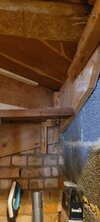
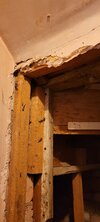
The previous owners started to utilse the space underneath the stairs as storage and I want to open it up a lot more. I have the following challenges:

1) The stairs creak underfoot.

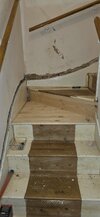
2) You will see from the images its a mess and the classic a block of wood and more nails will do the trick.

The go to support method is a piece of wood in the middle straight to ground. I would like to remove these so I open up the space for boxes and so on. The supporting walls are made out of dense block and the stair floor is hard wood. The property was built in the 1970s.

Whats the best way to support the stairs and solve the underfoot creaking?

Thanks in advance.
 

Attachments

  • 20240408_162833.jpg
    20240408_162833.jpg
    157.2 KB · Views: 177
  • 20240408_162854.jpg
    20240408_162854.jpg
    200.7 KB · Views: 178
  • 20240408_162906.jpg
    20240408_162906.jpg
    208.4 KB · Views: 181
Quality wood glue used to stick and screw blocks of wood where you think is a good spot.
I've done a few to fix.

Those stairs are probably built on site with nails holding together. Not the best but you can improve
 
Thanks for the replies. Seems like its a simpler job then what I was thinking. The only other thing is how to secure to the wall as I suspect I will make some bracing to support the mini landing area. Is this a case of using joist hangers and some 2x4 or similar?

RE using a company, this is the route I am trying to avoid for numerous reasons.
 
I've had a further look and done some more research. The stringers are 25mm and seems to have been built in 3 sections, the bottom and top then the middle turn section.

I have 2 thoughts for strengthening:

1) router beneath the current runners and put in some 18mm (or even 25mm) plywood to ineffect create a double deck. This can be reinforced on the stringer with blocks and glue if needed or full length timber and joist hangers. This feels like the easier and less intrusive option.

2) partial or total rebuild using 45 * 250mm carcassing. Runners routered into the stringer and doubled as above. Also makes replacing the "decorative" section of the deck easier if someone wants to change wood type, maintenance etc.

Not sure if I will build a timber frame for the turn section to keep it open and usable for storage at this point.

Any thoughts on the above based on experience? Main thoughts are whether 25mm stringers are strong enough and in both cases, if there is a minimum amount of material I need in the stringer.
 
general comments

not sure what you want to router but a string in situ is not really router compatible
half inch router around 70mm from cutter edge for base to run on and 1/4" perhaps 45mm with a trim router down to perhaps 30mm
 
For the string in situ, it's creating space for the plywood to sit underneath the current deck. Router came to mind but chisel works too.

Forgot to add if a 25mm string is too small, perhaps reinforce with a "new" plywood string underneath glued and screwed to it.

Of course a new string is easier to router but I'm trying to avoid a rebuild if I can.

I know removing materials is more work but it should mean the stairs are stronger overall.
 
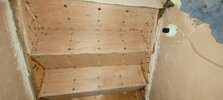
Started the upper section and decided to use 18mm Plywood to create a shadow staircase underneath and reinforced with triangle bracing on the stringers. It's work in progress but you see the concept.

The plywood is PVAed to the underneath and screwed in to create a single thicker plank.

Materials used:

18mm structural plywood

PVA glue (could use other stuff but I have lots around the place)

5 x 30mm TX structural screws for the risers

5 x 40mm TX structural screws for the treads

M8 and M6 washers to spread the load and prevent screws bursting through.

Gorilla Glue polyurethane expanding to fill gaps.

Tools used:

Impact driver

Combi drill

Multi Tool to cut old shims and prepare existing staircase

Varioua hammers to remove nails and old wood

Circular Saw

Chisel

Tape measure

Set square

Spirit level/long straight edge

Next stage is a little more complex so will probably use some C24 carcassing as columns and maybe create a timber frame. Let's see!
 

Attachments

  • 20250802_100133.jpg
    20250802_100133.jpg
    156.8 KB · Views: 45
15 per board and 7 for the triangles. This tub of 800 is starting to look light...
 
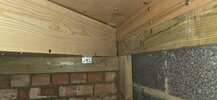
This is the work in progress. Had a couple of snags:

Skirting board was actually structural and held in by 4 nails. So that was removed and replaced with a wooden frame. In hindsight, better to have done the entire stair like that as much of it needed frame reinforcement in the end.

2 steps needed total replacement and 20mm tongue and groove is working nicely. Unsure if to straight varnish or charr before varnishing.

As for using PVA, I did need to deconstruct a board. It took 2 people with multiple wreaking bars and hammers to prise it apart so will stand the test of time and strength.
 

Attachments

  • 20250906_142538.jpg
    20250906_142538.jpg
    221 KB · Views: 24
  • 20250907_162043.jpg
    20250907_162043.jpg
    173.9 KB · Views: 25
Mine was very similar. I reglued and screwed some of the old blocks at the sides, doubled up the rest at the front tread/riser joints and then used timber when I ran out, I used angle iron at the back - rock solid now.

Screenshot_20250909-090415~2.jpg


Screenshot_20250909-090300~2.jpg
 
I thought about the angle Iron approach. However I found the treads were only 20mm so definitely needed some reinforcing underneath.

That said, on the bigger spans I may pop some angle iron or a 45x45mm carling. Im letting it settle but it definitely creaks a lot less. And will be a lot stronger overall.
 

If you need to find a tradesperson to get your job done, please try our local search below, or if you are doing it yourself you can find suppliers local to you.

Select the supplier or trade you require, enter your location to begin your search.


Are you a trade or supplier? You can create your listing free at DIYnot Local

 
Back
Top