• Looking for a smarter way to manage your heating this winter? We’ve been testing the new Aqara Radiator Thermostat W600 to see how quiet, accurate and easy it is to use around the home. Click here read our review.

Victorian Basement Flat internal walls badly spalled

I think, from a re-read, that it's an interior wall adjoining the ex-party wall that's now retaining. So it's safe to assume that ex-party wall is very wet, and the moisture is wicking from it along this adjoining interior wall.

A DPC isn't going to help. It may even make things worse by stopping it moving down, trapping it within the wall.
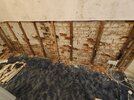
 
I think (but obviously don't know), that the wall facing us is an internal wall with another room on the other side, in which case it would benefit from a dpc that would be continuous with the floor dpm. If the right hand wall is the party wall now backfilled with whatever from the new construction next door there's no point installing a dpc - needs fully tanking as said.
Yes to all that. The wall with the radiator pipes is internal and separates the living room from the bedroom, the wall at right angles to it is the old party wall to what was the next property along (identical in design to ours), which has been filled in with **** knows what, there's a socking great block of flats there now.
The worst brick damage is the corner where they join and the corner at the other end of it (the other side of which is the outside front yard).
As I said, the floor is screeded but we don't know what's under that, possibly brick, and vanishingly unlikely there's any form of DPM. But the floor is not damp whatsoever in any area more than a few inches away from the wall.
We have found evidence in other rooms that they were indeed originally sculleries and kitchens but an old plan from 1912 mentions "offices" and "luggage storage".
 
...all before next-door was turned into a soakaway though.

Have you dared to look at what's under the plasterboard on that ex-party wall?
 
I think, from a re-read, that it's an interior wall adjoining the ex-party wall that's now retaining. So it's safe to assume that ex-party wall is very wet,
Only at the bottom dozen or so courses, and mostly at the corner where the walls meet and the other end of the old party wall.
and the moisture is wicking from it along this adjoining interior wall.
Seems right. The rest of the party wall is mostly dry and the odd spalled brick there is mostly due to them being mass-produced cheap Vistorian brick that is now 160 years old.
A DPC isn't going to help. It may even make things worse by stopping it moving down, trapping it within the wall.
Ideas? Continuous ventilation?
 
Last edited:
...all before next-door was turned into a soakaway though.

Have you dared to look at what's under the plasterboard on that ex-party wall?
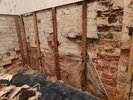
Pics attached. Note the 1970's "developer", or maybe someone who re-did the work sometime before we moved in in 2000 saw fit to put up polythene sheeting in that corner.
Rest of wall to the right of this is drier, bottom of the battens are not rotten although there's lots of (mostly dry) spalled brick dust, up to the corner at the other end and some efflorescence.
NB there's evidence of a separating wall having been removed, you can see where they chipped away, between the 4th and 5th batten
 

Attachments

  • IMG20250115122617.jpg
    IMG20250115122617.jpg
    377.4 KB · Views: 60
  • IMG20250115122638.jpg
    IMG20250115122638.jpg
    491 KB · Views: 63
Honestly, being utterly blunt it looks terrible. Get some good legal advice on the shared freehold thing and/or consider running away.
 
Sub-terranean structures are incredibly difficult and costly to make habitable, even those purpose built for habitable consumption. The numbers are eye-watering. Don't let anyone fool you into thinking you can resolve it with some battens, insulation, strategic DPM and clever paint.

As said, some underground buildings were just not meant for living in.
 
There's a further issue here that, besides the damp, the wall is literally dissolving.

I'm wondering if the internal walls were built from some sort of soft non-waterproof brick, the original building had an outer perimeter of harder bricks, wrapping around this house and the next door neighbour. One half gets bombed, its basement gets infilled, opening up the internal soft bricks to groundwater that they were never intended to be in contact with.

Either that or it's just age. Buildings haven't ever lasted for ever. Just like today, that victorian builder was only ever interested in getting paid and paying his bills, and probably bought his bricks from wherever was cheapest and would last until it wasn't his problem any more.
 

If you need to find a tradesperson to get your job done, please try our local search below, or if you are doing it yourself you can find suppliers local to you.

Select the supplier or trade you require, enter your location to begin your search.


Are you a trade or supplier? You can create your listing free at DIYnot Local

 
Back
Top