Views on wireless light switches

Joined
10 Jan 2010
Messages
289
Reaction score
60
Location
London
Country
United Kingdom
Dear Reader,

what is your view on wireless lighting switches?

Context:
I will be doing a side return extension with full kitchen teardown and rebuild. I.e. I can accommodate any wiring needed.... I want to have once smart switch with a fancy screen to control lighting, heating, audio... but that switch is located on the far side of the kitchen. I also want physical switches at the entrance so you can illuminate the kitchen w/out walking through it to get to the smart screen type switch on the far side

At the moment the option that fits the specs is a Lutron RA2 Select system with wireless battery operated switches. All lighting circuits have an inline dimmer switch, and then you can place these wireless battery operated remote switches anywhere. In addition, you can also install some Hub, which is also able to speak to the dimmer so you can app/smart control on top.

My question is, I feel a bit uneasy to not run any switch wiring down anywhere.... Is that how it's done these days? Would you run a spare/unused wire from each lighting circuit as backup to each switch location in case one wants to go back to traditional 2/3 gang regular switch or dimmer switches?
 
Wireless switches. Good grief.
I turned electric off and back on while working on a job and ended up working in a bathroom with multi coloured lights flashing all afternoon as I couldn't find the switch.
Was hidden in cupboard/panel.
I was shouting hay Google and hay Alexa just incase. Stuped things!
Ha.
The do work ok. Not for me though
 
what is your view on wireless lighting switches?

Wireless - OK if you like that sort of thing.

Battery powered - no thanks.

Run wires to the switch positions, including a permanent live and a neutral. I.e. a 3-core+earth for a 1-gang switch position. Then fit powered smart switches if you want.

There are also the quinetquick switches that don’t need wires or batteries.
 
The Tapo (TP-Link) light switch is battery powered, so turning the mains on/off does not affect its status.

My Energenie light switches need a load to work, so turn power off/on and all lights switch off.

Turn my smart bulbs off/on and they all turn on.

So at 9 am I set all lights to switch off, so any power cuts which turn them on, it is for a limited time.

On the odd time, we do get a hick-up, and google Nest fails, so want a light switch where using smart bulbs, so switching the lights of and on, will turn them on, even if the smart bit malfunctions.

I would say avoid any two way lighting, if you want a second switch then these
1793642018753.png
the Tapo S200D (D gives the square plate B is just switch) can give you as many switches as you want, without two way wiring, just use deep back boxes for the main switch S210 single or S220 two gang.

If you want dimming, use smart bulbs, so you can also set colour temperature. But include a switch, so when you go on holiday you can ensure lights stay off. Even if a key switch.

The advantage to my mind, is with a mixture of standard lamps, ceiling lamps etc, one command turns off all.
 
At the moment the option that fits the specs is a Lutron RA2 Select system
Wires and cables will last pretty much for ever and can be used with many different switches from any manufacturer.
They will continue to work until they break, at which point a replacement switch from any electrical shop anywhere can be installed in minutes by anyone.

Proprietary closed system affairs from the likes of Lutron and others will work for as long as the manufacturer can be bothered to support the product, and can be maintained while the specific replacement parts and those who can access the programming system are still around.
Once those go away, the whole lot is scrap.

This particular system is actually quite standard and can easily be amended/modified. One of my previous flats had a lutron system and it lasted w/out any problems until I sold after eight years. Some of my friends still live there and it still works fine 13 years later. So not too worried about quality issues or the company going down. On the broad I had a very good experience with Lutron (hence looking to use them again, but in a different setup)

My initial question was not about whether smart switches are good, I've deliberately left maker and model details out... It was more a question about the lack of physical wiring to the switch locations itself and if this has become standard for new projects with smart lighting. But in the end I think I will just get the sparky to put wiring to each location anyway and do a loop at switch setup. If at some point down the line I want to revert to regular switches that should be very easy. This system just has dimmer modules wired inline before the lamp fitting/circuit (just like an LED transformer). If not needed anymore, you can just pull it out of the ceiling void and wire the circuit directly onto the fitting.
Good luck with that when anyone who hasn't spent 3 days learning how to use it just wants to turn the lights on.
those were almost exactly my wife's comment.... :LOL: eh.. she got used to the previous system..it'll be fine...
 
My automation was not really by design, it was due to circumstances, it started back in around 2016 as an attempt to look after an ailing mother, two major problems, one how to heat the house, and two how to be alerted when mother went on wheel about, she was confined to a wheel chair.

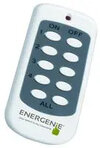
My answer was Energenie, both TRV heads for heating, and programmable and remote control operated sockets that supplied the extruder alarm, and since using Energenie also fitted some lights switches in the bedroom, as no two way switching, so the remote controls Remote control.jpgallowed me to turn lights on/off from in bed.

On mothers death and moving house, we found some Energenie stuff going cheap, so added a lot more, that was when the problems started, I will guess some interference as I had so many units, Mihome-used-crop.jpg some switches turned into flasher units, with a light switch or socket that's a problem as need to turn off power to remove them, so I now prefer plug in adaptors, or bulbs, as if they go wrong, easy to replace.

Two things happened next, one middle isle in Lidi I got a zigbee power strip, so then got a zigbee hub, and also FM radio does not work where I live, so we got Nest Mini speakers to listen to radio, and we found they could control devices.

But we have no neutral at the light switches, and I found the TP-Link (Tapo) which have batteries, so will switch even a PIR controlled outside light, and the socket adaptors even show what watts items use, and the dusk/dawn switching for the light switches I have used a lot.

For a 8 bulb chandelier fitting to use 8 smart bulbs is expensive, so a TP-Link light switch is cheaper, but with 4 bulbs, at £5 each, not much in the price, and you can have colour changing, and colour temperature changing as well as dimming and on/off, so the bulb is often the better option.

My problem was my living room has one light fitting, even with 8 bulbs in the chandelier, there are dark areas, so I have cabinet lights in the Billy book case, and up-lighters with large bulbs, to use Google home with the Nest Mini's means a single command can turn off all lights, and the same applies to our 7 outside lights, can turn them all on/off together.

Same goes for heating, one command can turn up or down wall thermostat and two TRV heads even when all different makes.

Some of our lights need a spacer to get the larger smart switch in, as the back boxes not deep enough, I have one odd relay in my landing light, lamp-landing_1.jpg the centre light and outer lights are separate centre one can change colour as well, cross fingers it has not failed, but in hind sight think it was a mistake.
 
I have a friend who has fully automated the lighting in their home without a single switch anywhere and all control is on their phones.

Not much use when a visitor - me - went to the toilet, a toilet without windows. I quickly used the light on my phone but very silly.
 
Overriding principle:

Just because you can, doesn't mean you should..
 

If you need to find a tradesperson to get your job done, please try our local search below, or if you are doing it yourself you can find suppliers local to you.

Select the supplier or trade you require, enter your location to begin your search.


Are you a trade or supplier? You can create your listing free at DIYnot Local

 
Back
Top