• Looking for a smarter way to manage your heating this winter? We’ve been testing the new Aqara Radiator Thermostat W600 to see how quiet, accurate and easy it is to use around the home. Click here read our review.

Wet rot wooden lintel in damp cellar

Joined
10 Jan 2010
Messages
241
Reaction score
47
Location
London
Country
United Kingdom
Hello all,

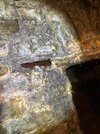
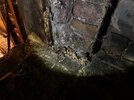
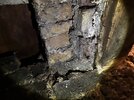
I am doing some works in my old victorian damp cellar. Whilst working there, I have noticed this lintel over the old coal chute arch, which is not is used anymore. The lintel is actually wood and suffers quite some wet rot, especially on the left side. I can almost peel off bits of the wood and the entire lintel feels damp to the touch.
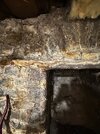
IMG_1189.jpgIMG_1190.jpg

It's not in great condition, but given that this is 100 years old in an already damp cellar, probably not too surprising. I am not looking to invest much here, but any suggestions of how I can cleanup/strengthen this a bit? I still have some ronseal wet rot wood hardener, but I am not really sure this is going do to anything. Are there perhaps some epoxy based hardener to add some strength here?

I am not looking to do any changes to the wall other than maybe a coat of lime wash to bright up the area a bit (as I have done on the right wall)
 
There's an arch above it, so hopefully the wood was just to enable the arch to be built rather than to hold the wall up. An arch won't hold itself up until the last brick is placed, so it needs temporary support.

Usually arch supports are removed after, but there's no harm in leaving it there. The same thing on a much bigger scale!....

building-viaduct-1890s.jpg
 
wooden lintel looks quite wide, I wouldn't trust taking it all out in one go

what is above the arch ?
 
Thanks both. I like the theory that the arch is supposed to hold itself up and the wood lintel is just a temp support and therefore I can "ignore" it....

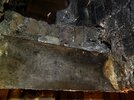
I fiddled around with it a bit, and a big chunk came off... that brown area behind feels very porous, I can almost carve out more with my finger
IMG_1191.jpg

what is above the arch ?

IMG_1193.jpg
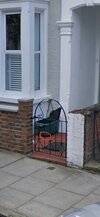
So this is from the outside. The old coal chute is roughly where the red circle is. so the arch is either just below the front garden, or is under the outside brick wall of the house.

IMG_1192.jpg
Here another closeup. Above the arch there is a bit mortar and then a DPC followed by more bricks.. the grey looking part is actually just another brick. So it could potentially be running under the house wall.
 
the right hand side of the arch looks good - but the left hand side the arch looks like it is sitting on the wood, even some cracking in the stonework where it may have settled a bit onto the rotten wood, if that is the case it could come down if you remved the rotten wood

chances are you could gently remove it and it may stay up, but if it does move down you may have to do some repairs to those tiles near your frnt door. If the wood is still has a bit on integrity too it where my arrow is pointing, acro prop it, slowly and gently remove the rotten wood and back fill with concrete

seriously though get some proper advice from someone who can have a feel and prod of it all - total guess work looking at a picture on the internet

1754949884458.png
 
Thanks @Munroast. Appreciate it's guesswork based on pictures, but still sounds like a good/reasonable assessment.

I don't really mind any potential damage to the tiles near my front door, as I plan to get the front garden redone in a few years, pending some more works inside the house.

Got a few more questions about the practicability of doing anything here.

1. Provided I find a short enough acrow prop to fit in that space to support the wood from below, the ground is on a very steep slope. I assume I would need to build some sort of wooden block to get a level surface?
2. Removing the entire lintel would probably also cause these filler bricks between the lintel and the actual arch to come down. Would it make sense to prop up the wood and then scrape/carve out only this rectangular bit and backfill with cement?
1754987099071.png
 
you don't want to be jacking up to much, in fact not jacking it up at all, it needs to be tight so it can't move down, lift it up and you have made things worse - you might get away with a car scissor jack on the end of a piece of 4x4 -

the green square you have highlighted - how far can you shove a screwdriver into that ? how soft is it a couple of inches in

and what can you see from the other side
 
the green square you have highlighted - how far can you shove a screwdriver into that ? how soft is it a couple of inches in

and what can you see from the other side
Will check tonight after work and provide pictures and more details.
 
If it's spanning the doorway then it's under almost no stress.

But if it's under that pillar on the left of the door then it's holding up the front of the house.

You need to work out where it is. I'm guessing the former rather than the latter, but check.

I agree with the above that it does look like the timber may extend beneath the load bearing end of the arch. In which case it does need something doing, and probably something similar on the other side.

If it does need work then it may be safer and simpler to just remove the whole arch and replace it with a concrete lintel. Obviously including a number of props during work.
 
There's an arch above it, so hopefully the wood was just to enable the arch to be built rather than to hold the wall up. An arch won't hold itself up until the last brick is placed, so it needs temporary support.

Usually arch supports are removed after, but there's no harm in leaving it there. The same thing on a much bigger scale!....

building-viaduct-1890s.jpg
Looks like a big (buttress) miscalculation in that image. :oops:
 
how far can you shove a screwdriver into that ? how soft is it a couple of inches in
pressed a screwdriver in with virtually no resistance.... all mushy..

Here some more details. The wooden lintel is about 17cm wide, but the entire brick arch is 40cm wide. The wood lintel is just on the front part...

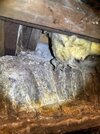
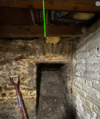
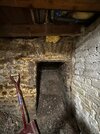
this picture shows the arch and the wood board from below:
IMG_1196.jpg

and then the left (bad) side from behind:
IMG_1201.jpg

and the right side from behind:
IMG_1202.jpg

Given that the board is only on the front, the arch must be supporting itself fine? To me it looks like the arch is stable, and the wood board is just holding up the filler bricks between the arch and the wooden lintel? What do you think?
 
OP,
Keep your arch its a rare Victorian survivor - dont go knocking everything about or using a concrete lintel.
The lintel & infill need replacing with, say, a steel, Former strap just like the wrought iron ones supporting Victorian fireplace arches. There would be no need for a Big Boy Acrow.

What the archway itself might be supporting is hard to tell?
Pics of the timberwork above the archway would help?
Joist tails seated in wall pockets & all timber showing signs of rot will need to be cut out, the area treated with fungicide, & replaced with treated & protected materials.

In post #11 there are signs of dry rot - can you post clear, detailed pics showing the floor to wall abutment?
Could you also post a pic of your GF Bay skirting boards?
Where & how does the bay roof drain?
 
Last edited:
quick vent >> AAAAARGHs.... why do so many DIY projects on victorian properties start with opening a can of worms and discovering problems that need addressing first. Buy a victorian period property they say...it's got so much charme... don't worry the L3 survey will pickup on any issues.. HAH! Been at the property for only two years and have fixed/improved/DIYed +50 projects...most of them small stuff, but the bigger ones have always cost much more time and money as expected....

ok I feel better now.

I definitely do not want to make big changes there if not needed. The idea was to make the cellar space somewhat more nicer for storage.

What the archway itself might be supporting is hard to tell?
1755075155955.png
Yes agreed. The green line is where my hallway is. My front door is setback about 1m from the wall, which is aligned with the front wall of the house. So left of the green line will be part internal, and part external, which is the tiled area outside under the doorway.
In post #11 there are signs of dry rot - can you post clear, detailed pics showing the floor to wall abutment?
See picture above. The rot you see is all on this wooden lintel we are discussing, unless I misunderstood your question. If the wood beam was not in such a terrible condition I would've just scraped it away and used fungicide + wood preserver + filler to repair. I have done this in other areas.

Could you also post a pic of your GF Bay skirting boards?
Where & how does the bay roof drain?
Pls clarify GF Bay skirting boards. Do you mean the area outside, where in #4 the green mixed recycling container sits?

This is an interesting point, coming to think about this. The bay roof actually drains towards the other side and runs into a shared downpipe with my neighbour. However(!), they bay roof drain also takes all the water from the main roof above on the same side. I have noticed during medium/heavy rainfall that the drain cannot cope with the amount of water bursting out of the top roof pipe where indicated in red. A good amount of water then splashes straight down onto the front garden on the tiled area exactly where arch in the cellar is. I did not think that this would sip through the tiles into the ground though... so never did anything about it, apparently nor the previous owners. I have pictures of the basement from 2 years ago when I moved in and it looks the same, i.e. this might have existed a long before I moved it.

1755076421558.png

Maybe this is the first point of action to increase the size of the gutters so they can cope with the amount of water appropriately. Another unexpected couple hundred quid out the door...
 
If it's just holding up the front doorstep I'd just leave it, you could create more movement by fixing it than will ever be likely to happen if you don't.

What's above it?
 
If it's just holding up the front path then it hardly matters. But it you want to be sure you could pull up the front path and rebuild it from above.

The red tiles are widely available, or you may even be able to re-use them if they come out whole.
 

If you need to find a tradesperson to get your job done, please try our local search below, or if you are doing it yourself you can find suppliers local to you.

Select the supplier or trade you require, enter your location to begin your search.


Are you a trade or supplier? You can create your listing free at DIYnot Local

 
Back
Top