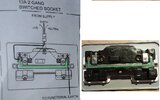
Wiring plug socket, 'to functional earth'

Joined
17 Mar 2022
Messages
70
Reaction score
5
Country
United Kingdom
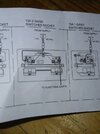
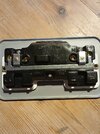
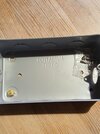
Sorry to make more than one thread, but I figured it was clearer to do separate threads for separate questions. I need to put in a couple of sockets and the ones I bought contain something I haven't seen before -- the instructions specify connecting a wire 'to functional earth'. I've included a picture of the instructions as well as of the box. My guess is that it's a wire extending from the earth terminal on the back of the plug, to the small terminal at the bottom of the back part. Is that right? Is it because the box is metal rather than plastic? Thanks for your help!
 

Attachments

  • 20250117_095538.jpg
    20250117_095538.jpg
    258.2 KB · Views: 138
  • 20250117_095548.jpg
    20250117_095548.jpg
    300.5 KB · Views: 123
  • 20250117_095553.jpg
    20250117_095553.jpg
    228.8 KB · Views: 129
That socket is confusing as it does not treat the Protective Earth as being separate and different from the Functional ( Clean ) Earth

A Functional Earth (FE) is used for operational purposes such as reducing noise and improving signal integrity in electronic systems.
A Protective Earth (PE) is used for safety, preventing electric shock by grounding exposed conductive parts.

mk clean earth.jpg
 
1. I don't think the OP needs a clean earth as Bernard pictures.

Just connection the socket up normally. Yes, it makes sense to connect that spare earth terminal upto the backbox (as you have metal clad sockets)
 
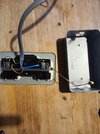
So would this be the gist of it? Sorry for the entry-level questions, just conscious this is an area where you don't want to mess around.
 

Attachments

  • 20250117_111539.jpg
    20250117_111539.jpg
    301.7 KB · Views: 89
Yes, but it is nothing to do with what is called a functional earth.

The bare wires should be sleeved with green and yellow.
 
Great, thank you. The cable's 2.5mm but Screwfix doesn't seem to have green/yellow sleeving in that diameter in quantities of less than 100m. Is it ok to use a larger diameter sleeve, since I can get that in smaller lengths?
 
the cpc - earth wire in 2.5mm twin and earth - is 1.5mm
on a ring/spur/radial - I would often sleeve both wires with one bit , and so use larger sleeving
and i often bend the wire and connect so its 1 continuous piece - but thats just a diyer now - taught electrical and electronics back in the 70's and rewired houses back then with some sparkies
 
Earth. The conductive mass of the Earth, whose electric potential at any point is conventionally taken as zero.
Functional earth. Earthing of a point or points in a system or in an installation or in equipment, for purposes other
than electrical safety, such as for proper functioning of electrical equipment.
In real terms, not so easy to separate, a functional earth can have non fault current travailing down it. Be this a radio transmitter, or a filter, pre-RCD days it was common to have radio interference filters which 'leaked' some current to earth, these stopped being used when the RCD came out as they could trip the RCD.

Today we have a problem, we want the functional earth to be the same voltage as the earth, so somewhere somehow they need bonding together, I have seen with a large gas installation a massive resistor about the size of a transit van connecting the DNO earth to the site earth. But not seen this with smaller installations, I have also seen a 2.5 mm² earth wire which connected a radio shack to the main house melt, caused by a broken PEN, but most people do not have an earth rod at each corner of the garden, and flat copper braid joining them. The earth was for his radio transmitter. He had some problems, which turned out to be a rusty bolt on the aerial acting as a diode, and the earth had been laid while hunting for the problem.

So in today's domestic premises, we may well have an earth rod, but not large enough to cause massive currents to flow, and as far as a clean or functional earth goes, somewhere somehow it needs to connect to the main earth. I have given up Armature radio for some years now, at least where it needs an earth, last time we used copper pipes below the concrete slab that the mast was anchored to again looking at a surface area large enough that to connect a TN-C-S earth to it directly would cause problems under fault conditions, so the signal box was on a TT supply.

I am sure when I did my RAE this was covered, but this was some 40 years ago. If I needed to fit a functional earth today, I would need to do some heavy reading. There are some odd systems, I seem to remember diodes in the earth as galvanic protection,
1737116989316.png
it seems wrong to rely on the current through a diode to earth bond, but it is common with canal boats. The instructions
1737117349724.png
I will guess more than one diode in the unit, as difference between copper and iron is more than 0.5 volt. Also in salt water the hull would be a good earth anyway, although not so much in fresh water.

 
Does your socket include an RCD? Or a USB power supply or something? I'm wondering why it has a functional earth.
 
Does your socket include an RCD? Or a USB power supply or something? I'm wondering why it has a functional earth.
It should have. The manufacture probably is referring to a stable 0V reference rather than a protective earth which sometimes is best for electronics. For domestic installations it doesn't matter which connection is used.
 
The silly manufacture is using the term functional earth.

Doesn’t matter what size sleeving you use.

Can get off eBay if u don’t want 100m!
Best to go a little bigger
 
The silly manufacture is using the term functional earth.

I would replace the word "silly" with the work "ignorant" and apply it primarily to the person(s) who wrote the instructions.

The diagram instructs the installer to connect the FE to one of the two Earth terminals and to connect PE to the other Earth terminal.
The picture shows a solid metal link between those Earth terminals

PE and FE should never be connected together,
 

Attachments

  • FE connected to PE.jpg
    FE connected to PE.jpg
    135.3 KB · Views: 46

If you need to find a tradesperson to get your job done, please try our local search below, or if you are doing it yourself you can find suppliers local to you.

Select the supplier or trade you require, enter your location to begin your search.


Are you a trade or supplier? You can create your listing free at DIYnot Local

 
Back
Top