
under the 17th sockets can be omitted from an RCD by means of machanical protection i.e steel conduit. But if this socket can be used to supply equipment used outside the equipotential zone i.e lawn mower does this need to have an RCD?

You are using an out of date browser. It may not display this or other websites correctly.
You should upgrade or use an alternative browser.
You should upgrade or use an alternative browser.
sockets to the 17th
- Thread starter garlicbread
- Start date

if the cable installation method allows non rcd protection and the socket is labelled as such for a particular piece of equipment then fine but for a socket oulet likely to be used to supply equipment outdoors and especially portable then, no
but surely with an extension lead all sockets could be used. And if a socket is specifically labeled for a piece of equipment the cables would have to be 50mm deep or mechanically protected still. Think thats where ive got my wires crossed
but surely with an extension lead all sockets could be used. And if a socket is specifically labeled for a piece of equipment the cables would have to be 50mm deep or mechanically protected still. Think thats where ive got my wires crossed
As spark123 said, it's irrelevant - all socket outlets rated at 20A or less in a domestic environment for use by ordinary persons must now be RCD protected.
not of they are labelled for a specific peiece of equipment they dont
Aye, or you may even use a different type of socket to the norm such as a round pin one.
The circuit supplying a non-RCD protected socket needs to be wired in such a way that the circuit itself doesn't require RCD protection i.e. surface mounted or if concealed less than 50mm in a wall/partition, in SWA, pyro, in earthed steel conduit etc.
The circuit supplying a non-RCD protected socket needs to be wired in such a way that the circuit itself doesn't require RCD protection i.e. surface mounted or if concealed less than 50mm in a wall/partition, in SWA, pyro, in earthed steel conduit etc.

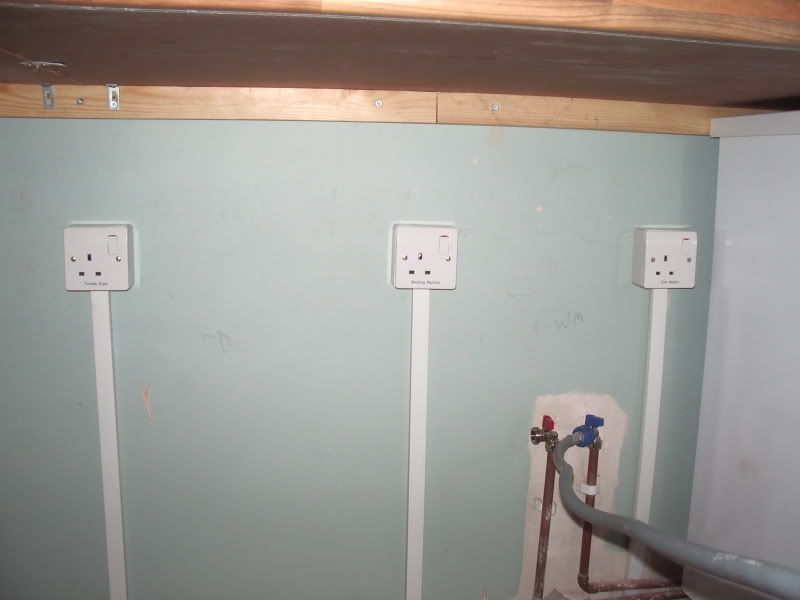
One of the few exemptions would be something like this:

411.3.3 Additional protection
In a.c. systems, additional protection by means of an RCD in accordance with Regulation 415.1 shall be provided for:
(i) socket-outlets with a rated current not exceeding 20A that are for use by ordinary persons and are intended for general use, and
(ii) mobile equipment with a current rating not exceeding 32A for use outdoors.
An exception to (i) is permitted for:
(a) socket-outlets for use under the supervision of skilled or instructed persons, e.g. in some commercial or industrial locations, or
(b) a specific labeled or otherwise suitably identified socket-outlet provided for connection of a particular item of equipment.

Care to tell us which regulation says that?under the 17th sockets can be omitted from an RCD by means of machanical protection i.e steel conduit.
er... the one i listed above..
if it doesn't need RCD for cable reasons ( ie it's installed greater than 50mm or in earthed conduit etc ), then if it's a specifically labled socket for the use of a specific piece of equipment, or it's under the supervision of a skilled or instructed person, then you don't have to have it RCD protected ( provided that it meets the criteria for disconnection times etc etc.. )
if it doesn't need RCD for cable reasons ( ie it's installed greater than 50mm or in earthed conduit etc ), then if it's a specifically labled socket for the use of a specific piece of equipment, or it's under the supervision of a skilled or instructed person, then you don't have to have it RCD protected ( provided that it meets the criteria for disconnection times etc etc.. )
Aye, or you may even use a different type of socket to the norm such as a round pin one.
never took time to think of it like that, with a switched fused spur above a worktop for instance, a 15A round pin plug and socket could be used to not only eliminate the RCD protection if other criteria are met but this also gets around the discrimination factor of the 13A fuse in the spur and the 13A in the plug top, and makes the fuse easily accessable compared to using a 20A double poled isolation switch above and the standard 13A socket below.

er... the one i listed above..
The regulation you quoted says nothing about sockets not needing RCD protection by reason of mechanical protection...under the 17th sockets can be omitted from an RCD by means of machanical protection i.e steel conduit.
if you screw a metal plate over the front of a socket that is fed in steel conduit, then that wont need an RCD, maybe that is what is being implied?
P
Paul_C
but surely with an extension lead all sockets could be used.
And that's the sort of thing which already resulted in disagreements with the 16th-edition requirement for RCD protection on sockets likely to be used to feed equipment used outdoors. Some people were taking it to the ridiculous extreme of saying that all sockets on a ground floor needed to be RCD protected because somebody could run an extension lead outside from any one of them.
Just one of many aspects in which the Wiring Regs. have become vague in the extreme.

DIYnot Local
Staff member
If you need to find a tradesperson to get your job done, please try our local search below, or if you are doing it yourself you can find suppliers local to you.
Select the supplier or trade you require, enter your location to begin your search.
Please select a service and enter a location to continue...
Are you a trade or supplier? You can create your listing free at DIYnot Local
Similar threads
- Replies
- 15
- Views
- 3K