'MF' JB Preference

Joined
8 Sep 2011
Messages
4,637
Reaction score
591
Location
Warwickshire
Country
United Kingdom
Hi

Am re-doing my bedroom currently, have extended the ring to add in two more socket outlets, I so far have been unable to trace the destination of the original leg of the RFC i have disconnected from the socket I have extended from

Obviously the ideal solution is to trace and replace the entire length of cable - if it stays in this room that's easy enough and will be replaced in seconds, if it leaves the room I am going to have to extend it.

Question is, what are your preferred methods of maintenance free joints?

The Hager JB or crimps and heatshrink (or another method)?

Flooring will be engineered wood so will need to be as secure as is possible
 
To my mind "as secure as is possible" is an unbroken cable!

If it's at all possible I'd replace with one piece. If it means serious disruption, you'll need to rethink, though.
 
Hi

Am re-doing my bedroom currently, have extended the ring to add in two more socket outlets, I so far have been unable to trace the destination of the original leg of the RFC i have disconnected from the socket I have extended from

Have you got a continuity tester or multi-meter?
If so, you should be able to find the legs and feed points of the RFC.
But if this is not possible I personally would opt for MF junctions rather that crimp and heat sink, but would be advisable to do a little more investigation, to prevent any additional joints within ceiling/floor voids.
 
If at all possible, replace the cable, if not, make the joint accessible. If you really must have a concealed joint then I'd go with crimps rather than MF joints every time.
 
Yea i have a Megger and a Fluke T140.

I fully agree a cable with no joint in it is better than no joint.

And now I'm not swayed either way, two very knowledgable guys with opposite opinions.

If I get time tomorrow I will try find where this leg goes. The joint will be fairly close to the landing light fitting, so perhaps with some cable rerouting I could get it close enough to the rose to make it accessible from below (assuming replacing isn't possible
 
To my mind "as secure as is possible" is an unbroken cable!

If it's at all possible I'd replace with one piece. If it means serious disruption, you'll need to rethink, though.

Normally it's just as easy to put a new cable in. It means a little bit of making good each end, but if the cable is free to pull then it is a much better solution.

In another post there is talk of an electrician using connections as his 1st point of call, to my mind they should be the last point of call if they are going to be inaccessible. I say this not to be pedantic about the rules (though I do wholeheartedly agree with them) , but because when the job is finished - if there is an issue with a hidden joint - well it is such a shame for all of the hard work to be ruined to get to it, plus some perfect finishes are hard to re-achieve
 
In another post there is talk of an electrician using connections as his 1st point of call, to my mind they should be the last point of call if they are going to be inaccessible.
I have the same opinion.
well it is such a shame for all of the hard work to be ruined to get to it, plus some perfect finishes are hard to re-achieve
Of course a properly made MF joint or crimp will never fail... the problem is knowing for certain that the joint was properly made before being made in-accessible.......
 
In similar circumstances, I've been known to install an extra socket where I didn't really need one, just to create a "sensible" place to make a joint...
 
I am a bit confused because you say you have extended the ring but you have a 'leg' left disconnected.
 
Of course a properly made MF joint or crimp will never fail... the problem is knowing for certain that the joint was properly made before being made in-accessible.......
If (per the recent 'RCBO tripping' thread), the first thing I was taught during my higher education was "Common things afre common" (given that students have a horrible tendency of thinking first of the very uncommon!), the second thing I was probably taught was "Never say 'Never' " (or 'always', or 'none', or 'all'!). However, with that proviso, I essentially agree with you.

The third thing may have been "Trust no-one other than yourself"! My personal concern with 'MF' JBs involving spring contacts is essentially a (probably irrational) 'psychological' one. With a screwed connection, I am 'reassured' (perhaps because of arrogance) by the fact that I have been personally responsible for tightening the screws satisfactorily. With an 'MF' JB, one is essentially totally reliant on the thing having been manufactured (and inspected/tested) satisfactorily. Given that no manufacturing process is perfect/infallable and that I doubt that these JBs are subjected to 100% 'I&T' of the contact mechanism, I am left with some uneasiness.

I've often voiced my concerns about crimped joints. Again, I do not doubt that if "properly made" a crimped joint is very unlikely to ever fail, but here we have an issue of skill/experience. Even if I say so myself, I'm usually quite good at learning practical skills. However, as I've said before, over the years I have had countless attempts 'on the bench' to develop/perfect crimping skills, using tools ranging from the fairly cheap to the very expensive, and, despite have attempted to make hundreds, if not thousands, of 'test crimps' over those years, I've never been able to convince myself that the results were sufficiently reliable for me to be happy to use them 'in anger', certainly in inaccessible locations. I do not doubt that there are some people who are so good/experienced that they can more-or-less guarantee a 'perfect crimp' every time - but, given my personal failure to get to that point, I can't help but wonder how 'good' some of the people making crimped joints (particularly if only occasionally) actually are.

If I had to say what sort of joint I would be most comfortable about being 'inaccessible', it would probably be soldered/brazed (with strain relief) - but, again, there is the issue of it being 'done properly'. ... and why is it so uncommon these days (cheaper?!) to see screwed connections with two screws? A few decades ago it was quite common (remember the beautifully-engineered Wylex 'Standard' CUs?), and the redundancy surely must have decreased the risk of joint failure consdierably.

Kind Regards, John

 
I can't help but wonder how 'good' some of the people making crimped joints (particularly if only occasionally) actually are.
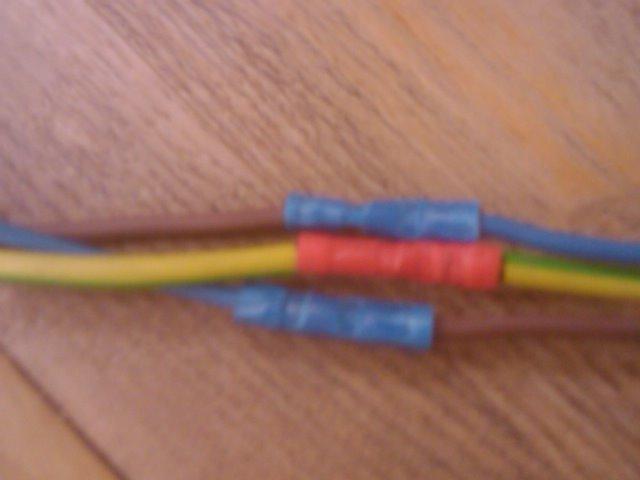
As found behind a pub dimmer switch
I suppose anyone cable of doing that would be equally capable of doing it with any other method of joining cables!! [of course, if it's only going to a 2-wire dimmer, the polarity probably doesn't theoretically matter {albeit the blue should be over-sleeved} - but that's hardly the point!!]

However, the point obviously is that even if they had connected the correct conductors together (and over-sleeved and adequately insulated/sheathed it all), one still could not be sure how well the crimped joints had been made (although other aspects of the job clearly would not inspire one with confidence in the perpetrator!).

Kind Regards, John
 
I am a bit confused because you say you have extended the ring but you have a 'leg' left disconnected.

The leg isn't disconnected, currently it's extended with a crimp joint, it's still accessible as the floorboard above it isn't even nailed down currently.

As to simply pulling the new cable through with old, not sure this will be possible as the sparks that rewired the house seem to have taken some interesting cable routes, there a good few right angles in what i've seen so far
 
[of course, if it's only going to a 2-wire dimmer, the polarity probably doesn't theoretically matter
Kind Regards, John

Should have said it was a multi channel dimmer pack, rather than a switch, therefore all the internal fuses became in the neutral, leaving the fused circuits of GU10 fittings not working but still live
 

If you need to find a tradesperson to get your job done, please try our local search below, or if you are doing it yourself you can find suppliers local to you.

Select the supplier or trade you require, enter your location to begin your search.


Are you a trade or supplier? You can create your listing free at DIYnot Local

 
Back
Top