
Where to bond?

Joined
31 Mar 2006
Messages
20,030
Reaction score
1,396
Location
Leeds
Country
United Kingdom
Main cold water incommer is an alkethene pipe as indicated by the red arrow.

There is a lead pipe at the bottom in the middle which goes underground to the outside toilet.

As you can see, all the pipework is a bit of a mess!
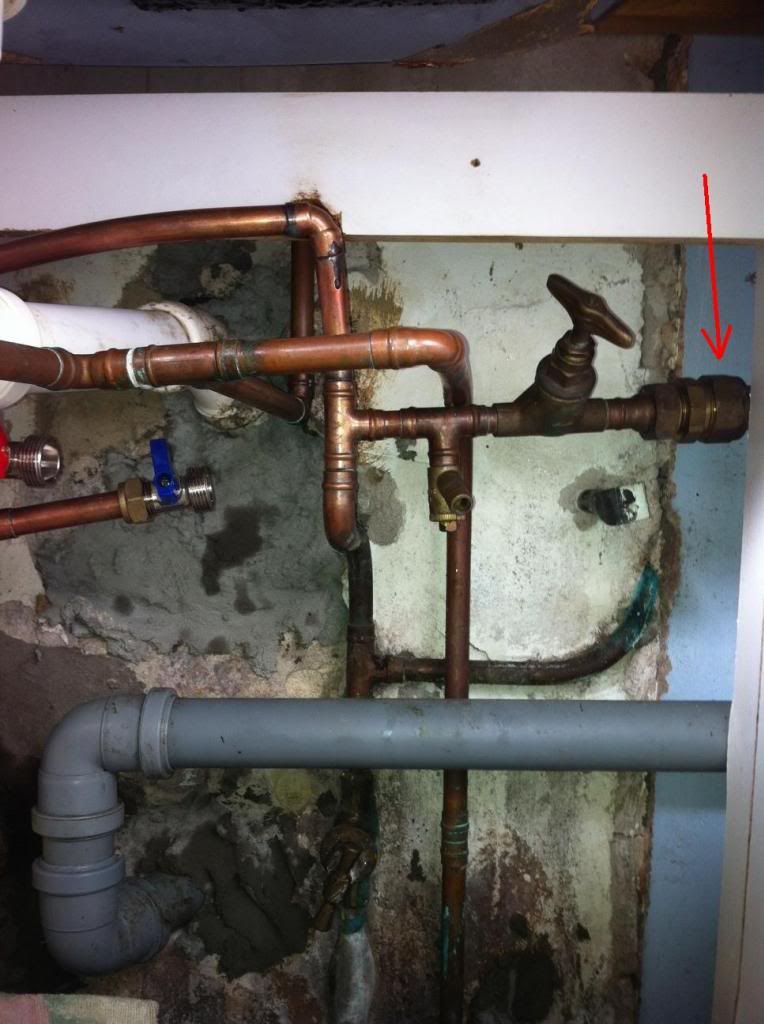
pipes.jpg


Where would YOU bond this installation?
 
Should have said, the other vertical pipe is a gas pipe and is bonded just as it leaves the picture on the left.

There would be room to bond behind the grey pipe should that be the correct / best place to do so.
 
There is a lead pipe at the bottom in the middle which goes underground to the outside toilet.
Wot EFLI said makes sense - or, if you can't get a bond on that, the next best thing would above the stopcock, I suppose.

However, is this an 'attached' outside toilet and, if so, does it count as 'part of the premises'? If it does, there could be an argument that the regs would also require it to be bonded where it emerges out of the ground in the toilet. (yes, I know both ends of the pipe are connected by the pipe, but ....!!)

Kind Regards, John
 
The toilet is a seperate building about 3 meters from the house, and does not have electricity to it.

Interesting point though!
 
The toilet is a seperate building about 3 meters from the house, and does not have electricity to it. Interesting point though!
If it has no electricity, then bonding would obviously be silly/unnecessary, at least in common-sense terms. However, if it had a mains light (or a pipe heater - I've seen those in outside loos!), or any other electricity, then it might be difficult to argue against bonding the pipe in there.

Kind Regards, John
 
I agree, above the main stop tap, behind the waste pipe would be my choice.

The lead pipe to the out house may be suitable to be used AS a protective bonding conductor...

543.2.6 Except as prohibited in Regulation 543.2.1, an extraneous-conductive-part may be used as a protective conductor if it satisfies all the following requirements:
(i) Electrical continuity shall be assured, either by construction or by suitable connection, in such a way as to be protected against mechanical, chemical or electrochemical deterioration
(ii) The cross-sectional area shall be at least equal to that resulting Irol11 the application of Regulation 543.1.1
(iii) Unless compensatory measures are provided, precautions shall be taken against its removal
(iv) It has been considered for such a use and, if necessary. suitably adapted.
 
I agree, above the main stop tap, behind the waste pipe would be my choice.
It's difficult to be certain from the pic, but it looks as if there might possibly be a drain cock there and then, immediately above it, a branch.

Kind Regards, John
 
The main stop tap is the one top right in the picture with the arrow pointing at it.

The stop tap at the bottom is the outgoing supply to the toilet.
 
Ah right, that's odd, you would expect the bottom one to be the mains!

'where practicable' applies here, on the short straight section vertically at the top I reckon.
 
I agree, above the main stop tap, behind the waste pipe would be my choice.
But it's not actually the main stop tap; the main stop tap is not extraneous in itself.

The lead pipe to the out house may be suitable to be used AS a protective bonding conductor...
Not as a main bond.

If you mean as supplementary, what are you going to bond to it?
 
The main stop tap is the one top right in the picture with the arrow pointing at it. The stop tap at the bottom is the outgoing supply to the toilet.
Sorry, I realised that and didn't notice that Lectrician called it 'main' - but I think we're all talking about the bottom one (the outside toilet one), aren't we? Is that a drain cock immediately above it, behind the waste pipe?

Kind Regards, John
 
I agree, above the main stop tap, behind the waste pipe would be my choice.
But it's not actually the main stop tap; the main stop tap is not extraneous in itself.

The lead pipe to the out house may be suitable to be used AS a protective bonding conductor...
Not as a main bond.

If you mean as supplementary, what are you going to bond to it?

I guess you just have to make a judgment call and bond it somewhere on that pipework. At least it's all copper and there is no plastic joints to confuse things further. Even with a plastic service you are encouraged by the NICEIC to bond, so both 'stop taps' are fair game, just get a clamp on there somewhere!

EFL - Are you sure about not being able to use the lead pipe as a protective conductor? Tell me why not.
 
I guess you just have to make a judgment call and bond it somewhere on that pipework. At least it's all copper and there is no plastic joints to confuse things further. Even with a plastic service you are encouraged by the NICEIC to bond, so both 'stop taps' are fair game, just get a clamp on there somewhere!
I agree - it won't make much difference.

EFL - Are you sure about not being able to use the lead pipe as a protective conductor? Tell me why not.
You can, as I said (meant) use pipes as supplementary bonds.

However, it's difficult to see how it would be physically possible to use a pipe for main bonding.

You wrote -
The lead pipe to the out house may be suitable to be used AS a protective bonding conductor...
Did you mean main bonding?
 

If you need to find a tradesperson to get your job done, please try our local search below, or if you are doing it yourself you can find suppliers local to you.

Select the supplier or trade you require, enter your location to begin your search.


Are you a trade or supplier? You can create your listing free at DIYnot Local

 
Back
Top