What kind of conduit should I be using?

Joined
18 Apr 2014
Messages
126
Reaction score
3
Location
Birmingham
Country
United Kingdom
What kind of conduit should I be using to run the cables that need to be sunken into my solid brick walls?

Is the metal capping that you tack to the wall still ok to use? The stuff that just covers it or do I have to run PVC tube type stuff which would involve chasing the wall out?
 
What kind of conduit should I be using to run the cables that need to be sunken into my solid brick walls?
What reason is behind the need for conduit to be used?
Is the metal capping that you tack to the wall still ok to use?
It is okay if used for the correct purpose
The stuff that just covers it
What reason requires it to be covered?
or do I have to run PVC tube type stuff which would involve chasing the wall out?
Again why do you require conduit to be chased in the wall?
As you have now mentioned PVC, I assume it is not a measure for mechanically protection, there is no requirement for cable to be capped or contained if being plastered over.
 
Also read this:
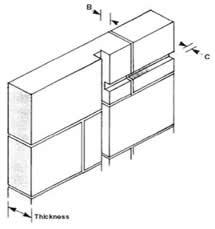
*Vertical chases indicated B on the diagram should not be deeper than 1/3rd of the wall thickness, or in a cavity wall 1/3rd of the relevant leaf.

*Horizontal chases indicated C on the diagram should not be deeper than 1/6th of the wall thickness, or in a cavity wall 1/6th of the relevant leaf.

*Chases should not position so as to impair the stability of the wall; back to back chases are not permitted.

*For hollow or cellular blocks maintain a residual thickness of 15mm between the chase and the void unless otherwise recommended by the manufacturer.


What kind of conduit should I be using to run the cables that need to be sunken into my solid brick walls?

Is the metal capping that you tack to the wall still ok to use? The stuff that just covers it or do I have to run PVC tube type stuff which would involve chasing the wall out?

Capping will be fine for what you have in mind. PVC capping is fine to use, assuming your cable runs are in safe zones. PVC capping is easier to work with.
 
sorry I didnt explain myself properly.

Im rewiring my house. Ill need to run the ring main up the walls to sockets. light swtich cables down the walls to switch's.

And ill also have to wire the ring main down from the ceiling and back again ( my consumer unit will be downstairs but ceiling mounted)

The ring for the kitchen down and up again. and the lighting circuit from the down stairs ceiling upto the loft.


So buy the sounds of it I can do whatever I want. I could just plaster state over the cables. Box them im. chase in PVC pipes or use those metal capping strips?
 
So buy the sounds of it I can do whatever I want. I could just plaster state over the cables. Box them im. chase in PVC pipes or use those metal capping strips?

Providing you install cables within the permitted safe zones and and meet the requirements for RCD protection on buried cables. You do not need any form of mechanical protection, nor do you need any kind of protection or containment to route cables, they can be clip/secured to walls and then be plastered over.

Check out permitted routes walls/floors
http://www.diynot.com/wiki/Electrics:Installation-Techniques
 
I recommend you do use capping or conduit though.

Without this, if a cable should get drilled through, you are STUCK.

With capping or conduit, there is often a chance of pulling a new cable through, or at least a chance to pull some slack to make a joint.
 
sorry I didnt explain myself properly.

Im rewiring my house. Ill need to run the ring main up the walls to sockets. light swtich cables down the walls to switch's.

And ill also have to wire the ring main down from the ceiling and back again ( my consumer unit will be downstairs but ceiling mounted)

The ring for the kitchen down and up again. and the lighting circuit from the down stairs ceiling upto the loft.


So buy the sounds of it I can do whatever I want. I could just plaster state over the cables. Box them im. chase in PVC pipes or use those metal capping strips?

If you are doing this YOURSELF, please remember that you must raise a Builkding Notice with the local authority. They will be inspecting your work and will expect that all of the design, installation and testing work complies with BS7671.
If you are not aware of this LEGAL requirement, then please read the link on the WIKI. http://www.diynot.com/wiki/Electrics:part_p:DIY-Electrical-Work-and-the-Law

The LABC will want to see the cabling work before any plastering etc is done.

With respect, your questions are very basic and I wonder if you have the competence to carry out this work yourself? Maybe it would be better to do the donkey work yourself under the guidance of a registered electrician?

Also:

my consumer unit will be downstairs but ceiling mounted
really, on the ceiling?? Why on earth would you be doing that??
 
Thank you for your concern but ive learnt pretty much everything else I need to know and have links and information to the specs I need to follow.

It might be that my question was so basic I couldn't find the answer to it. But you've all cleared that up for me now and im grateful.


The reason for having my consumer unit ceiling mounted is that is where it is at the moment. I don't want to and believe im not aloud to move the meter and the cutout/ main power cable in. Ive got a TNS supply. So im going to leave it where it is atm.

Tbh though it seems like it will work out quite well mounted there as most of the wiring will run though the down stairs ceiling with only the kitchen and downstairs ring main coming down to ground level and upstairs lighting circuit going up into the loft.

Thank you for the safe zones. It happens thats where I wanted to run the cables anyway.


Regarding building regs I researched into this a few weeks back and all information I came across said that I can do the work as long and a Part P electrical signs the work off before I plaster.

Ive got a Part P electrician willing to come and check my work over and do all the test. Is this no longer good enough.

I also read that if the house had been rewired before hand building regs are happy as long as a part P electrician checks it over tests it and signs it off?


One more thing. At the moment all the old cables have been notched into the floor joists. I dont like this at all.

At what point can I drill wholes though the flooring joists to run my cables and what size drill bit.

Again thanks for the help
 
Caveat - I'm not an electrician, but ready to be shot down if this info is out of date or wrong  8)

I wonder whether you'd be better doing a building control notice to the council than using an electrician who isn't giving you this advice? As I understand it, the sparkie in question would then be responsible as if he were the installer. Unless he is able to see the entire thing BEFORE you cover it up, how can he comment on what he can't see? He may even do it anyway, but is he really doing anyone any favours?

One more thing. At the moment all the old cables have been notched into the floor joists. I dont like this at all.

Don't blame you - cable should be 50mm down OR if you can find a suitable (whatever that may be) earthed metal covering, you can do it, but it's a bit rubbish.

At what point can I drill holes though the flooring joists to run my cables and what size drill bit.

Ideally before running the cables! :)

Talking more seriously, the building regs advise you are allowed to notch or hole joists at between 25% and 40% of the span of the joist - so a joist supported on walls 10 feet apart could be drilled anywhere along its length from 30" to 48" from both ends only. Holes should have three times their diameter of unnotched/holed wood between each other and should be on the height of the joist's centreline, and should not exceed a diameter of a quarter of the height of the joist (but probably better to have a few smaller holes than one massive one). EDIT - hole must allow the cable to be 50mm from the top of the joist (unless earthed covering as before), but since most joists are at least 6" high, this isn't usually an issue.

Best put on my parachute eh? :wink:
 
I wonder whether you'd be better doing a building control notice to the council than using an electrician who isn't giving you this advice? As I understand it, the sparkie in question would then be responsible as if he were the installer.
What "sparkie in question" did you have in mind?

Kind Regards, John
 
Ive got a Part P electrician willing to come and check my work over and do all the test. Is this no longer good enough.

That was what I meant by 'the sparkie in question'. I have a weird way of phrasing things.
 

If you need to find a tradesperson to get your job done, please try our local search below, or if you are doing it yourself you can find suppliers local to you.

Select the supplier or trade you require, enter your location to begin your search.


Are you a trade or supplier? You can create your listing free at DIYnot Local

 
Back
Top