
Whats this under my floor?

Joined
22 Mar 2014
Messages
291
Reaction score
7
Location
Devon
Country
United Kingdom
Following on from this thread....

http://www.diynot.com/diy/threads/what-type-of-floor-to-replace-a-damp-floor-in-an-old-house.414656/


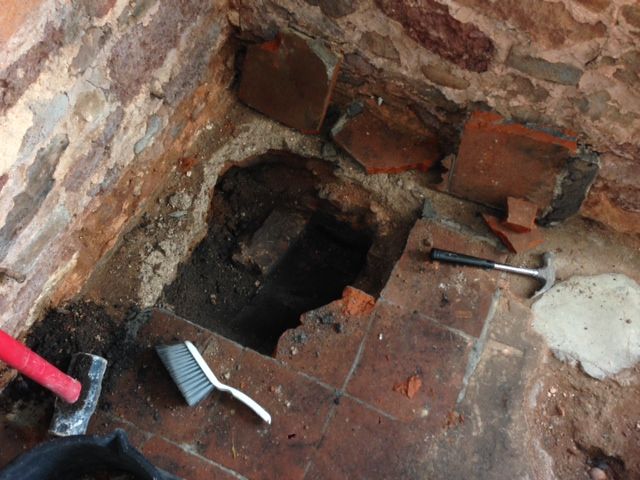
I've had a bit of a dig in a corner. I've put a pic of what the floor loos like now all the bitumen is up and 'clean'.

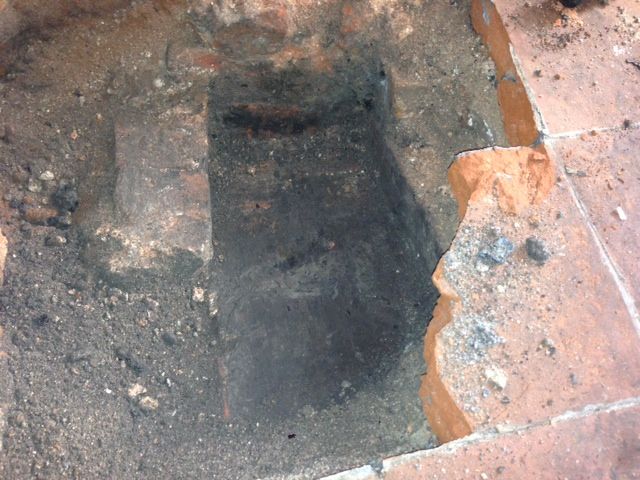
I decided to lift a couple of the broken clay tiles, with a view to having a dig to see whats there, well there was a about 3 inch of ash/stuff, then I found an old brick, made more of aggregate than newer stuff(past 200years ish), when I was digging I noticed that there was something down there.

What is it? looks like a brick slope into a brick horseshoe, its sealed against itself...

drops down from about 4" below the underside of the clay tile, down about another 7" over the bit you can see...


It could be the remains of a foundation from a previous structure, or part of a structure. It could even be a brick drain - google pics of the building of Victorian sewers and tunnels. Doubtful that it would be connected to a redundant cellar or well - they would be down hill in the scheme of things.

What do you intend to do next with the floor? Whatever, you must work the new floor laying into the cutting out of the rotten sole plate(s). Avoid going back on yourself or disturbing completed work.

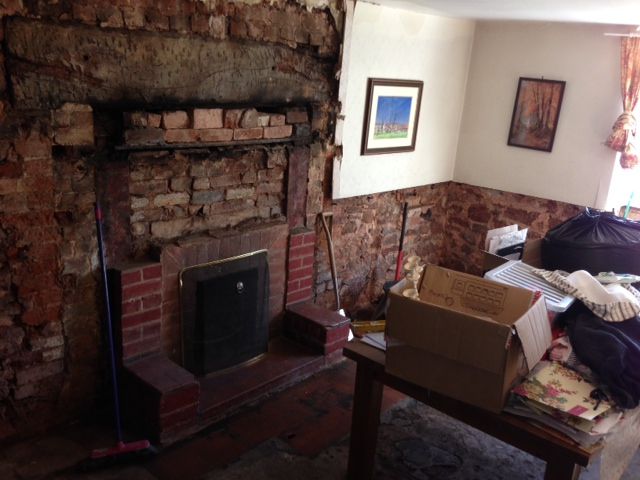
Is that enormous timber lintel sound, & free from rot - what a feature. Perhaps consider removing the fire surround, and the filler brickwork below the oak(?) lintel. You could then examine the concealed surfaces, and the state of the flue? It would give you a fresh opening to work with - unless the fire opening is in use this winter?

Note: if you contact/email an architectural historical assn. with brief info. and clear pics, they will often identify features for you.
 
It could be the remains of a foundation from a previous structure, or part of a structure. It could even be a brick drain - google pics of the building of Victorian sewers and tunnels. Doubtful that it would be connected to a redundant cellar or well - they would be down hill in the scheme of things.

What do you intend to do next with the floor? Whatever, you must work the new floor laying into the cutting out of the rotten sole plate(s). Avoid going back on yourself or disturbing completed work.

Is that enormous timber lintel sound, & free from rot - what a feature. Perhaps consider removing the fire surround, and the filler brickwork below the oak(?) lintel. You could then examine the concealed surfaces, and the state of the flue? It would give you a fresh opening to work with - unless the fire opening is in use this winter?

Note: if you contact/email an architectural historical assn. with brief info. and clear pics, they will often identify features for you.

Its not a drain as its completely solid at the bottom, its got lots of compacted ash over it, 3-4mm, I think it might have been some internal coal type store from when there use to be a huge bread oven.

That lintel is sound, it was a real nice find as the house has thrown up some not so nice surprises. Its about 7ft long, 15" wide and 8" thick. Its had an attack of worm in a couple of places but its still rock solid, the worm attack was only about 4mm in depth.

I'm going to leave the floor for a while, its now bone dry, I'm going to monitor the hole and see if there's any water appear over our wet winter.

The room next to this is the next on my list of jobs, its got a tiny little fire sitting in a 9ft x 5ft chimney, well at the bottom its that size. I've got to strip the plaster off the lower part of the wall and off the beams in the cealing there to see whats what, I'm really hoping that there's something there.

While im in that room I need to do the same to the floor, so once thats up it'll be an ideal time to do the sole plate area.

I might dig down lay a compacted hardcore layer then build in block upto about 2ft above floor height. This would mean I don't have to worry about it rotting again.

Regarding the chimney you can see, I'm going to get it swept and use it as is this year. There's basically 3 versions there. The original inglenook, up the chimney the bar for hanging things to smoke is still there, then the bread oven build, which is the out later of bricks/stone, then the conversion to something smaller. Its been built up from the rear to create a flue, so it'll be messy work however worth it. When cash allows this will become the kitchen again.
 
FWIW: your first job, and most important, is to stop water entering the property, hence the French drain (not expensive and very DIY'able) should top the list.

FWIW: dont work in cluttered rooms - remove all, create clean surfaces before starting.

FWIW: i know that i've suggested various activities but thats the nature of forum posts. Perhaps, you should be cautious about starting a variety of jobs and completing none in good time - it can be disheartening, especially to wives. Just saying.
 
FWIW: your first job, and most important, is to stop water entering the property, hence the French drain (not expensive and very DIY'able) should top the list.

FWIW: dont work in cluttered rooms - remove all, create clean surfaces before starting.

FWIW: i know that i've suggested various activities but thats the nature of forum posts. Perhaps, you should be cautious about starting a variety of jobs and completing none in good time - it can be disheartening, especially to wives. Just saying.

Hi,

I've stopped the water/moisture entering. French drain goes in next spring when the conservatory gets sold.

The room was completely empty when I did it, there was no other way.

I'm not starting a variety of jobs, just removing all the damp plaster as I've a mortgage retention and have a few things to do to enable me to get some of my money back. The wifes very on side :) The floor will go in after the french drain, I'm just planning ahead, sole plate fix will be done before the floor or just after, depending on what the room next to this is like. :)

thank you for your structured input. Its nice to see someone who does say tank the walls/fit a dpc or use chemical injection etc etc!
 

If you need to find a tradesperson to get your job done, please try our local search below, or if you are doing it yourself you can find suppliers local to you.

Select the supplier or trade you require, enter your location to begin your search.


Are you a trade or supplier? You can create your listing free at DIYnot Local

 
Back
Top