When I was a boy back in the 1950s, our part of town was supplied at 210V, but the adjacent area was supplied at 240V. We were supplied with new lamps, new electric fire elements and other bits and pieces when our area was upgraded to 240V. Decades later, I noticed in the plant room where I worked (in the next city) the switchgear was still marked 365/210V even though the actual supply was 415/240V

You are using an out of date browser. It may not display this or other websites correctly.
You should upgrade or use an alternative browser.
You should upgrade or use an alternative browser.
My New Bedtime Read: ASEE Guide To The 11th Edition (July 1939)
- Thread starter securespark
- Start date

With regard to the voltage, I found this in my book:


- Joined
- 11 Jan 2004
- Messages
- 46,883
- Reaction score
- 3,987
- Country

Cool.
I'd like to get some more earlier regs, but sensibly priced ones are thin on the ground.
The first regs are interesting.
I'd like to get some more earlier regs, but sensibly priced ones are thin on the ground.
The first regs are interesting.
- Joined
- 11 Jan 2004
- Messages
- 46,883
- Reaction score
- 3,987
- Country
I have posted these elsewhere in the forum, but as part of my divorce with Photobucket, I want to move them away before they disappear completely.
Here is the first edition of the wiring regulations, 1882. Not BS, Not IEE but STEE.
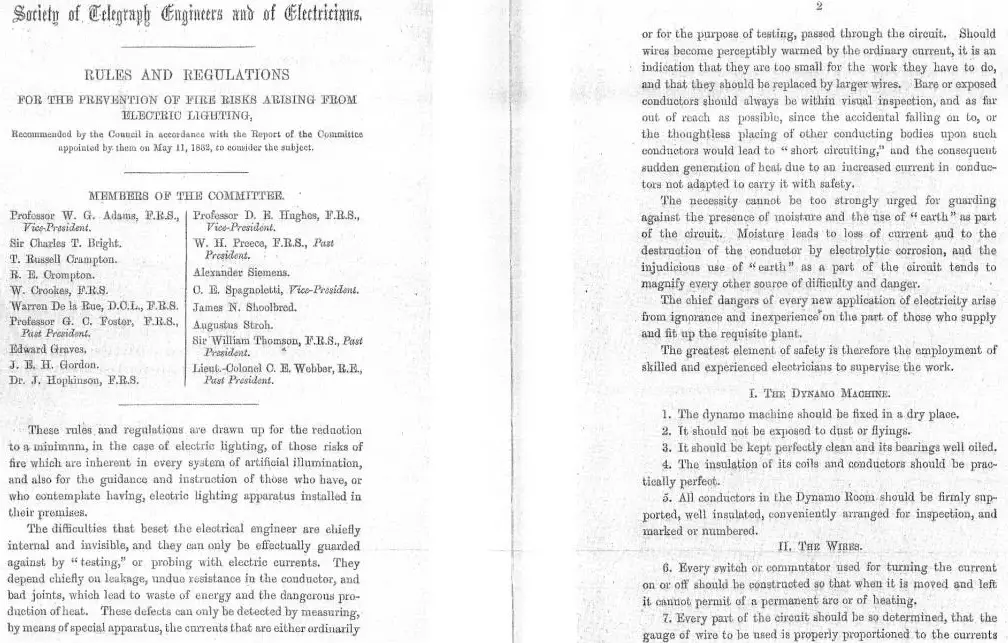
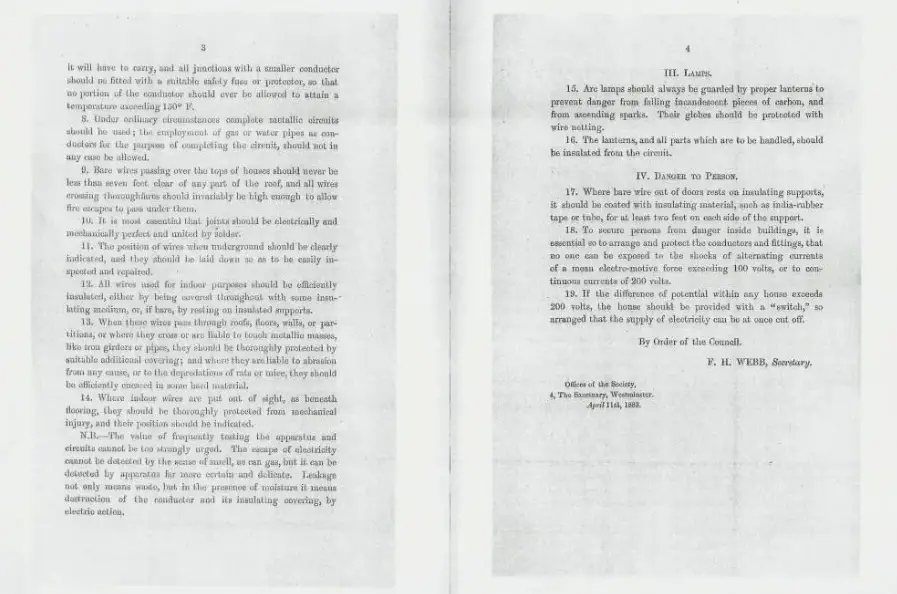
Here is the first edition of the wiring regulations, 1882. Not BS, Not IEE but STEE.
- Joined
- 11 Jan 2004
- Messages
- 46,883
- Reaction score
- 3,987
- Country
For fun, see how much you can recognise from the current regs.
Thanks - very interesting!For fun, see how much you can recognise from the current regs.
I suppose we shouldn't be surprised but, although that document is obviously devoid of any explicit detailed requirements, nearly all of the concepts it talks about are as true today as they were nearly 140 years ago. For example, we obviously now have numerical criteria for determining required cable CSA, but they didn't have too bad a rule of thumb back then when they said that if a cable became 'perceptibly warmed by ordinary current' it was undersized, and should be upgraded. In fact, that was probably a lot more cautious/conservative than current regs, which see to assume that conductor temp at deign current may be as high as 70C (i.e. a lot more than 'perceptibly warmed'!).
It's also interesting that, even then, emphasis was put on the need for 'testing', particularly in relation to what would now usually be described ad 'continuity' and IR.
Of course, in comparison with subsequent (and current) regulations, that document was (per its title) essentially almost all about reduction of fire risks, with 'direct (electrical) risks to persons' being almost an afterthought at the very end.
Kind Regards, John
- Joined
- 11 Jan 2004
- Messages
- 46,883
- Reaction score
- 3,987
- Country
Back to reading this book...
If you have a DC supply and sockets above 2A, they must have switches, but if AC, sockets don't need switches.
Also, if a socket may be misused by a child, it must be the type where the contact tubes cannot remain live after, or alternatively, are automatically screened by, the withdrawal of the plug.
And another...it's the first mention I've seen of MICC.
I must be a bit sad, but I find these old regs very interesting.
Good bedtime reading!
If you have a DC supply and sockets above 2A, they must have switches, but if AC, sockets don't need switches.
Also, if a socket may be misused by a child, it must be the type where the contact tubes cannot remain live after, or alternatively, are automatically screened by, the withdrawal of the plug.
And another...it's the first mention I've seen of MICC.
I must be a bit sad, but I find these old regs very interesting.
Good bedtime reading!
Most of Europe had settled on 220/380 or 240/415 V 50 Hz AC for new supplies around WWI but there were plenty of legacy systems in place until well after WWII, both DC and AC with various frequencies and voltages. Electric railways in rural areas would sometimes supply villages along the line with electricity using low-frequency AC, e.g. 25 Hz.
Voltages I know of are:
110 V, 127/220 V, 150 V, 220 V, 240 V, 250 V. All of these, and probably some more, were used in various European countries in the past.
Posh remote places, e.g. manors, occasionally had their own generators. I don’t know what voltages these systems used in Europe but remember reading that 32 V was popular in pre-WWI US.
Voltages I know of are:
110 V, 127/220 V, 150 V, 220 V, 240 V, 250 V. All of these, and probably some more, were used in various European countries in the past.
Posh remote places, e.g. manors, occasionally had their own generators. I don’t know what voltages these systems used in Europe but remember reading that 32 V was popular in pre-WWI US.

- Joined
- 18 Apr 2022
- Messages
- 7,179
- Reaction score
- 1,074
- Country
Photobucket excellent.
Now Photobucket is phukced.
my divorce with Photobucket,

- Joined
- 11 Jan 2004
- Messages
- 46,883
- Reaction score
- 3,987
- Country
Context and dates please!
Where did you pull these from?
Why post without context and dates? It makes no sense...
I started using PB decades ago to store pictures of electrical stuff as it was free (in the days when you had to pay). It was very good.
Then they gave notice they were pulling support, so everyone using them to store their photos had to move them elsewhere or lose them.
Eventually, if you had a photo uploaded with PB beyond the cut-off date, your images would disappear.
Where did you pull these from?
Why post without context and dates? It makes no sense...
I started using PB decades ago to store pictures of electrical stuff as it was free (in the days when you had to pay). It was very good.
Then they gave notice they were pulling support, so everyone using them to store their photos had to move them elsewhere or lose them.
Eventually, if you had a photo uploaded with PB beyond the cut-off date, your images would disappear.

- Joined
- 22 Jan 2007
- Messages
- 24,297
- Reaction score
- 3,627
- Country
Click on the red arrow against your name on the quote.Where did you pull these from?

DIYnot Local
Staff member
If you need to find a tradesperson to get your job done, please try our local search below, or if you are doing it yourself you can find suppliers local to you.
Select the supplier or trade you require, enter your location to begin your search.
Please select a service and enter a location to continue...
Are you a trade or supplier? You can create your listing free at DIYnot Local
Similar threads


- Replies
- 64
- Views
- 16K

- Replies
- 3
- Views
- 3K